Why ERP Implementations Fail — And How to Make Sure Yours Doesn't
Dylan Coetzee · ERP Solution Architect & Founder · 14 min read · May 2026
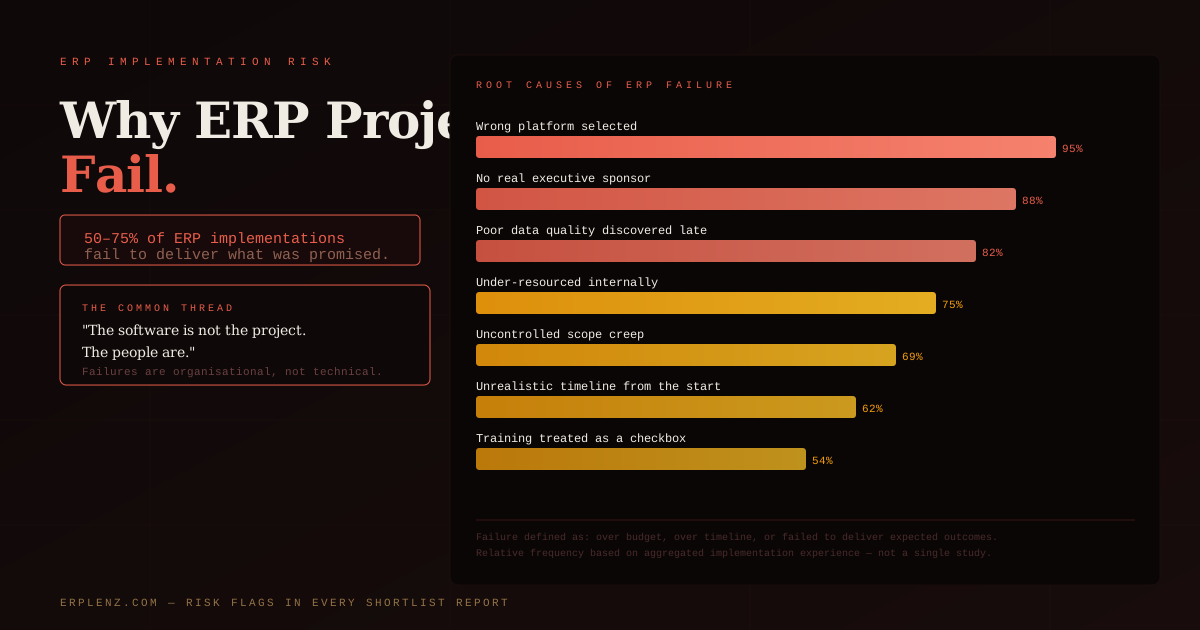
Quick answer: ERP implementations fail because of decisions, not software. Independent research from Panorama Consulting, Gartner, and ISG consistently puts the failure rate at 50–75 percent. The dominant root causes — wrong platform chosen for the wrong reasons, absent executive sponsorship, under-resourced internal teams, unready data, uncontrolled scope, unrealistic timelines, and treating training as an event — sit inside the business, not the technology. Fix the selection process, govern scope, and resource the change properly.
Independent research from Panorama Consulting, Gartner, and ISG consistently puts the ERP project failure rate between 50 and 75 percent. Depending on how failure is defined — over budget, over time, under-delivered, or outright abandoned — the number shifts. The direction does not: the majority of ERP projects do not deliver what was promised.
This is not a new problem. It has been true for thirty years. The platforms have improved dramatically. The reasons ERP implementations fail have barely changed.
That's because the failure points are almost never technical. The software works. The failures happen in decisions made before software is selected, in how the project is resourced and governed, and in the chronic underestimation of what it means to ask an entire organisation to change how it works.
The Wrong System Chosen for the Wrong Reasons
Every ERP implementation failure has a selection decision somewhere near its root. A platform was chosen because the CEO had used it at a previous company. Because the demo was impressive. Because a peer at an industry conference recommended it. Because it was the cheapest option that cleared the finance committee. Because the vendor's reference customers sounded similar and the sales team promised it would fit.
None of those are selection criteria. They're noise dressed up as justification.
When a business selects a platform that doesn't fit its operational requirements, the mismatch shows up in implementation — as customisation scope that wasn't in the original quote, configuration workarounds that introduce fragility, and go-live delays caused by functionality promised in the demo that requires three months of development to actually deliver.
By the time the gap between "what we were sold" and "what this system can do" is fully visible, the business is already six months in and several hundred thousand dollars committed. Switching platforms is almost unthinkable. So the project continues — patching gaps, extending the timeline, spending money to make a poor fit work — until the system goes live with a set of compromises nobody is happy with.
The fix is a rigorous, vendor-agnostic selection process before any contract is signed. Not demo-and-decide. Structured requirements analysis, objective platform scoring, and a shortlist driven by fit — not familiarity. For the underlying method, see how to select an ERP system and which ERP is right for my business.
No Executive Sponsor With Real Authority
ERP implementations touch every department. They require decisions that cross departmental lines — about process priorities, whose workflow gets accommodated, what the business is willing to change. None of those decisions can be made by a project manager. They require organisational authority.
An executive sponsor is not someone who approves the budget and attends the steering committee quarterly. A real sponsor actively removes obstacles, makes decisions when departments conflict, communicates strategic rationale to the organisation, and treats the implementation as a business priority — not an IT project.
When this person is absent — when the project is delegated downward with a mandate but no authority — decisions stall. Competing departmental priorities derail the timeline. The project manager escalates issues that sit unanswered for weeks. The implementation team, unable to get direction, makes choices that feel locally reasonable but create problems elsewhere.
Panorama's annual reports consistently identify executive engagement as one of the strongest predictors of ERP project outcome. It matters more than budget. It matters more than which platform was chosen.
Underestimating Internal Resource Requirements
The implementation partner brings technical expertise. The business brings subject-matter knowledge — and that knowledge is not optional. It is the raw material from which the system is configured.
Every requirements workshop needs finance staff who understand how the chart of accounts should be structured for the relevant tax regime — UK MTD, EU VAT, US sales tax (Avalara/Vertex/Sovos), AU GST, India GST, ZATCA. Every inventory configuration decision needs a warehouse manager who knows the actual movement flows. Every manufacturing workflow needs a production supervisor who can explain how the shop floor really runs versus how management thinks it runs.
These are not part-time contributions. A Mid-Market implementation (75–500 employees, USD 10M–100M revenue) typically requires one or two dedicated internal resources for the project duration — people who attend every session, make decisions, test configurations, and own internal communication. Businesses that run an ERP implementation as a side project routinely find themselves at the mercy of the partner's interpretation of their requirements.
When the system goes live and doesn't work the way people expected, the post-mortem usually finds the right person wasn't in the room when the key decisions were made.
Data That Was Never Ready to Move
Almost every business that has run legacy systems for more than five years has data quality problems they're not fully aware of. Duplicate customer records accumulated over years. Product codes created for a one-off job and never cleaned up. Supplier accounts with inconsistent naming. Chart of accounts entries created to solve an immediate problem a decade ago and never reconciled since.
None of these are obvious until you try to migrate. At that point they become the critical path. Every data quality issue surfaced during migration extends the timeline. Issues found in UAT are more expensive than issues found in cleansing. Issues found after go-live are the most expensive of all.
Businesses that manage data migration well start the audit in the first month of the project — not the last. For the full playbook, see the ERP data migration guide.
Scope That Grows Without Acknowledgement
Every ERP implementation generates a wishlist. Users engage with the new system, see what it can do, and identify enhancements they want. Each enhancement is individually reasonable. Collectively, unmanaged, they extend the timeline and expand the budget beyond what was sanctioned.
Scope creep does not announce itself. It arrives as "small additions" and "it'll only take a day." The implementation partner, depending on incentive structure, may accommodate these without formally updating timeline or cost — because the conversation about scope change is awkward and the relationship is already in flight.
A formal change control process is the only defence. Every request outside agreed scope gets documented, sized, and presented with a cost and timeline impact. Some get approved. Others get deferred to Phase 2. The critical thing is that every addition is a conscious decision. The choice between big bang, phased, and modular delivery interacts directly with scope discipline — see ERP implementation approaches.
A Go-Live Date That Was Never Realistic
Sales timelines and delivery timelines are different things. The implementation partner, eager to win the business, sometimes quotes an optimistic timeline. The client, anxious to leave the old system, accepts. Both parties know somewhere that four months for this scope is probably six months in reality. Nobody says it out loud.
What follows is a project in permanent catch-up mode. Testing gets compressed because there's no time. Training gets shortened because the date is fixed. Migration quality checks get rushed. The system goes live with known issues that will be "resolved post-go-live" — meaning the business absorbs them in production.
The antidote is a timeline built bottom-up: scope the project, estimate each workstream honestly, add appropriate contingency, and arrive at a date — rather than working backwards from one. For benchmarks by business size, see how long does ERP implementation take.
Training Treated as an Event, Not a Process
One training session two weeks before go-live is not training. It's exposure. Users walk away knowing they've seen the system but not knowing how to use it under the pressure of real transactions, real deadlines, and the inevitable edge cases that weren't covered.
Effective ERP training is role-specific, repeated, and contextual. Businesses that invest properly report faster adoption, fewer post-go-live issues, and higher long-term utilisation. The ones treating training as a checkbox produce systems that are technically live but practically underused — and then wonder why the promised efficiency gains haven't materialised. The full picture lives in the ERP change management guide.
Failure Modes Ranked by Frequency
| Failure mode | Typical impact | Primary mitigation |
|---|---|---|
| Poor platform-to-business fit | Customisation overruns, slow adoption, eventual replacement | Structured, vendor-agnostic selection; budget as a hard filter |
| Absent or weak executive sponsorship | Stalled decisions, missed milestones, scope drift | Named C-level sponsor with authority and time committed |
| Under-resourced internal team | Wrong configuration choices, post-go-live rework | Dedicated SMEs by domain; reduce day-job load |
| Unready source data | Migration overruns, reconciliation failures | Start cleansing in month one; run 2–3 mock migrations |
| Uncontrolled scope creep | Budget overrun, timeline slip | Formal change control; defer to Phase 2 where possible |
| Sales-driven timeline | Compressed testing and training, fragile go-live | Bottom-up estimation with contingency |
| Training as event, not process | Workarounds, underused modules, lost ROI | Role-specific, repeated, hands-on training; super users |
The Common Thread
Every failure point on this list traces to the same source: underestimating how much the implementation depends on the business, not the technology.
The software is not the project. The software is the tool the project delivers. The project is about decisions, processes, data, people, and change — and all of those live inside the organisation, not inside the ERP.
Businesses that understand this go into implementations with appropriate humility about the effort required on their side, and appropriate rigour about the governance, resourcing, and data preparation that give the technology its best chance of succeeding.
Frequently Asked Questions
What percentage of ERP implementations fail?
Panorama Consulting, Gartner, and ISG research consistently places the failure rate between 50 and 75 percent, depending on how failure is defined. Panorama's annual ERP report typically shows around 55–65 percent of projects running over budget, over time, or under-delivering on expected benefits. Outright abandonment is rarer — usually under 10 percent — but partial failure is the norm. The figure has barely moved in two decades, even as platforms have improved, because the dominant root causes are organisational rather than technical.
What is the number one reason ERP implementations fail?
Poor platform selection — choosing a system that doesn't genuinely fit the business — sits at the top of nearly every failure analysis. Selection mistakes propagate downstream: customisation scope expands, integration gaps appear, users resist a tool that doesn't match their workflows, and the implementation partner spends the project bridging structural mismatches rather than delivering value. Most other failure modes (scope creep, timeline overrun, weak adoption) compound on top of a selection error rather than existing independently.
How can we tell if an ERP implementation is at risk of failing?
Watch for missed milestones with no recovery plan, scope decisions deferred rather than resolved, an executive sponsor who has stopped attending, requirements being interpreted by the partner rather than authored by the business, mock migrations not being run, training pushed to the final fortnight, and rising "we'll fix it post-go-live" deferrals. Any two of these together is a red flag. Three or more typically means the go-live date is no longer realistic and the project needs intervention before launch.
What does an executive sponsor actually do on an ERP project?
Beyond approving the budget, an effective sponsor removes cross-departmental blockers, arbitrates conflicting process decisions, holds the partner accountable to commitments, communicates strategic rationale to the wider organisation, and models adoption visibly in their own work. They attend steering committees with decision-making authority — not as observers — and are reachable when issues escalate. The role typically demands 4–8 hours per week during active phases, more around go-live.
Can a failing ERP implementation be rescued?
Yes, but usually only with intervention. Common rescue patterns include re-baselining scope and timeline honestly, replacing or augmenting the implementation partner, bringing in an independent ERP advisor to assess risk, deferring non-critical functionality to Phase 2, and reinforcing executive sponsorship. Rescues are expensive but consistently cheaper than completing a doomed project or starting over. The trigger to act is recognising that the current trajectory will not deliver the business case — not waiting until go-live confirms it.
How much should we budget for ERP implementation risk?
Plan 15–25 percent contingency above the partner's quoted implementation services for Mid-Market projects, and 25–40 percent for Upper Mid-Market and Enterprise deployments where multi-entity, multi-currency, or regional regulatory complexity (UK MTD, EU VAT, India GST, ZATCA, Brazilian NF-e) compounds risk. Contingency exists to absorb scope additions, integration surprises, and data issues without re-opening the business case. Projects without contingency become projects with quiet quality compromises. See how much does ERP cost for full breakdowns.
Does choosing a bigger vendor reduce ERP failure risk?
No. Failure rates are broadly similar across SAP, Oracle, Microsoft, NetSuite, Infor, and niche vendors. What matters is fit — platform-to-business, partner-to-platform, scope-to-resourcing. A Mid-Market manufacturer running Tier 1 enterprise software it doesn't need will fail. A complex multi-entity Upper Mid-Market business running a Small Business tool will also fail. Match the platform to the operational profile, not to brand reassurance. For tier definitions and how to match them, see major ERP vendor vs niche ERP.
Should we use an ERP implementation partner or go direct to the vendor?
It depends on the platform and your internal capability. Some vendors (Oracle NetSuite, SAP) deliver direct on some segments; others (Microsoft Dynamics, Acumatica, Odoo, Sage, Syspro) deliver almost exclusively through partners. The right answer is rarely automatic. See implementation partner vs vendor direct for the trade-offs and a framework for deciding.
How ERPLenz Reduces Failure Risk Before It Starts
A significant proportion of implementation failures begin with the selection decision — and with a vendor who was never properly pressure-tested before the contract was signed.
ERPLenz's 116-point diagnostic scores 17 platforms against your specific requirements, with hard elimination rules for functional gaps that create implementation risk. Budget is a hard filter too — platforms that exceed your realistic total cost of ownership are eliminated before they reach your shortlist, so you're not comparing options you can't afford to implement properly. Your shortlist comes with a risk register for each platform — identifying where gaps exist before you commit, not after you've spent nine months trying to bridge them. The vendor intel in your report surfaces known traps, hidden costs, and commercial practices that consistently catch businesses out on specific platforms.
For each shortlisted vendor, your report includes tailored questions to ask during demos and partner evaluations — covering implementation methodology, Phase 1 structure, go-live support, and the specific risk flags in your assessment. These are the questions that separate a vendor who has delivered for businesses like yours from one who is hoping you don't ask.
Get the selection right. Everything else gets easier from there.
Most ERP "failures" are foreseeable. ERPLenz exists to put the foresight on the table before the contract — built by people who keep meeting these projects in their second, more expensive attempt.
If you're earlier in the process
- Which ERP is right for my business?
- How much does ERP actually cost?
- When does a business need ERP?
- How to choose an ERP in 2026
On implementation