Which ERP Is Right for My Business? A Tier, Industry, and Fit Framework
Quick answer: The ERP that is right for your business is the one that matches your tier (Micro, Small Business, Mid-Market, or Upper Mid-Market), aligns with your industry's process depth, integrates with the non-negotiables in your current stack, and lands inside a five-year total cost of ownership you can actually fund. "Best ERP" is a marketing question. "Right ERP for us" is an engineering one.
There are over a hundred credible ERP systems on the market. Every vendor will tell you theirs is the best fit for your industry. Sales consultants will walk you through glossy demos designed to impress, not inform. And by the time you have signed a contract, you may be locked into a platform that does not match how your business actually operates.
This article cuts through the noise. It explains the real criteria that should drive your decision — and why getting this wrong is one of the most expensive mistakes a growing business can make, whether you operate out of Birmingham, Brisbane, Bangalore, Riyadh, São Paulo, or anywhere in between.
Why "best ERP" is the wrong question
Searching for the "best ERP" is like searching for the "best vehicle". The right answer depends entirely on what you need to do with it. A 40-tonne articulated truck is objectively more powerful than a sedan — you would not use one to drop the kids at school.
The right question is: Which ERP is right for my business, given my size, industry, processes, geography, and growth trajectory?
That reframe changes everything.
The four variables that should drive your ERP decision
1. Company tier and transaction volume
ERP platforms are tiered. Running an Upper Mid-Market system in a 20-person business is overkill — you will pay for it in licence, implementation, and complexity overhead. Running a Micro Business tool in a 300-person operation will create painful limitations within eighteen months.
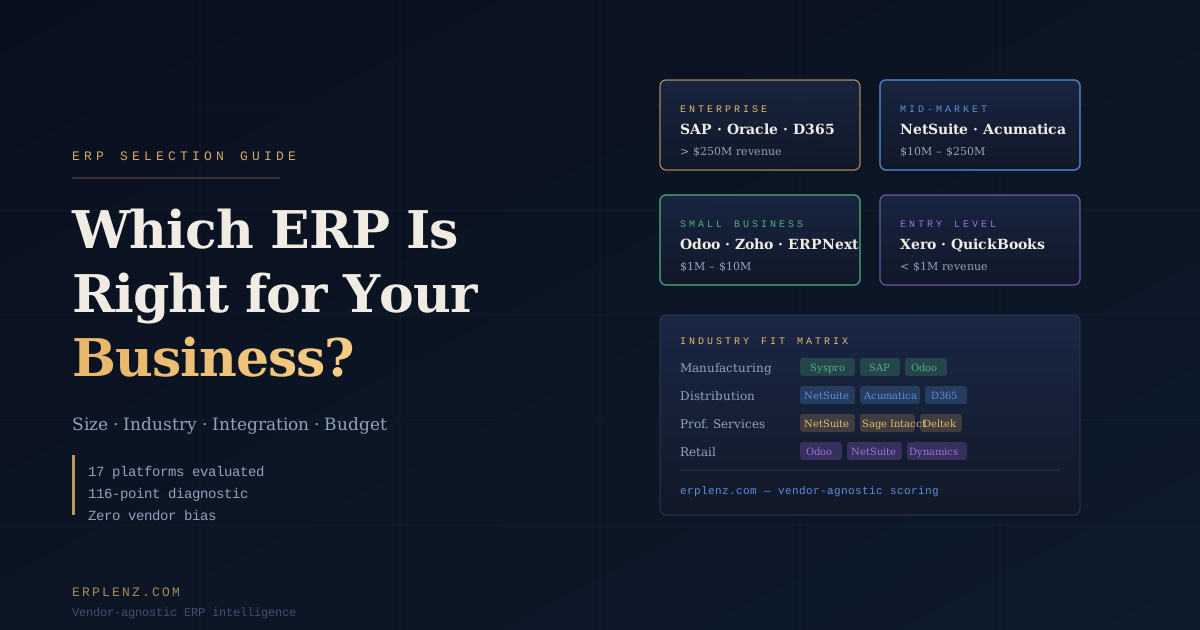
Use the standardised tier framework below as your sanity check before any vendor enters the room:
| Tier | Headcount | Revenue (USD) | Representative platforms |
|---|---|---|---|
| Micro Business | <10 | <$1M | Xero, QuickBooks Online, Zoho Books |
| Small Business | 10–75 | $1M–$10M | Odoo, ERPNext, Zoho One |
| Mid-Market | 75–500 | $10M–$100M | NetSuite, Microsoft Dynamics 365 Business Central, Acumatica, Sage Intacct, Syspro, SAP Business One |
| Upper Mid-Market / Enterprise | 500+ | >$100M | SAP S/4HANA, Oracle Fusion Cloud ERP, Microsoft Dynamics 365 F&O, JD Edwards, Infor CloudSuite |
If your headcount and revenue sit on a tier boundary, weight toward the higher tier only if you have multi-entity, multi-currency, or heavy compliance complexity. Otherwise, stay in your tier — the licensing, implementation, and operational cost will be materially lower without sacrificing capability.
2. Industry and operational complexity
Different industries have fundamentally different process requirements. A professional services firm needs project accounting and resource planning. A manufacturer needs bill of materials, work orders, and shop-floor control. A distributor needs landed-cost tracking, lot traceability, and multi-warehouse management. A subscription business needs revenue recognition under ASC 606 / IFRS 15.
Industry alignment by platform (high-level):
| Industry | Mid-Market candidates with native depth |
|---|---|
| Discrete manufacturing | Syspro, SAP Business One, Acumatica Manufacturing, DELMIAworks (formerly IQMS), Epicor Kinetic |
| Process manufacturing | SAP Business One, Aptean, Sage X3, Infor CloudSuite Industrial |
| Wholesale & distribution | NetSuite, Acumatica, Dynamics 365 Business Central, Odoo |
| Professional services | NetSuite, Sage Intacct, Dynamics 365, Kantata (formerly Mavenlink) |
| Retail & e-commerce | NetSuite SuiteCommerce, Odoo, Dynamics 365 Commerce |
| Construction & project-based | Acumatica Construction, Sage Intacct Construction, Procore + ERP, Viewpoint |
| Non-profit / public sector | Sage Intacct, Microsoft Dynamics, Workday |
| Subscription / SaaS | NetSuite, Sage Intacct, Zuora + ERP |
Do not let a vendor talk you into a generic platform "with customisation" when a better-fit, vertically-specialised platform exists out of the box. The trade-offs are mapped in major ERP vendor vs niche ERP.
3. Integration requirements
ERP does not live in isolation. Before evaluating any platform, map your current stack and your non-negotiable integrations. Some platforms have deep native integrations; others rely on iPaaS middleware (Boomi, Celigo, Workato, MuleSoft).
Questions to ask every vendor:
- Is this integration native, certified, or third-party middleware?
- Who maintains it when the upstream platform changes its API?
- How does the system handle real-time vs batch sync?
- Does the integration support multi-entity, multi-currency, and multi-jurisdiction data?
- Which banking rails are supported — SEPA, BACS, Faster Payments, ACH, NPP, UPI, SWIFT?
- Which tax engines are certified (Avalara, Vertex, Sovos) for the regimes you operate under — UK MTD, EU VAT, US sales tax, AU GST, India GST, ZATCA, CFDI?
For a full treatment of integration architecture, see ERP integration with existing systems.
4. Budget — total cost of ownership, not just licence
This is where buyers consistently get blindsided. Five-year TCO includes:
- Software licensing (per-user or module-based, annual or perpetual)
- Implementation services (typically 1–3× the annual licence for Mid-Market, 3–5× for Upper Mid-Market)
- Customisation and development
- Data migration (guide here)
- Training and change management
- Integration build and ongoing maintenance
- Ongoing support, sandbox environments, infrastructure
- Annual price escalation at renewal (often uncapped at 7–10%)
A US$30,000/year SaaS subscription that requires US$180,000 in implementation services and US$40,000/year in support is not a US$30K system. Get the full picture before you commit. The structured cost breakdown is in how much does ERP cost.
ERP by industry: quick reference
Manufacturing
Manufacturing ERP must do more than finance. You need:
- Bill of materials (BOM) and routing management
- Work order, production scheduling, and capacity planning
- Shop-floor data capture (barcode, RFID, MES integration)
- Real-time costing (standard or actual)
- Lot and serial traceability for compliance (FDA, EU 1169, ISO)
- Quality control and non-conformance management
Best-fit candidates: Syspro, SAP Business One, Odoo, Epicor Kinetic, Acumatica Manufacturing, DELMIAworks, Infor CloudSuite Industrial.
Wholesale and distribution
Distribution lives and dies on inventory accuracy, fulfilment speed, and landed-cost visibility. You need:
- Multi-warehouse management with zone, bin, and replenishment logic
- Landed-cost calculation across freight, duty, and currency
- Lot, serial, and expiry tracking
- EDI connectivity (X12, EDIFACT, PEPPOL)
- Demand forecasting and replenishment planning
- 3PL and dropship support
Best-fit candidates: NetSuite, Acumatica, Dynamics 365 Business Central, Odoo, Sage X3.
Professional services
Revenue recognition, project profitability, and resource utilisation are the core metrics. You need:
- Project accounting (not just job costing)
- Time and expense capture (mobile, multi-currency)
- Multi-entity consolidation
- Revenue recognition under ASC 606 / IFRS 15
- Resource planning and utilisation reporting
- Client billing flexibility (T&M, fixed-fee, milestone, retainer)
Best-fit candidates: NetSuite, Sage Intacct, Dynamics 365, Kantata.
Retail and e-commerce
Omni-channel order management, real-time inventory, and unified customer data dominate. You need native or certified integrations into Shopify, Magento (Adobe Commerce), BigCommerce, Amazon, eBay, and regional marketplaces.
Best-fit candidates: NetSuite SuiteCommerce, Odoo, Dynamics 365 Commerce, Acumatica Retail.
Construction and project-based
Long-cycle revenue, certified payroll, retention accounting, and progress billing make this its own world. WIP reporting and committed-cost tracking are non-negotiable.
Best-fit candidates: Acumatica Construction, Sage Intacct Construction, Viewpoint, Procore + ERP backbone.
Small Business (general)
If you are between US$1M and US$10M revenue and need operations under control before committing to a Mid-Market platform, the most cost-effective route is often a modular open-source platform.
Best-fit candidates: Odoo Community (self-hosted, no licence cost), ERPNext, Zoho One.
The mistake most businesses make
The most common ERP selection mistake is not picking the "wrong" vendor. It is starting the selection by talking to vendors.
When you engage a vendor first, you evaluate their system through their lens — their best features, their ideal customer story, their pricing constructed to look manageable. You do not know what you do not know.
The right sequence is:
- Confirm readiness. Are you actually in a position to run an ERP project? Run through when does a business need ERP first.
- Define requirements independently. Before talking to any vendor.
- Score vendors against those requirements objectively.
- Shortlist three or four genuine candidates.
- Run structured demos with pre-defined scenarios — not vendor-scripted ones.
- Validate through reference customers in your industry and tier.
This takes longer. It saves years. The full methodology is in how to select an ERP system and how to choose an ERP in 2026.
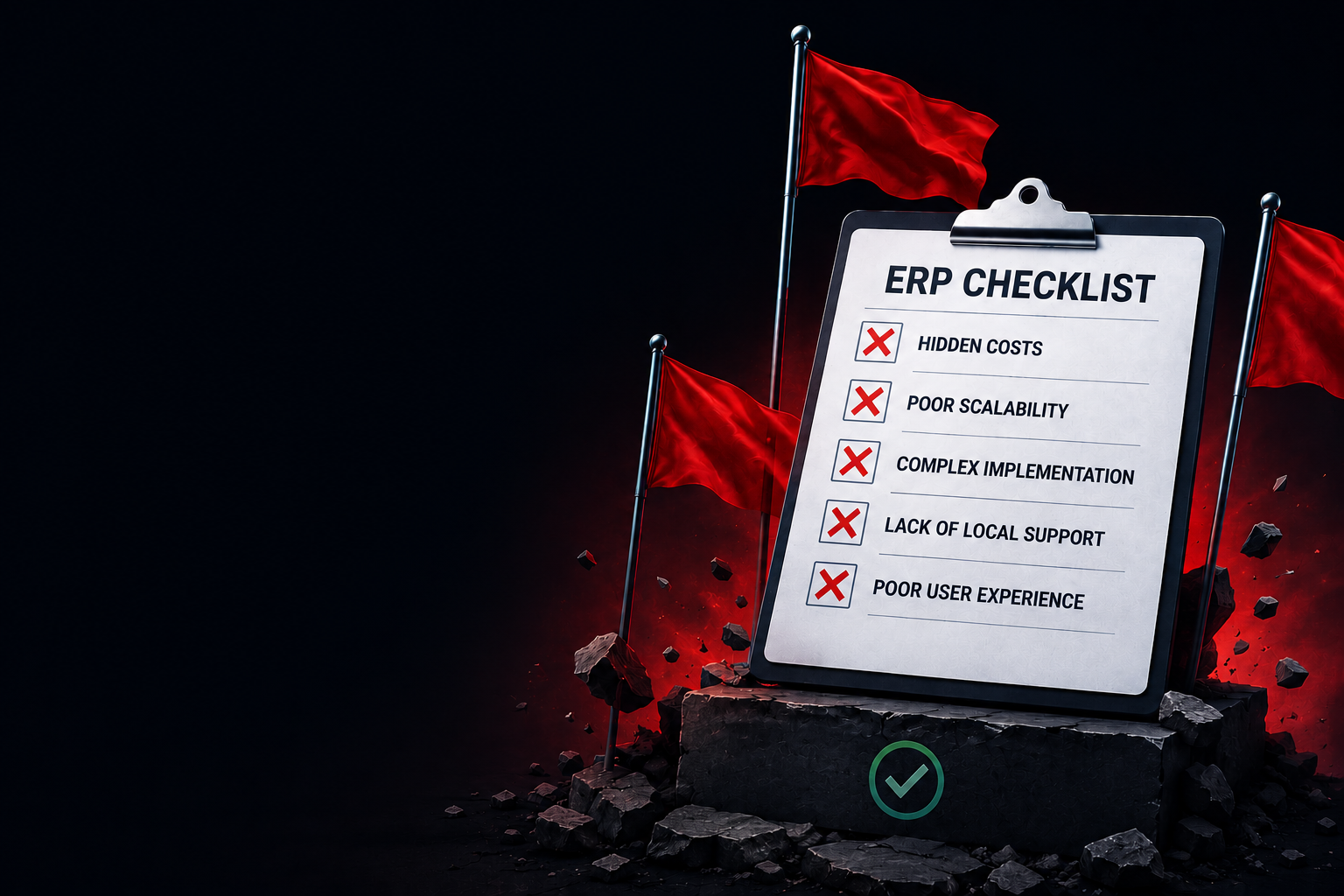
Red flags in the ERP sales process
- "We can configure it to do anything." Customisation promises without a costed scope and timeline are dangerous. Every line of customisation is a line you maintain forever — see ERP customisation: how much is advisable.
- Vague implementation timelines. A credible partner gives a realistic timeline and explains the methodology. If you are getting hand-waves, ask for a written work breakdown.
- No reference customers in your industry or region. A vendor who cannot connect you with a live customer in your sector and tier has not proven fit.
- Pricing revealed only after multiple meetings. A good vendor is transparent about cost structure early. Delayed pricing is a negotiation tactic, not a service.
- Oversized implementation teams. A ten-consultant implementation for a 60-person business is a billing strategy, not a delivery strategy.
- No defined go-live criteria. Without a contractual definition, the vendor decides when the support clock starts.
A seven-question fit test
Answer these in writing before any vendor demo:
- What is our tier today, and where will we be in three years?
- What two or three processes define our operational complexity?
- What does our integration map actually look like — what must the ERP talk to?
- What are our hard compliance constraints (data residency, e-invoicing, certifications)?
- What is our realistic five-year budget — including implementation, integration, and renewal uplifts?
- Do we have the internal capacity to lead a multi-month project, or do we need a partner-led delivery?
- What does "go-live" mean for us — and what does success look like at twelve months post-go-live?
If you cannot answer all seven, you are not ready to talk to vendors. You are ready to do requirements work.
Frequently Asked Questions
Which ERP is best for a small manufacturing business?
For a Small Business (10–75 people, US$1M–$10M revenue) manufacturer, the strongest candidates are Odoo Manufacturing, ERPNext, and SAP Business One. Odoo and ERPNext offer open-source flexibility and lower licence cost; SAP Business One offers stronger out-of-the-box financial depth and a deeper partner ecosystem. The deciding factors are usually the depth of your BOM and routing complexity, your traceability requirements, and whether you need MES integration.
Which ERP is best for a mid-market distributor?
For Mid-Market distribution (75–500 people, US$10M–$100M), NetSuite, Acumatica, and Dynamics 365 Business Central are the most common shortlisted platforms. NetSuite leads on multi-entity and multi-currency depth, Acumatica on consumption-based pricing and partner-led customisation, Business Central on Microsoft 365 integration and total cost. EDI capability, landed-cost calculation, and 3PL integration usually decide the final pick.
Which ERP is best for a global professional services firm?
For multi-entity professional services in the Mid-Market and Upper Mid-Market, NetSuite (with SuiteProjects or OpenAir) and Sage Intacct are the strongest. For larger groups with complex resource planning, Kantata (formerly Mavenlink) layered on a financial backbone is increasingly common. Revenue recognition compliance and global consolidation are usually the deciding criteria.
What ERP do most US companies use?
There is no single answer. Among US Mid-Market companies, NetSuite has the largest market share by deal volume, followed by Microsoft Dynamics 365 Business Central, Acumatica, Sage Intacct, and SAP Business One. In Upper Mid-Market and Enterprise, SAP S/4HANA, Oracle Fusion, and Dynamics 365 F&O dominate. Market share by region varies — Microsoft and SAP are stronger in Europe and APAC, NetSuite stronger in the US.
How much does an ERP system cost for a mid-sized business?
For a Mid-Market deployment (75–500 users), realistic five-year TCO ranges from US$400K to US$3M depending on platform, customisation depth, and geography. Headline subscription pricing is typically one-third of true five-year run-rate. The full structured breakdown by tier and deployment model is in how much does ERP cost.
How long does ERP implementation take?
For Small Business, three to six months. For Mid-Market, six to twelve months. For Upper Mid-Market and Enterprise, twelve to twenty-four months — sometimes longer for multi-country rollouts. Compressed timelines push risk into post-go-live stabilisation rather than removing it. Full breakdown in how long does ERP implementation take.
Should I pick an industry-specific ERP or a horizontal one?
Vertical platforms typically win when your industry has heavy process specialisation (process manufacturing, construction, healthcare, defence) or strict regulatory requirements. Horizontal platforms typically win when you operate across multiple business models, need a global multi-entity consolidation backbone, or expect M&A. The honest trade-off is in major ERP vendor vs niche ERP.
Is open-source ERP a serious option for a real business?
Yes — Odoo and ERPNext run real Small Business and lower Mid-Market operations every day, especially in EU, India, LATAM, and increasingly the GCC. The trade-off is operational responsibility: you (or a managed-services partner) handle hosting, upgrades, and security. The infrastructure side of that trade-off is covered in cloud vs on-premise ERP.
How ERPLenz helps
ERPLenz exists because this process is broken.
Most businesses approach ERP selection without an independent framework — and end up being sold the platform a vendor wants to sell, not the one the business needs.
ERPLenz's diagnostic scores ERP platforms against your specific profile: tier, industry, current stack, growth trajectory, geography, budget, and operational complexity. The result is a precision-scored report with fit percentages, risk flags, module requirements, and a five-year TCO reality check across your top candidates.
It is vendor-agnostic. No ERP vendor pays for placement. The shortlist is driven entirely by fit.
Walk into your first vendor meeting already knowing which platforms fit — and exactly why.
"Best ERP" is the wrong frame. The right frame is "right ERP for us", and that requires a structured, vendor-free diagnostic before any sales engineer opens a demo environment.