How to Measure ERP Success and ROI: The Practical KPI Framework
Dylan Coetzee · ERP Solution Architect & Founder · 14 min read · May 2026
Quick answer: To measure ERP success and ROI, define a baseline before go-live, then track a fixed set of operational and finance KPIs against it — month-end close days, inventory accuracy, order fulfilment accuracy, DSO, manual-effort hours, and FTE equivalents. Mid-market deployments typically show measurable ROI by months 4–9 and full payback inside 18–30 months. Anything else is a vendor case study, not a measurement.
Every ERP vendor has a case study. It reads something like: "Company X reduced operational costs by 30% and increased inventory accuracy to 98% within 12 months of go-live."
What the case study never tells you is what Company X measured before go-live, what their actual baseline was, how they isolated the ERP's contribution from every other change that happened in the same period, and whether those numbers survived month 18 — when hypercare ended, the implementation partner rolled off, and the novelty wore off.
ERP ROI is not something that happens to you. It is something you define before you start, measure throughout, and actively manage after go-live. Businesses that skip that discipline end up with an expensive system and a vague feeling that things are better — without the data to prove it, defend the next round of investment, or steer the improvement roadmap.
This article gives you the framework to measure ERP success and ROI properly — across mid-market deployments in any region.
Why Most ERP ROI Calculations Are Wrong Before They Start
The most common mistake is building the ROI case backwards. A business selects a platform, agrees on a price, needs to justify the spend to a board or finance committee, and then assembles a business case designed to validate a decision already made.
That is not an ROI model. It is rationalisation. It produces projections nobody believes, nobody tracks, and nobody mentions after go-live.
The correct sequence is the inverse. Define what success looks like before you select the platform. Use those definitions to inform which platform you choose. Then hold the implementation — and the organisation — accountable to those definitions after go-live. This works the same way whether you are running a single-entity Small Business in Australia or a Mid-Market multi-entity rollout across the UK, EU, GCC and India.
For the broader selection logic that feeds into this, see How to Select an ERP System and How to Choose an ERP in 2026.
The Two Categories of ERP Value
ERP value falls into two buckets, and treating them the same is where most ROI models go wrong.
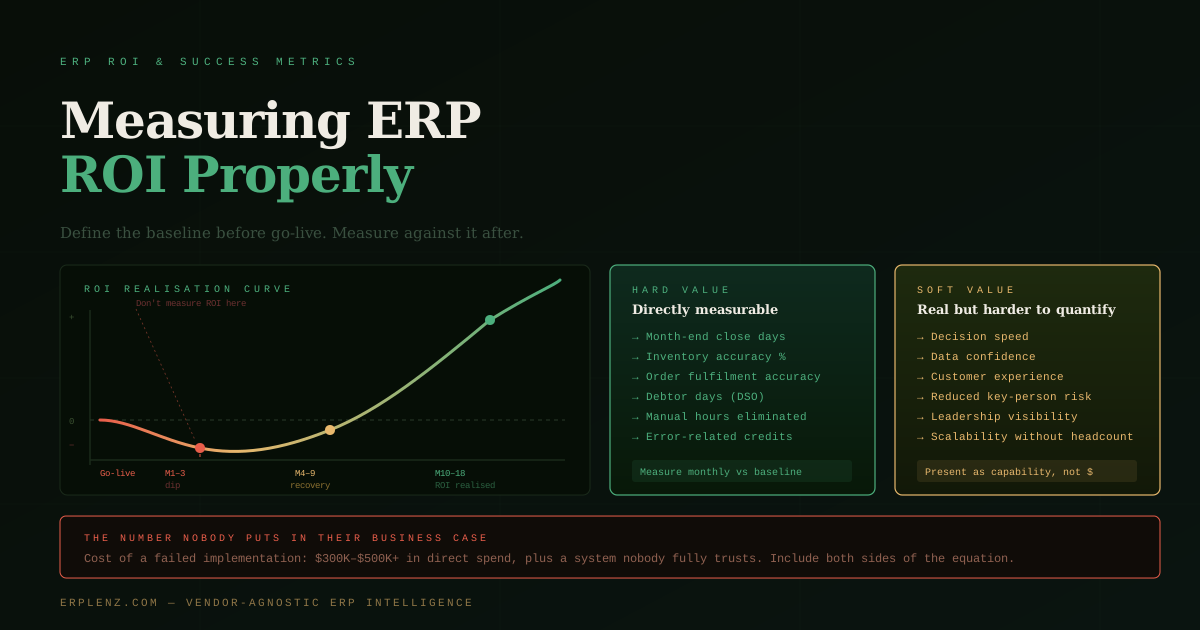
Hard value is directly measurable in money. Hours saved multiplied by fully loaded hourly cost. Inventory write-offs reduced by a traceable percentage. Headcount avoided because automation replaced manual handling. Customer credits and error costs that no longer occur. These can be put in a spreadsheet and tracked month by month.
Soft value is real but harder to translate into cash. Faster decisions because the data is current. Better customer experience because orders ship accurately. Leadership confidence in the numbers. Reduced key-person dependency because knowledge sits in the system instead of someone's spreadsheet. These often represent the majority of an ERP's actual value — but they need a different measurement approach.
Both categories belong in your business case. Do not conflate them. A board will push back hard on soft value presented as a financial figure. Present hard value as a number; present soft value as a capability statement with a leading indicator behind it.
Define Your Baseline Before Go-Live
You cannot measure improvement without knowing where you started. This is obvious. It is consistently skipped.
Before implementation begins, document the current state of every metric you plan to improve. Not estimates — actual measured baselines.
Operational baseline
- End-to-end purchase order cycle time (requisition to receipt)
- Order fulfilment accuracy (first-pass perfect orders)
- Order cycle time (order entry to dispatch)
- Inventory count discrepancies per cycle count
- Stock-out frequency and back-order rate
Finance baseline
- Working days to close the month (and consolidate, if multi-entity)
- Manual journal entries per period
- Days sales outstanding (DSO)
- Days payable outstanding (DPO)
- Time to produce a consolidated P&L across entities and currencies
People baseline
- Hours per week the finance team spends reconciling between systems
- Hours per week spent on manual report production
- Support tickets and customer complaints linked to order errors
- FTE equivalents whose primary task is moving data between disconnected systems
Measure these. Write them down. Date them. They become your pre-implementation baseline, and every post-go-live measurement is made against them. If your data is too messy to baseline, that is itself a finding — and a strong signal you need to read ERP Data Migration Guide before you go any further.
The KPIs That Actually Matter (with Benchmark Ranges)
Not all ERP metrics carry equal signal. These are the ones with the most.
Month-end close duration
One of the clearest indicators of ERP health.
| Maturity stage | Typical close (working days) |
|---|---|
| Pre-ERP, disconnected systems | 12–20 |
| Year 1 post go-live | 6–10 |
| Year 2 mature ERP | 4–6 |
| Best-in-class Mid-Market | 2–4 |
Multi-entity, multi-currency consolidations typically add 1–3 working days. Every day shaved off the close is a day the business operates on current information rather than last month's.
How to measure: calendar days between period end and final management accounts sign-off. Monthly.
Inventory accuracy
For any business holding physical stock, inventory accuracy is tied directly to revenue (you sell what you actually have) and cost (write-offs, expedited procurement, obsolescence).
Benchmark range: mature mid-market ERP warehouses run 97–99%. Below 95% indicates either a process or data discipline problem.
How to measure: cycle counts. Accuracy = (lines counted correctly ÷ total lines counted) × 100. Weekly or monthly depending on warehouse size.
Order fulfilment accuracy (perfect order rate)
What percentage of orders are picked, packed, and dispatched correctly on the first attempt — right product, right quantity, right address, right time, right documentation?
Benchmark range: 95–98% for a well-run ERP-driven warehouse. Best-in-class operations achieve 99%+. Anything below 92% is bleeding margin into returns, credits and relationship damage.
How to measure: (orders fulfilled without error ÷ total orders shipped) × 100. Weekly.
Order cycle time
Time from order receipt to dispatch. ERP-driven order management with integrated warehouse and stock visibility typically halves this for distribution businesses.
How to measure: average elapsed hours between order entry and dispatch confirmation, by channel.
Days sales outstanding (DSO)
DSO measures how long it takes to collect after invoicing. An ERP with automated invoice dispatch, payment reminders, e-invoicing compliance (relevant in the EU, India, GCC and increasingly elsewhere) and real-time AR visibility typically produces a measurable DSO improvement inside six months.
Benchmark range: expect a 10–25% DSO reduction in the first year for B2B mid-market businesses. Larger improvements are possible where the prior state was reliant on manual chasing.
How to measure: (total AR ÷ average daily revenue). Compare monthly to baseline.
Manual effort reduction (FTE savings)
Hardest to measure, often the largest single source of hard ROI. Count the hours spent on work the ERP should eliminate: re-keying between systems, spreadsheet reconciliation, manual report assembly, manual PO creation, manual bank reconciliation across multiple banking rails (SEPA, ACH, Faster Payments, NPP, UPI).
Benchmark range: mid-market deployments typically eliminate 1.5–4.0 FTE worth of manual administrative effort across finance and operations combined. Converted at fully loaded cost, this is frequently the single largest line in the hard ROI case.
How to measure: time-track affected functions for two weeks before go-live. Repeat six months and 18 months after. Convert the delta to fully loaded labour cost.
Compliance and audit readiness
Less visible but increasingly material. UK MTD, EU ViDA / e-invoicing, India GST e-invoicing, Saudi ZATCA Phase 2, Mexico CFDI — the cost of meeting regional digital compliance manually is rising every year. A platform that handles these natively reduces both compliance risk and the FTE cost of meeting it.
How to measure: audit prep hours per cycle; number of compliance findings per audit; e-invoicing rejection rate.
The ROI Timeline: What to Expect and When
ERP ROI does not arrive in month one. Businesses that expect it are usually disappointed; businesses that understand the curve stay the course.
| Phase | Window | What is happening | When to measure |
|---|---|---|---|
| Stabilisation | Months 1–3 | Productivity dips. Users learning. Processes refining. | Do not measure ROI yet. Track adoption and ticket volume. |
| Early wins | Months 4–9 | Close shortens. Inventory variances drop. Manual tasks fall away. | First formal post-go-live measurement vs baseline. |
| Compounding | Months 10–18 | Automation embedded. Reporting trusted. Decisions faster. | Largest share of ROI typically realised here. |
| Maturity | Year 2+ | Integrations expand, adoption deepens, business grows into the system. | Annual ROI refresh; feed into improvement roadmap. |
Businesses that follow a phased rollout typically see early wins arrive faster on the modules deployed in Phase 1. See Big Bang, Phased, or Module-by-Module for the full case. The realism on timelines — particularly across multi-country rollouts — is covered in How Long Does ERP Implementation Actually Take?.
The Number Nobody Puts in Their Business Case
There is a cost almost no ERP business case includes: the cost of a failed implementation.
ERP project failure rates are consistently reported at 50–75% in independent research from Panorama Consulting, Gartner and ISG — where "failure" means significantly over budget, significantly over schedule, or failing to deliver expected business outcomes. A failed Mid-Market implementation routinely costs USD 300,000–700,000 in direct project spend and leaves a system nobody fully trusts. Upper Mid-Market failures scale to seven and eight figures.
That cost does not appear in any vendor's ROI model. It appears in your P&L two years later, when you are budgeting a replacement. The full failure modes — and how to avoid them — are in Why ERP Implementations Fail.
This is the risk that sits on the other side of the ROI equation. Not just "how much will we save" but "what does it cost if we get this wrong." Including both sides of that calculation is what separates a serious business case from an optimistic one. The realistic total cost of ownership picture is covered in How Much Does ERP Actually Cost? — and the partner-versus-vendor delivery decision that drives much of the risk is in ERP Implementation Partner vs Vendor Direct.
Frequently Asked Questions
How long does ERP ROI typically take to materialise?
For Small Business to Mid-Market deployments, expect 4–9 months for the first measurable hard-value wins (faster close, lower DSO, fewer manual hours) and full payback in 18–30 months. Upper Mid-Market and multi-country deployments stretch this to 30–48 months because the implementation runway is longer. ROI in month one is a vendor pitch, not reality. Track adoption and ticket volume in the first quarter, and do not run formal ROI measurements until month six at the earliest.
What is a good ERP ROI percentage?
There is no universal answer, but well-executed Mid-Market deployments typically target a five-year ROI in the 100–250% range — meaning total quantified benefit is 2x–3.5x total cost of ownership across licence, implementation, integration, customisation and ongoing support. Anything substantially higher in the business case usually reflects optimistic soft-value monetisation. Anything below 100% across five years means either the platform is wrong, the implementation underdelivered, or the business never moved beyond like-for-like operations.
Which ERP KPIs matter most for finance teams?
Days to close, manual journal volume, DSO, DPO, audit prep hours and consolidation time across entities and currencies. For multinational organisations, add e-invoicing compliance rate and tax-filing automation coverage (MTD, EU ViDA, India GST, ZATCA, AU BAS). These are the metrics that translate directly into FTE savings and risk reduction.
How do you isolate ERP impact from other changes?
You cannot do it perfectly, but you can do it credibly. Hold non-ERP variables constant for the measurement window where possible — no major process changes, no other system replacements, no large headcount swings. Use a control: a function or entity that has not yet moved onto the new system. Document confounding events (acquisitions, regulatory changes, market shocks) so you can adjust the narrative. Honest attribution is more credible than tidy attribution.
What ERP success metrics should a board care about?
Boards do not want a ticket-volume report. They want four things: faster decisions (close days, time-to-insight), tighter working capital (DSO, inventory turns, stock-out rate), lower cost-to-serve (FTE per revenue dollar, cost per order), and reduced risk (audit findings, compliance posture, key-person dependency). Frame every KPI in those terms.
How do you measure soft ERP value without overstating it?
Use leading indicators rather than dollar figures. Decision latency (time from question to answer), report self-service rate, percentage of staff using the system as their primary tool, employee NPS on the system, customer NPS where ERP touches the experience. Track these alongside hard metrics. They tell the story the financial KPIs cannot, without inviting the board pushback that comes from monetising the unmonetiseable.
Should ERP ROI include the cost of failure?
Yes. A serious business case includes a probability-weighted view of failure risk. If independent research puts ERP failure rates at 50–75% and your selection process is informal, the expected value of failure is a real number that belongs in the model. Buyers who include it tend to invest more in selection rigour, change management and partner due diligence — which is precisely how the number then gets smaller.
How often should we re-measure ERP ROI after go-live?
A formal measurement at month 6, month 12, month 24, and annually thereafter. Operational KPIs (close, accuracy, DSO) should be tracked monthly as part of normal management reporting. The formal ROI refresh is what feeds the improvement roadmap and the case for the next investment — new modules, new entities, new geographies.
How ERPLenz Helps You Measure What Matters
ROI is made or lost at the selection stage. The right platform — matched to your actual requirements, not a vendor's idealised use case — is the one that goes live on time, gets used properly, and delivers the operational gains it was bought to deliver.
ERPLenz's 116-point diagnostic scores 17 platforms against your specific requirements. Budget is applied as a hard filter — platforms that exceed your realistic total cost of ownership are eliminated before they reach your shortlist, not presented with a caveat. Every shortlisted platform comes with a fit score, risk flags identifying functional gaps that would require expensive workarounds, and vendor intel surfacing the hidden cost patterns and commercial practices specific to each platform.
The budget reality check shows where total cost of ownership actually lands for your size, complexity and regional footprint — the number you will be comparing to your ROI projection in year two.
How ERPLenz scores every vendor →
Get your free ERP budget reality check →
Know the platform that gives you the best chance of the ROI you are planning for — before you commit.
Built by ERP consultants who have measured these KPIs in real implementations across NetSuite, SAP, Odoo, Dynamics 365 and Business Central — and watched optimistic ROI cases collide with reality more times than any of us would like to admit.
Related reading