Big Bang vs Phased vs Modular ERP Implementation: Which Approach Wins?
Quick answer: Phased ERP implementation produces the best outcomes for the overwhelming majority of businesses. Big bang (everything live on one day) is high-risk and only suitable for very small, simple businesses. Module-by-module is slow and creates fragmented data landscapes during the transition. The winning pattern: a phased rollout where Phase 1 is a like-for-like replacement of the current system (no new features, no new workflows), Phase 2 layers in new capability, and Phase 3 adds optimisation and advanced reporting. Treating implementation as organisational change — not software installation — is the difference between success and a written-off investment.
Before a single screen is configured or a single user is trained, there's a decision that will shape everything that follows: how are you going to roll this out?
Get this wrong and you can have the right system, the right partner, and the right budget — and still end up with a failed implementation. The approach isn't a detail. It's the structure inside which everything else either works or falls apart. (If you haven't yet confirmed the underlying readiness, see our guide on when a business actually needs an ERP — selecting the right approach assumes the foundation is in place.)
There are three recognised ERP implementation methods. Most vendors will present all three as viable. In practice, the right answer for the overwhelming majority of businesses — especially those doing this for the first time — is the same one.
The Three ERP Implementation Approaches
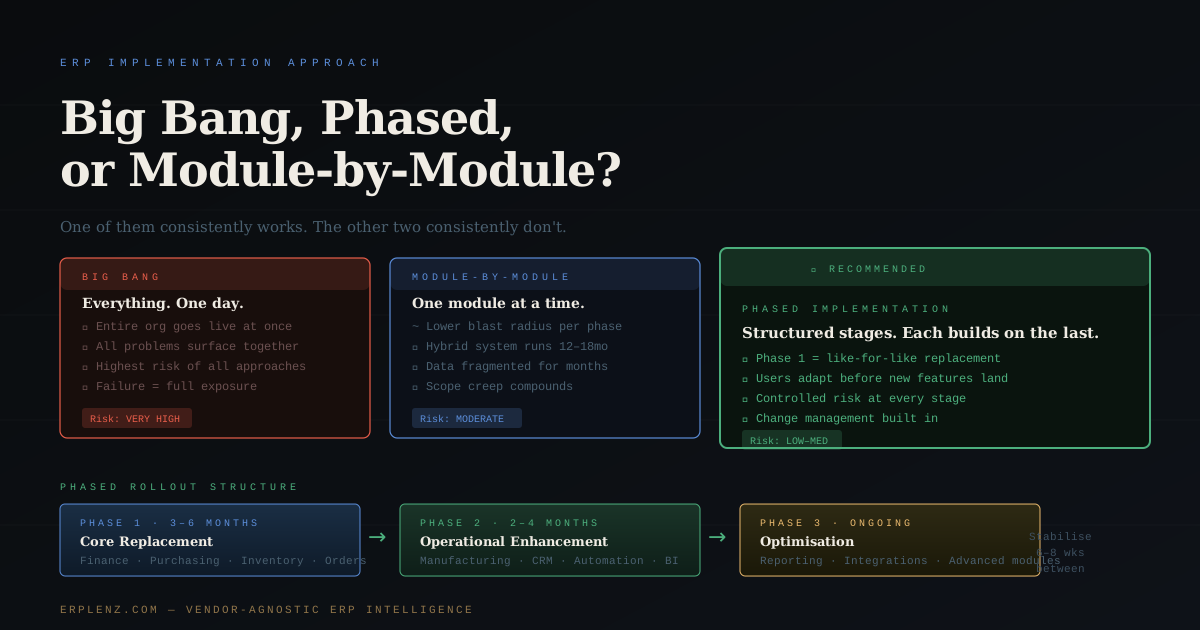
1. Big Bang Implementation
Everyone goes live on the same day. The old system is switched off. The new system is switched on. The entire organisation migrates at once.
This sounds efficient. In theory, it eliminates the complexity of running two systems in parallel, forces a clean break, and gets the business onto the new platform as quickly as possible.
In practice, big bang is the highest-risk approach available to you.
When the whole organisation goes live simultaneously, every problem surfaces at once. Finance can't close the day. Warehouse staff can't pick orders. Customer service can't see invoices. The implementation partner is fielding 40 simultaneous support calls. And the business — which still has customers, orders, and obligations — is grinding through all of it in real time.
Big bang implementations can work for genuinely small, simple businesses where the entire system footprint is modest and the user count is low. For anything with meaningful operational complexity, it is a high-wire act without a net. When it goes wrong, it goes expensively wrong — and the post-go-live stabilisation period can cost more than the implementation itself (our full breakdown of ERP costs covers what that recovery actually costs).
2. Module-by-Module Implementation
The opposite extreme. You implement one module at a time — finance first, then inventory, then procurement, then manufacturing — each as a standalone deployment before the next begins.
The logic is risk reduction. Smaller scope means smaller blast radius if something goes wrong.
The problem is fragmentation. During the transition period — which can stretch to 18 months or more — you're running a hybrid landscape: the new system for some functions, the old system for others, and a growing set of manual bridges between them. Data lives in multiple places. Reporting is impossible across the whole business. Staff are trained on systems that don't yet connect to each other.
Module-by-module also tends to extend the project timeline significantly, which means extended exposure to dual-running costs, prolonged disruption, and the creeping scope changes that accumulate when a project runs for two years instead of six months. Our implementation timeline guide shows how this stretches.
3. Phased Implementation (The Winner for Most Businesses)
This is the approach that consistently produces the best outcomes — and it's the one this article recommends without qualification for most businesses.
Phased ERP implementation means you go live in structured stages, with each phase having a clear scope, a defined go-live, and a stabilisation period before the next phase begins. The business is never asked to absorb the entire change at once. Each phase builds on the last.
But phased doesn't just mean splitting the project into chunks. The discipline is in how you structure Phase 1 — and most businesses get this wrong.
Why Phase 1 Should Always Be a Like-for-Like Replacement
Here's the temptation: you've just selected a new ERP with capabilities your old system never had. You want to use them. The new inventory module has lot tracking, demand forecasting, and automated reorder points. The new finance module has multi-dimensional reporting and automated bank reconciliation. Why would you implement a limited version when you could use everything from day one?
Because your people have never used any of it.
The single most underestimated variable in every ERP implementation is change management. People take time to adapt. Not days — weeks, sometimes months, before a new system feels natural to an experienced user. And during that adaptation period, the business needs to keep functioning. Customers still need their orders. Invoices still need to go out. The month still needs to close.
If Phase 1 introduces both a new system and new ways of working simultaneously, you've created two change problems on top of each other. Users are struggling to find the equivalent of what they did yesterday — and simultaneously being asked to use features they've never seen before, in workflows that don't yet match their mental model of how the business operates.
This is how implementations fail. Not technical failures — people failures. Staff revert to old habits, maintain shadow spreadsheets, and gradually stop trusting the new system. Six months later, you have an expensive ERP that nobody fully uses.
The right approach for Phase 1: replicate what you have. Map every process the current system handles. Make sure the new system can do all of it. Train users until they can do their existing job in the new system at least as well as they could in the old one. Then go live — and stabilise.
Once the business is running stably on the new platform and users are comfortable, Phase 2 unlocks the additional capability: the new reporting, the automation, the modules that didn't exist before. By that point, users have a foundation to build on. They understand the system. They trust it. They're ready to learn more.
The new features don't disappear by waiting 90 days. But the goodwill of your team will, if you overwhelm them at go-live.
What a Well-Structured Phased Rollout Looks Like
Every business is different, but a sensible phased ERP rollout for a mid-market company typically looks like this:
Phase 1 — Core Replacement (3–6 months) Finance, purchasing, basic inventory, and order management. Everything the business currently does, replicated in the new system. No new workflows, no new modules beyond the core. Go-live. Stabilise for 6–8 weeks minimum before Phase 2 begins.
Phase 2 — Operational Enhancement (2–4 months) The features that weren't in the old system — advanced inventory, manufacturing, CRM, automated workflows, integration with third-party tools (eCommerce, payroll, EDI, tax engines like Avalara or Vertex). Users are now comfortable with the platform. New capability lands on stable ground.
Phase 3 — Optimisation and Reporting (ongoing) BI dashboards (Power BI, Tableau, native ERP analytics), custom reports, process automation, advanced modules, AI-driven insights. This is where the full value of the new system starts to compound.
The temptation is to collapse all three phases into one. The discipline is resisting that temptation.
The Change Management Reality
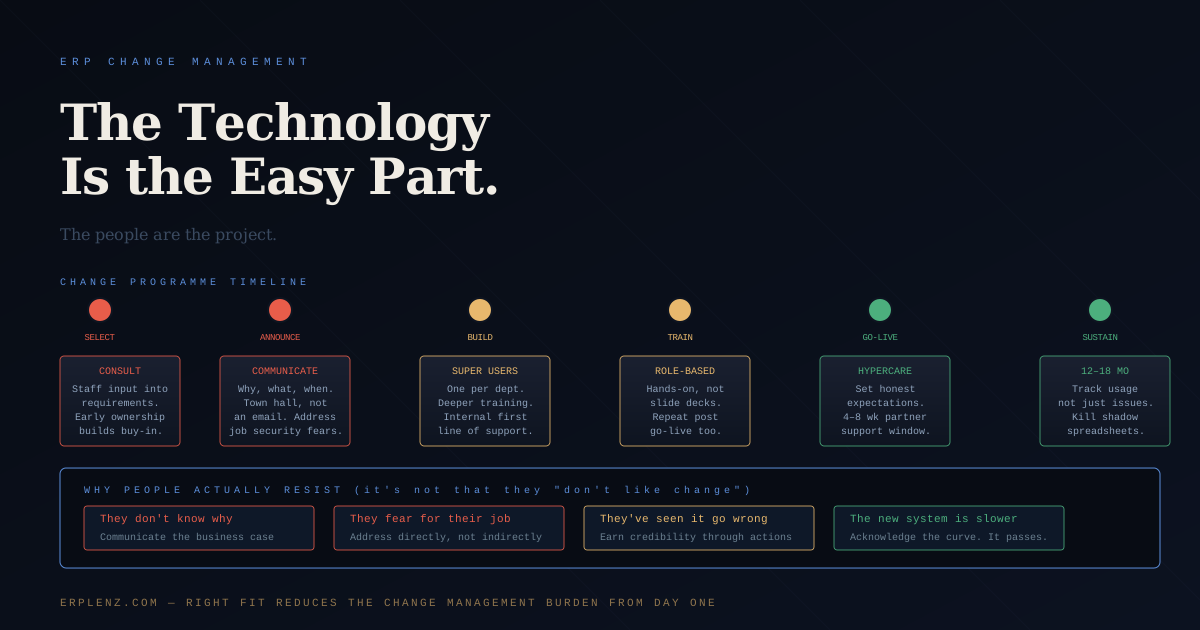
Change management is not a training session before go-live. It's a sustained programme that begins when the project kicks off and doesn't end until the last department is operating confidently on the new system.
It includes:
- Early communication: staff who understand why the change is happening are more likely to embrace it than those who have it imposed on them. The business case should be communicated, not just the go-live date.
- Role-based training: not everyone needs to know everything. Train people for their specific role in the new system. Generic training sessions that cover every module to every user create confusion, not competence. For multi-country deployments, training should be delivered in local language by trainers familiar with regional business practices.
- Super users: identify one or two advocates in each department who receive deeper training and become the first point of contact for their colleagues after go-live. This removes the bottleneck from the implementation partner and creates internal ownership.
- A realistic stabilisation period: budget 4–8 weeks post-go-live where reduced productivity is expected and acceptable. The implementation partner should be available. Issues should be expected. A business that treats the first week after go-live as "done" will pay for it.
The businesses that navigate ERP change well treat it as an organisational transformation, not a software installation. The technology is the easy part. The people are the project.
Choosing the Right Approach for Your Business
| Your Profile | Recommended Approach |
|---|---|
| Micro business, <10 employees, single entity | Big bang acceptable (low risk profile, small user count) |
| Small business, 10–75 employees | Phased — 2 phases, Phase 1 like-for-like |
| Mid-market, 75–500 employees | Phased — 3 phases, Phase 1 like-for-like, deliberate stabilisation between phases |
| Multi-entity / multi-country | Phased by entity or country, with a pilot site first |
| Enterprise, 500+ employees | Phased by business unit, with global template before regional rollouts |
| Heavy manufacturing or compliance-driven industry | Phased with extra UAT and compliance validation in each phase |
For multi-country deployments — common in mid-market and enterprise — the most successful pattern is "pilot site → wave 1 (2–3 similar countries) → wave 2 (remaining geographies)." This contains risk to a single market before expansion.
The right approach is also a function of the right partner. Our guide on partner vs vendor-direct delivery covers how to choose a delivery team that can actually execute a phased plan.
Frequently Asked Questions
What is phased ERP implementation?
Phased ERP implementation is a rollout strategy where the system goes live in structured stages, each with a defined scope and a stabilisation period before the next phase begins. The typical pattern is Phase 1 (core finance and operations as a like-for-like replacement), Phase 2 (operational enhancements and new modules), and Phase 3 (optimisation, reporting, automation). It is the recommended approach for the majority of businesses.
Is big bang ERP implementation risky?
Yes — significantly. Big bang implementations require the entire business to switch from old to new systems on a single day, with no fallback. Every issue surfaces at once: support is overwhelmed, users can't perform daily tasks, and the business loses productivity in real time. It can work for very small, simple businesses but is high-risk for anything with meaningful operational complexity.
What is the best ERP implementation strategy?
For most businesses: phased implementation with a like-for-like Phase 1. This approach minimises change management risk, gives users time to adapt to the new platform before learning new workflows, and contains the blast radius if something goes wrong. The discipline is in resisting the temptation to do everything at once.
How many phases should an ERP implementation have?
Most mid-market ERP implementations are best structured as three phases: (1) core replacement of existing functionality, (2) operational enhancements and new modules, (3) optimisation and advanced reporting. Enterprise deployments often add wave-based geographic or business-unit rollouts within each phase.
What should be included in Phase 1 of an ERP implementation?
Phase 1 should replicate the functionality your business currently uses — typically finance, purchasing, basic inventory, and order management. The goal is to get users operating the new system at parity with the old one before introducing any new capability. New features, automation, and advanced modules belong in Phase 2.
How long should the stabilisation period between phases be?
For mid-market businesses: 6–8 weeks minimum. For enterprise: 8–12 weeks. The stabilisation period is when users learn the new system, edge cases surface, and the implementation partner provides hypercare support. Compressing this period to start Phase 2 early is one of the most common — and most expensive — mistakes in ERP delivery.
Can I do a hybrid implementation approach?
Yes. Many successful deployments combine elements: phased rollout by business unit (geographic wave) plus modular sequencing within each phase (finance first, then operations, then reporting). The key principle is the same — never ask the whole organisation to absorb everything at once.
How ERPLenz Can Help
Selecting the right implementation approach starts with selecting the right platform. A system that requires heavy customisation to match your current processes forces a more complex Phase 1. A system that fits your workflows out of the box means Phase 1 is cleaner, faster, and lower risk.
ERPLenz scores 17 platforms against your specific operational requirements — including a risk flag for functional gaps that would create implementation complexity and extend your timeline. Your report tells you not just which systems fit, but where the implementation risk sits for each candidate.
Begin your free ERP assessment →
Know the implementation risk before you commit to the platform — not after.
ERPLenz is a vendor-agnostic ERP selection platform serving businesses across North America, the UK, EU, Australia, the Middle East, India, and Latin America. Our consultants have hands-on implementation experience across NetSuite, SAP, Odoo, Microsoft Dynamics, Acumatica, and Sage — and our scoring engine is deterministic, not commercial.