How Much Does ERP Actually Cost? The Full Breakdown Nobody Gives You
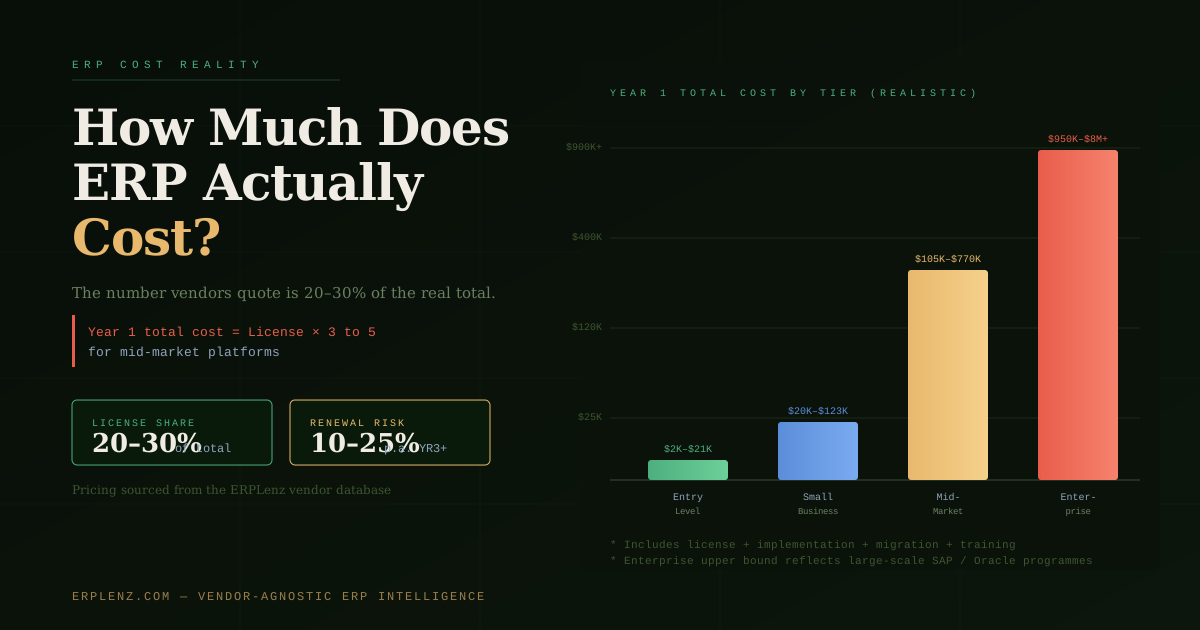
Quick answer: ERP licence fees represent only 20–30% of true Year 1 cost. Expect total Year 1 spend of $2K–$21K for entry-level accounting tools, $20K–$120K for small-business ERP (Odoo, ERPNext, Zoho One), $105K–$770K for mid-market ERP (NetSuite, Business Central, Acumatica), and $950K–$8M+ for enterprise ERP (SAP S/4HANA, Oracle Fusion, Dynamics 365 F&O). The licence is the entry ticket; implementation, customisation, data migration, training, and renewal escalation drive the real cost.
Ask an ERP vendor how much their system costs and you'll get one of two responses: a polished evasion ("it depends on your requirements"), or a licence fee that sounds manageable but represents about 20–30% of what you'll actually spend in Year 1.
The licence is the entry ticket. What follows — implementation, customisation, data migration, training, support, and the annual renewal escalation — is where the real ERP cost accumulates. This article gives you the complete breakdown by business tier (in USD, applicable globally), so you can plan accurately before a vendor shapes your expectations.
Costs are quoted in USD; multiply by local FX rates for GBP, EUR, AUD, INR, BRL, AED, or other regional currencies. Pricing patterns are remarkably consistent across markets.
Why ERP Pricing Is So Hard to Pin Down
ERP pricing is deliberately opaque. Most vendors don't publish pricing on their websites because they want to have the commercial conversation before you've formed a reference point. By the time you see a number, you've already invested weeks in the evaluation process and your perception of "reasonable" has been shaped by their narrative.
There are also legitimate reasons costs vary: company size, user count, modules required, integration complexity, data quality, geography, and whether you're implementing on greenfield or replacing an existing system all affect the final number.
But "it depends" is not an answer. Here's what the data actually looks like.
ERP Cost by Business Tier: Licence + Implementation Reality
Entry-Level Accounting Tools (Micro Business: <10 employees, <$1M revenue)
These aren't full ERPs — they're accounting platforms with some operational extensions. But for many micro businesses globally, they're the right starting point.
Platforms: Xero, QuickBooks Online, Zoho Books, Sage Business Cloud, FreshBooks
| Component | Typical Range (USD) |
|---|---|
| Annual licence | $500 – $6,000 |
| Implementation (DIY to assisted) | $0 – $5,000 |
| Integrations / add-ons | $1,000 – $8,000/yr |
| Training | $500 – $2,000 |
| Total Year 1 | $2,000 – $21,000 |
These platforms are intentionally self-serve. Most micro businesses implement them without a consultant. The cost risk here is add-on creep — the base licence is cheap, but payroll, inventory, advanced reporting, and eCommerce integrations quickly multiply the annual cost.
Small Business ERP (10–75 employees, $1M – $10M revenue)
This is the tier where you're buying a genuine ERP — modules for finance, inventory, CRM, and operations — not just accounting software. If you're not sure you've crossed the threshold yet, our guide on when a business actually needs an ERP explains the operational signals.
Platforms: Odoo, ERPNext, Zoho One
| Component | Typical Range (USD) |
|---|---|
| Annual licence | $2,000 – $20,000 |
| Implementation partner fees | $8,000 – $50,000 |
| Customisation / development | $5,000 – $30,000 |
| Data migration | $3,000 – $15,000 |
| Training | $2,000 – $8,000 |
| Total Year 1 | $20,000 – $123,000 |
The wide range reflects implementation approach. An Odoo Community self-hosted deployment by a capable internal team looks completely different from an Odoo Enterprise cloud deployment with a certified partner doing the full implementation. Both are legitimate — your internal capability determines which is realistic.
The open-source advantage: Odoo Community and ERPNext have no licence cost. If you have technical capability in-house or a development partner willing to work with open-source, the licence component drops to zero. Total Year 1 cost for a lean Odoo Community implementation can be as low as $15,000–$25,000 USD.
Mid-Market ERP (75–500 employees, $10M – $100M revenue)
This is where costs become significant and where the gap between the quoted number and the final number is widest.
Platforms: NetSuite, SAP Business One, Microsoft Dynamics 365 Business Central, Sage Intacct, Acumatica, Syspro
| Component | Typical Range (USD) |
|---|---|
| Annual licence | $10,000 – $100,000 |
| Implementation partner fees | $50,000 – $400,000 |
| Customisation / development | $20,000 – $150,000 |
| Data migration | $10,000 – $50,000 |
| Training and change management | $10,000 – $40,000 |
| Infrastructure / middleware | $5,000 – $30,000 |
| Total Year 1 | $105,000 – $770,000 |
NetSuite — the most commonly deployed mid-market cloud ERP — typically costs $25,000–$100,000 USD per year in licensing. Implementation fees through a certified partner generally run 1.5x–3x the annual licence. A $60,000/year NetSuite licence commonly sees $90,000–$180,000 in implementation fees.
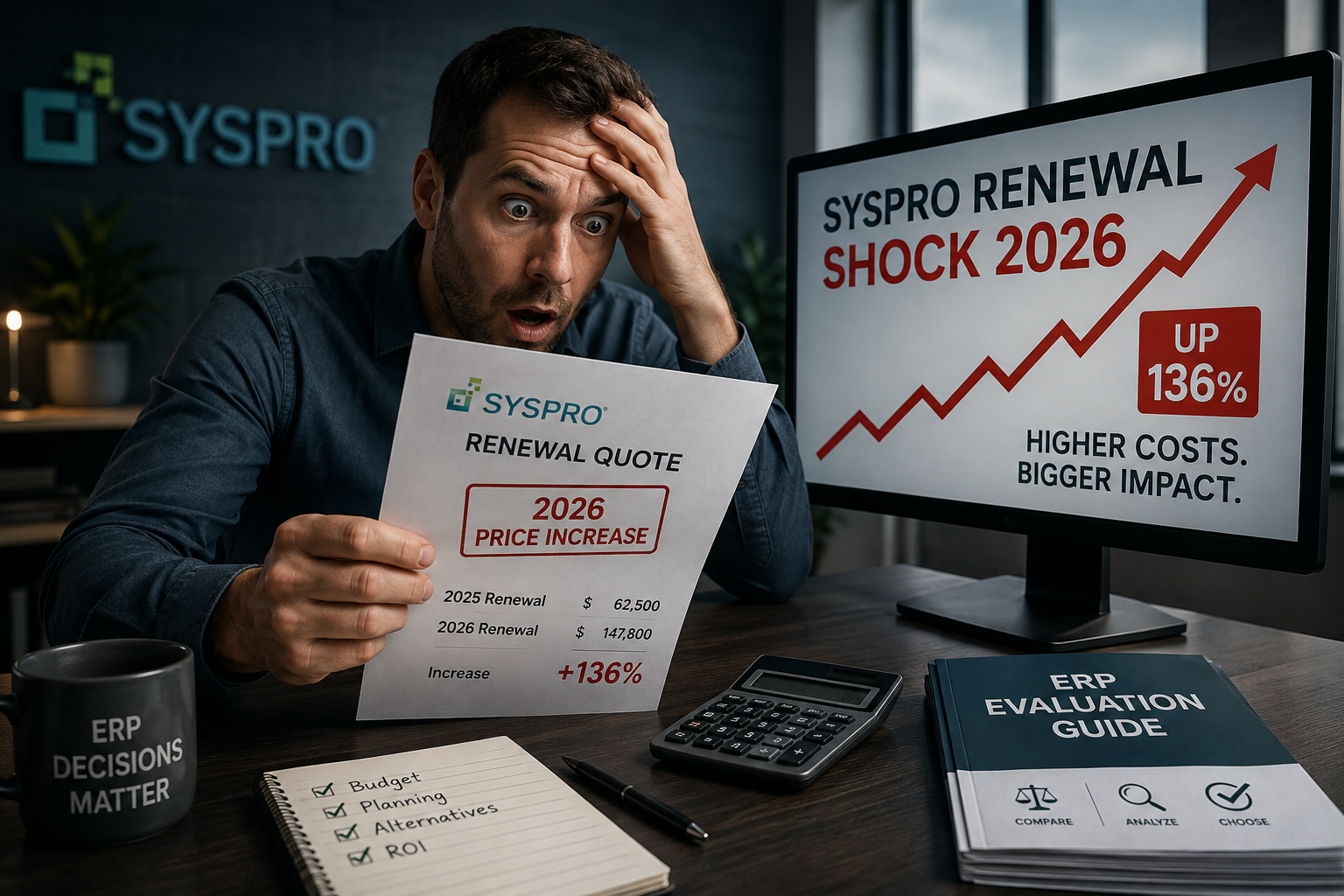
This is also the tier where annual renewal escalation becomes a material business risk. Mid-market SaaS ERP vendors — NetSuite in particular — have a widely reported pattern of significant price increases at renewal once you're embedded. Budget for 10–25% annual increases from year 3 onwards; some customers report more.
Our breakdown of how long ERP implementation actually takes explains why these implementation budgets balloon at this tier — and what you can control.
Enterprise ERP (Upper Mid-Market: 500+ employees, >$100M revenue)
Enterprise ERP projects are in a different category. These are multi-year transformation programmes with dedicated project teams, external consultancies (Deloitte, Accenture, IBM, Capgemini, KPMG, PwC), and ongoing operational costs that run indefinitely.
Platforms: SAP S/4HANA, Oracle Fusion Cloud ERP, Microsoft Dynamics 365 F&O, JD Edwards, Infor CloudSuite
| Component | Typical Range (USD) |
|---|---|
| Annual licence | $50,000 – $500,000 |
| Implementation (consulting fees) | $500,000 – $5,000,000+ |
| Customisation / integration | $200,000 – $2,000,000+ |
| Data migration and cleansing | $50,000 – $500,000 |
| Change management and training | $100,000 – $500,000 |
| Infrastructure and support | $50,000 – $300,000/yr |
| Total Year 1 | $950,000 – $8,800,000+ |
SAP S/4HANA implementations at scale routinely exceed $2M USD. Oracle Fusion at a large listed company can run $5M–$10M in total project cost. These numbers are real; they reflect the actual complexity of replacing multiple legacy systems, cleaning decades of accumulated data, training thousands of users across multiple countries and languages, and building the integrations required by a complex enterprise technology stack.
The Hidden Cost Components That Kill ERP Budgets
1. Change Management (Almost Always Underfunded)
Most ERP project budgets allocate 5–10% for change management. Research from Prosci, Gartner, and Panorama Consulting consistently shows 30–50% is more appropriate for a successful implementation. The systems work; the people don't adapt to them. When the project runs over time and budget, it's usually because of change resistance, not technical failure.
2. Data Migration and Cleansing
You cannot migrate dirty data into a clean system. Before any ERP goes live, years of accumulated customer records, inventory data, historical transactions, and open balances need to be cleansed, transformed, and validated. Vendors quote migration costs assuming your data is clean. It rarely is. Budget 1.5x–2x the quoted migration cost.
3. Post-Go-Live Hypercare Support
The first 90 days after go-live are the most expensive. Users generate a wave of support requests, edge cases surface that weren't caught in testing, and the implementation partner typically charges premium rates for hypercare support. Budget a dedicated post-go-live support allocation separate from the implementation cost.
4. Customisation Maintenance
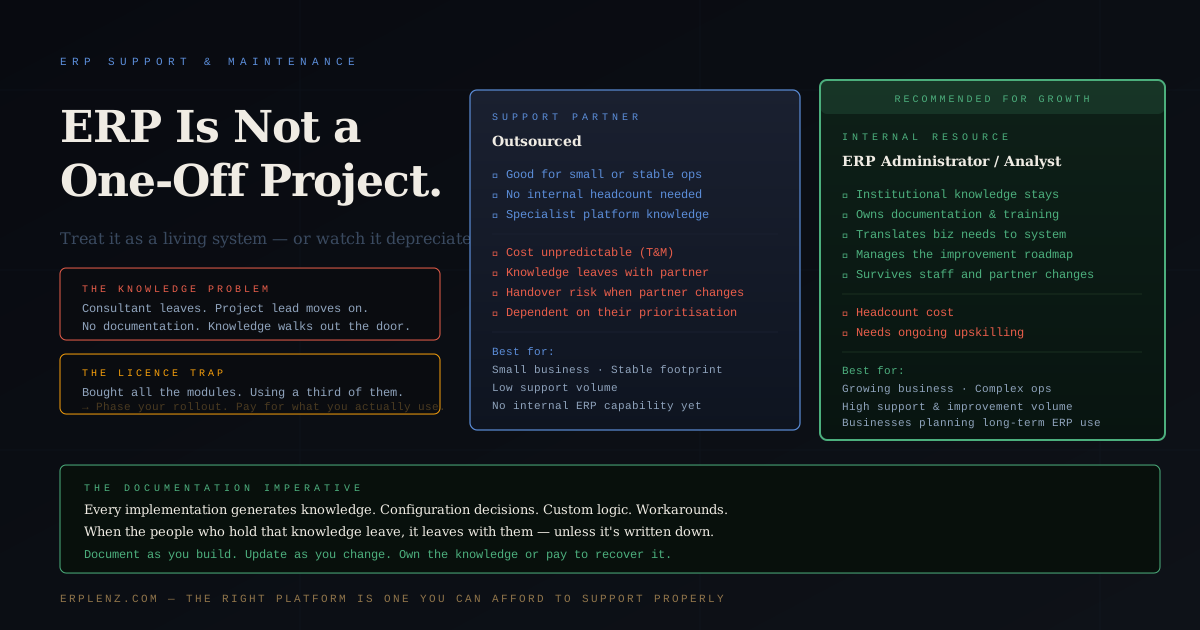
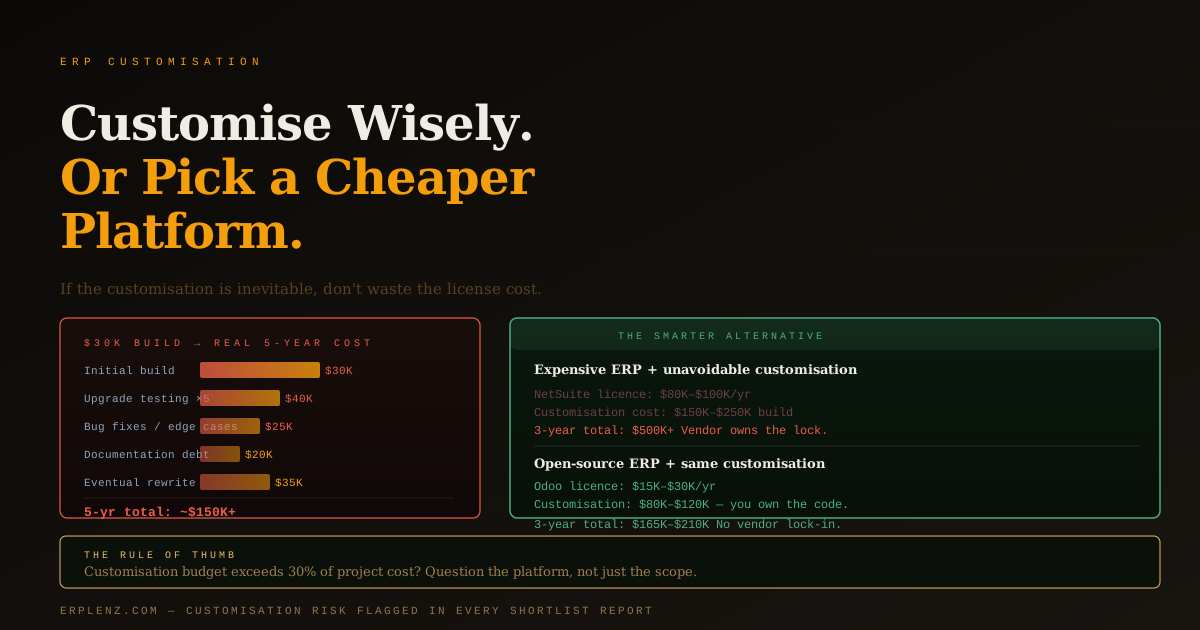
Every customisation you build becomes a maintenance liability. Each time the ERP vendor releases an upgrade (NetSuite is twice-yearly, SAP S/4HANA quarterly, Microsoft Dynamics 365 continuous), customisations need to be tested, sometimes rebuilt. The more you customise, the higher your long-term annual cost. This is why implementation partners who promise to "configure it to do anything" are creating future cost for you, not solving it — see our guide on choosing the right implementation partner.
5. Integration Ongoing Costs
Integrations to third-party systems (CRM, eCommerce, payroll, EDI, tax engines like Avalara or Vertex, banking APIs) have upfront build costs and ongoing maintenance costs. APIs change. Vendors update their platforms. Budget 15–25% of the initial integration cost annually for ongoing maintenance.
6. Currency, Localisation, and Regional Tax Compliance
For multi-country deployments, every additional jurisdiction adds licensing tiers, localisation packs, tax engine integrations, and statutory compliance overhead. EU VAT, UK Making Tax Digital, India GST, Brazil eNotaFiscal, GCC VAT, US state-level sales tax (handled by Avalara or Vertex) — these are not "configuration", they're billable scope.
What "Cheap" ERP Actually Costs You
The lowest-cost ERP decision isn't the one with the smallest licence fee. It's the one with the lowest total cost of ownership over five years, accounting for:
- Actual fit to your operational requirements (customisation cost to close gaps)
- Implementation duration (every month of implementation is a month of dual-running cost and productivity loss)
- Renewal escalation trajectory
- Migration cost if you need to leave the platform
A $15,000/year Odoo implementation that fits your business well, runs on infrastructure you control, and requires minimal customisation will frequently be cheaper over five years than a $40,000/year NetSuite contract with 2x annual renewal increases and $200,000 in implementation fees — even before accounting for the switching cost if you eventually outgrow it.
Industry-specific niche ERPs (Syspro, Epicor, Aptean, IFS, Deltek) often beat major horizontal vendors on 5-year TCO for specialised businesses because they ship with industry workflows pre-built. Our comparison of major ERP vendors vs niche industry ERPs explains when each wins. And the implementation approach you pick — see our guide on phased vs big bang ERP rollouts — directly drives implementation cost.
The sticker price and the total price are different numbers. Build your business case on the total number.
ERP Pricing Quick Reference (2026)
| Platform | Tier | Annual Licence (USD) | Deployment |
|---|---|---|---|
| Xero | Entry | $1,000 – $6,000 | Cloud only |
| QuickBooks Online | Entry | $1,000 – $5,000 | Cloud only |
| Zoho Books | Entry | $500 – $4,000 | Cloud only |
| Sage Business Cloud | Entry | $1,500 – $6,000 | Cloud only |
| Odoo | Small Business | $5,000 – $20,000 | Cloud / Self-hosted |
| ERPNext | Small Business | $2,000 – $12,000 | Cloud / Self-hosted |
| Zoho One | Small Business | $3,000 – $15,000 | Cloud only |
| Microsoft Dynamics 365 BC | Mid-Market | $10,000 – $50,000 | Cloud SaaS |
| SAP Business One | Mid-Market | $15,000 – $60,000 | Cloud / On-prem |
| Acumatica | Mid-Market | $15,000 – $65,000 | Cloud SaaS |
| Syspro | Mid-Market | $15,000 – $80,000 | Cloud |
| Sage Intacct | Mid-Market | $20,000 – $80,000 | Cloud SaaS |
| NetSuite | Mid-Market | $25,000 – $100,000 | Cloud SaaS |
| Microsoft Dynamics 365 F&O | Enterprise | $50,000 – $250,000 | Cloud (Azure) |
| JD Edwards | Enterprise | $60,000 – $250,000 | On-premise |
| SAP S/4HANA | Enterprise | $80,000 – $400,000 | Cloud / RISE / GROW |
| Oracle Fusion Cloud ERP | Enterprise | $100,000 – $500,000 | Cloud only |
Licence ranges are indicative annual costs in USD. Total Year 1 cost including implementation is typically 2–5x these figures for mid-market platforms and 5–15x for enterprise platforms. Negotiated enterprise pricing varies significantly.
Frequently Asked Questions
How much does NetSuite cost per year?
NetSuite licensing typically runs $25,000–$100,000 USD per year for mid-market deployments, depending on user count, modules (Financials, OneWorld, Manufacturing, Advanced Inventory, SuiteCommerce), and transaction line volume. Implementation through a certified partner adds 1.5x–3x the annual licence in the first year. Budget Year 1 total of $100,000–$500,000 for most mid-market NetSuite deployments.
What is the cheapest ERP for small businesses?
Open-source platforms — Odoo Community and ERPNext — have no licence cost. Year 1 total can be as low as $15,000–$25,000 USD with a capable internal team or a low-cost implementation partner. The trade-off is that you carry more responsibility for hosting, upgrades, and custom development governance.
How much does SAP cost?
SAP Business One (for SMEs) typically costs $15,000–$60,000 USD per year in licensing. SAP S/4HANA Cloud (mid-market and enterprise) starts around $80,000 USD per year and scales into seven figures for large enterprises. Implementation is the dominant cost: budget 2–5x the annual licence for Business One, 5–15x for S/4HANA at enterprise scale.
How much does ERP implementation cost compared to the licence?
For mid-market ERP, implementation typically costs 1.5x–3x the annual licence. For enterprise ERP, implementation can be 5–10x the annual licence — sometimes much more for complex multi-country rollouts. A useful rule of thumb: the licence is roughly 20–30% of Year 1 total cost.
What is the typical 5-year total cost of ownership (TCO) for a mid-market ERP?
For a 100-user mid-market deployment on NetSuite, Business Central, or Acumatica, expect 5-year TCO of $400,000–$1.5M USD. The licence component is 40–60% of the 5-year figure; implementation, customisation maintenance, integration upkeep, and renewal escalation make up the rest. Heavy customisation can push 5-year TCO 50% higher.
Why are ERP implementation costs so high?
Three reasons: (1) ERP touches every business process, so requirements gathering and configuration take months of consultant time; (2) data migration from legacy systems is consistently underestimated and almost always longer than quoted; (3) change management — getting people to actually use the system correctly — is more expensive than the technology itself. Most overruns are people problems, not technology problems.
Can I negotiate ERP pricing?
Yes — and you should. Almost no major ERP vendor publishes list prices, which means every deal is negotiated. Leverage points include: multi-year commitments (locks in your discount), end-of-quarter timing (sales teams have quotas), competitive bids (the vendor knows you have alternatives), and capping renewal escalation in writing (this is the single most important contractual term).
How ERPLenz Can Help
The most expensive ERP mistake isn't overpaying for a system. It's choosing the wrong system and paying to implement it twice.
ERPLenz's 116-point assessment produces a shortlist of your top three ERP candidates with a full budget reality check for each — covering licence, implementation band, customisation risk, and a five-year TCO estimate calibrated to your business size, geography, and operational complexity.
No vendor pays to appear in results. Your budget is a hard elimination filter, not a suggestion. Systems that exceed your realistic total budget are eliminated before they reach your shortlist.
Get your free ERP budget reality check →
Know what you should actually be spending — before a vendor tells you what's reasonable.
Pricing data is sourced from the ERPLenz vendor database and validated against published partner rate cards across North America, the UK, EU, Australia, and emerging markets. Licence ranges reflect standard configurations; enterprise pricing is negotiated and may vary significantly. Last updated March 2026.