Major ERP Vendor vs Niche Industry ERP: Which Should You Choose?
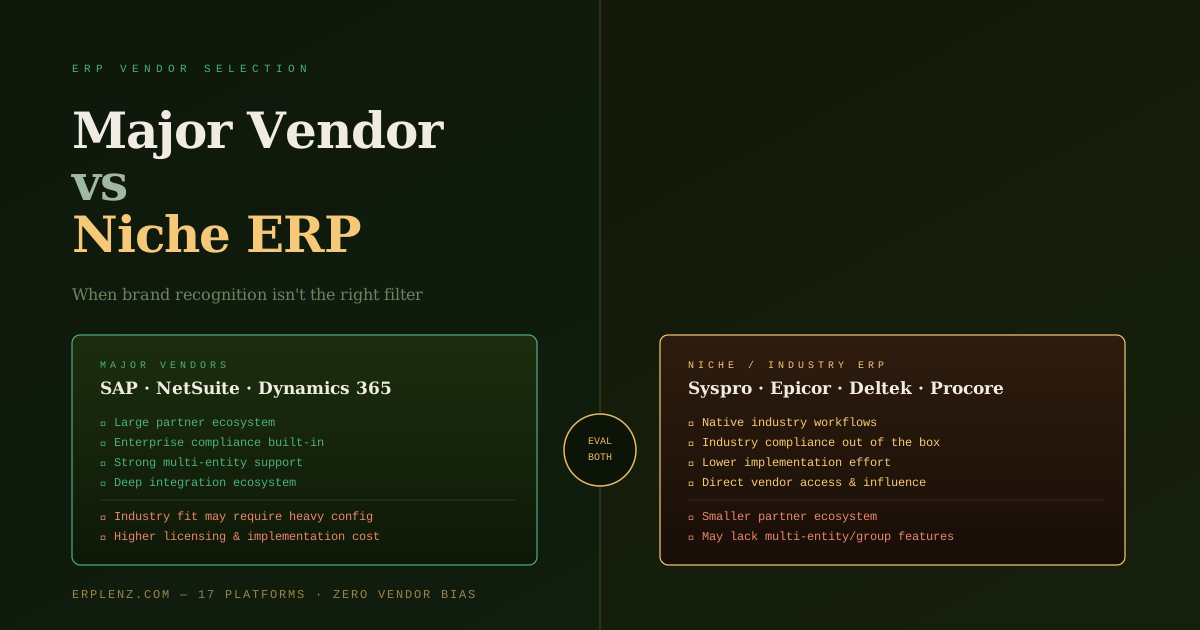
Quick answer: Major horizontal ERPs (SAP S/4HANA, NetSuite, Microsoft Dynamics 365, Oracle Fusion) offer breadth, large partner ecosystems, and enterprise-grade compliance. Niche industry ERPs (Syspro, Epicor, DELMIAworks, Plex, Deltek, Aptean) ship with industry-specific workflows pre-built, reducing implementation effort and customisation cost. The right answer depends on whether your operational requirements are mostly generic (favours major vendors) or industry-specific (favours niche vendors). For specialised manufacturers, contractors, food processors, and life-sciences companies, the niche option is often cheaper and lower-risk over a 5-year TCO.
Walk into any ERP sales conversation and you'll hear about SAP, Oracle (NetSuite and Fusion), and Microsoft Dynamics. These are the names with the biggest marketing budgets, the most implementation partners, and the longest reference customer lists.
But market presence doesn't equal fit. And for a significant portion of businesses — particularly those in specialised industries — the right answer isn't the most famous name. It's the platform built specifically for how their industry actually operates.
This article lays out the honest trade-offs between major horizontal ERP vendors and niche, industry-specific ERPs.
What Makes a "Major" ERP Vendor?
The major vendors — SAP, Oracle (NetSuite and Fusion Cloud), Microsoft Dynamics, Infor, and Sage — share a few defining characteristics:
- Broad horizontal functionality: Built to serve many industries, not one
- Large partner ecosystems: Hundreds or thousands of certified implementation partners globally
- Significant R&D investment: Continuous product development, AI integration, and enterprise feature roadmaps
- Higher baseline cost: Licensing, implementation, and support costs trend higher
- Brand credibility: Boards and audit committees recognise the names
They are, in many ways, the "safe" choice — in the sense that no one gets fired for buying SAP. But safe isn't the same as right.
What Makes a Niche ERP?
Niche or industry-specific ERP platforms are built from the ground up for a particular industry or business function. Instead of offering every module for every industry, they go deep on a specific domain.
Examples by industry (global vendors):
| Industry | Niche ERP Examples |
|---|---|
| Discrete Manufacturing | Syspro, Epicor Kinetic, Infor LN, DELMIAworks (formerly IQMS), Global Shop Solutions, JobBOSS² |
| Process Manufacturing | Aptean Process Manufacturing, BatchMaster, Deacom, Sage X3 Process |
| Construction | Procore, Viewpoint, Jonas Construction, Sage Construction, COINS |
| Food & Beverage | Aptean Food & Beverage, BatchMaster, JustFood, Sage X3 Food |
| Automotive | Plex Systems (Rockwell), Infor CloudSuite Automotive, QAD Adaptive |
| Aerospace & Defence | IFS Cloud, Infor LN Aerospace, Deltek Costpoint |
| Healthcare / Life Sciences | Greenway Health, NextGen Healthcare, BatchMaster Pharma, ProcessPro |
| Non-Profit | Blackbaud Financial Edge, Sage Intacct Non-Profit, Aplos |
| Professional Services | Deltek Vantagepoint, Kantata (formerly Mavenlink/Kimble), Unit4 PSA |
| Retail / Hospitality | LS Central, Lightspeed Retail, NCR Counterpoint |
| Distribution / Wholesale | Acumatica Distribution Edition, Infor Distribution SX.e, DDI System |
These platforms often have capabilities the major vendors simply can't match out of the box — because those capabilities are specific to an industry's regulatory requirements, operational workflows, or compliance needs.
The Case for a Major ERP Vendor
1. You Need Breadth, Not Depth
If your business is a general wholesale distributor, a professional services firm, or a multi-entity business that doesn't have highly specialised operational requirements, a major horizontal platform like NetSuite or Microsoft Dynamics 365 Business Central will cover you well. You won't be paying for specialised manufacturing capability you don't need, and you'll benefit from a mature, well-documented system with a large global support ecosystem.
2. You're Scaling Across Multiple Business Units
Major vendors are built for complexity at scale. If you're running multiple legal entities across the US, UK, EU, APAC, or LATAM with multi-currency consolidation, intercompany transactions, and group reporting, a platform like NetSuite OneWorld or SAP S/4HANA handles this natively. Niche platforms often struggle at the group level.
3. Your Integration Ecosystem Demands It
If your business runs deep in the Microsoft stack (Azure, Teams, Power BI, SharePoint), Microsoft Dynamics 365 has native integrations that reduce friction significantly. Similarly, Salesforce-heavy organisations often find NetSuite's CRM integration smoother than alternatives, and Google Workspace-heavy organisations may prefer Odoo or Zoho.
4. You Need Enterprise-Grade Compliance and Audit Capability
For listed companies, heavily regulated industries, or businesses with Big 4 audit relationships, the compliance frameworks built into SAP or Oracle Fusion can be decisive. These platforms have invested decades in GAAP, IFRS, SOX, GDPR, and regulatory compliance frameworks — and they continuously update to meet new mandates like e-invoicing in the EU, ZATCA in Saudi Arabia, or India's GST and e-way bill requirements.
5. Partner Availability Globally
If you operate in multiple countries, a major vendor likely has implementation partners in every market you serve. Niche vendors often have geographic concentration — strong in their home market, thin elsewhere.
The Case for a Niche Industry ERP
1. Your Industry Has Specific Requirements That Major Vendors "Configure Around"
This is the critical point. When a major vendor says they support your industry, ask exactly what that means. Often it means: "We have a manufacturing module that handles the basics, and with enough configuration, it can approximate what you need."
That configuration comes with a cost and a risk. Configured workarounds for core operational processes break at upgrade time, require specialist resources to maintain, and often don't keep pace with your industry's evolving requirements.
A niche ERP built for discrete manufacturing — like Syspro or Epicor Kinetic — ships with shop floor control, work order management, routing, real-time costing, and quality management as native capabilities. No configuration. No workarounds. Just the functionality your team needs on day one.
2. Your Compliance Requirements Are Industry-Specific
FDA 21 CFR Part 11 for medical device and pharmaceutical manufacturers. GFSI food safety compliance for food processors. AS9100 for aerospace. ITAR for defence contractors. SQF and BRC for food and beverage. GMP for pharmaceuticals. These aren't modules a general ERP vendor builds as a priority. Niche vendors in these industries build their entire product around compliance capability — because their customers can't go live without it.
3. Total Cost of Ownership Is Often Lower
This surprises people. A major ERP vendor with a lower per-user licence cost can easily become more expensive than a niche system once you factor in the implementation effort required to configure industry-specific functionality.
A niche ERP that ships with your workflows pre-built takes less time to implement. Fewer consultants. Shorter project timelines. Less customisation. These savings often more than offset a higher baseline licence cost. Our full ERP cost breakdown and implementation timeline guide cover the numbers behind this.
4. You Want Vendor Attention as a Customer
A mid-market manufacturer spending $80,000/year on a major ERP vendor's licence is a rounding error to that vendor's revenue. The same spend with a niche vendor focused on your industry often means direct access to the product team, faster support resolution, and roadmap influence.
5. Better Reference Customers in Your Industry
Niche vendors typically have hundreds of customers in your specific industry. When you talk to references, they're operating the system exactly the way you will. Major vendor references are often from adjacent industries, larger or smaller in scale, or running heavily customised versions that don't match your intended deployment.
The Hybrid Reality: Some Major Vendors Have Built Strong Industry Solutions
The distinction between "major" and "niche" is blurring. Several major vendors have invested significantly in industry-specific capability:
- SAP Business One for Manufacturing: Genuinely strong for SME manufacturers, with MRP, BOM, and production order capability
- NetSuite for Wholesale Distribution: Native multi-warehouse, advanced inventory, and EDI support make it a credible choice for distributors globally
- Acumatica: Has built dedicated editions for manufacturing, distribution, construction, and retail — giving it some niche depth within a mid-market platform
- Microsoft Dynamics 365 Business Central with LS Central: The dominant retail and hospitality stack within the Microsoft ecosystem
- Infor: Has moved heavily into industry-specific vertical ERP (Infor CloudSuite Industrial, Automotive, Fashion, Healthcare, Distribution)
- Oracle NetSuite for Software/SaaS: Strong revenue recognition and subscription billing capability via SuiteBilling and Advanced Revenue Management
This means the question isn't always "major vs niche." Sometimes a major vendor's industry edition genuinely matches a niche platform's depth. The only way to know is to evaluate both against your specific requirements — not vendor marketing materials.
The Framework: How to Choose Between Major and Niche ERP
Step 1: Define your non-negotiable functional requirements
List the operational capabilities your business cannot go live without. Be specific. Not "inventory management" — "lot-controlled multi-warehouse inventory with FEFO costing, customer-specific pricing, and compliance with US FDA 21 CFR Part 11 audit trails." The more specific your requirements, the easier it is to expose the gap between a generic module and a native capability.
Step 2: Identify which vendors support those requirements natively
"Native" means: the capability ships out of the box, is part of the standard product, and doesn't require third-party add-ons or custom development to function.
Step 3: Score both major and niche vendors against your requirements
Don't dismiss a niche vendor because you haven't heard of them. And don't assume a major vendor covers everything because their demo looked impressive.
Step 4: Compare total cost of ownership, not just licence cost
Include implementation, configuration, training, and the ongoing cost of maintaining any customisations or workarounds. A niche ERP at higher licence cost but lower implementation effort often wins on 5-year TCO.
Step 5: Talk to reference customers in your industry
Not the vendor's selected references. Ask for introductions to customers who went live in the last 18 months — not the ones they've had for eight years — and who are operating in your country or region.
Frequently Asked Questions
Should I choose SAP or a niche ERP?
SAP is the right answer if you need enterprise-grade global compliance, multi-country consolidation, and you're large enough (typically >$250M USD revenue) to justify the implementation investment. A niche industry ERP is the right answer if your industry has specialised compliance, workflow, or costing requirements that SAP would need significant configuration to match — and you're below enterprise scale. Most mid-market manufacturers, food processors, contractors, and life-sciences companies are better served by niche vendors.
What is a niche ERP?
A niche ERP is a platform built specifically for one industry or vertical — manufacturing, construction, food and beverage, professional services, non-profit, healthcare, automotive, aerospace. Instead of offering broad horizontal functionality, it ships with industry-specific workflows, terminology, and compliance capability pre-built. Examples include Syspro, Epicor Kinetic, Deltek, Aptean, IFS, and DELMIAworks.
Are industry-specific ERPs better than general ERPs?
Better is contextual. For businesses whose operational requirements closely match an industry pattern (a discrete manufacturer with shop floor control needs, a food processor with batch traceability, a contractor with job costing), industry-specific ERPs typically deliver better fit, faster implementation, and lower customisation cost. For businesses with generic operational requirements, a horizontal ERP is usually more cost-effective and offers broader partner support.
Which ERP is best for manufacturing?
For SME manufacturers (10–75 employees): Odoo Manufacturing, ERPNext, or SAP Business One Manufacturing. For mid-market manufacturers (75–500 employees): Syspro, Epicor Kinetic, NetSuite Advanced Manufacturing, Infor CloudSuite Industrial, or Microsoft Dynamics 365 BC Manufacturing. For enterprise manufacturers (500+ employees): SAP S/4HANA Manufacturing, Oracle Fusion Cloud Manufacturing, Infor LN, or Microsoft Dynamics 365 F&O. Process manufacturers (food, pharma, chemicals) should evaluate Aptean, BatchMaster, and Sage X3 Process specifically.
Is SAP better than NetSuite?
They serve different segments. NetSuite (owned by Oracle) is mid-market focused — typically the right fit for $10M–$250M USD revenue businesses. SAP S/4HANA is enterprise-focused — typically $250M+ revenue, with operations across multiple countries. For mid-market businesses, SAP Business One competes more directly with NetSuite. Neither is universally better; fit to your specific operational profile is the question that matters.
What is the best ERP for small businesses?
For 10–75 employees and $1M–$10M USD revenue: Odoo (Community or Enterprise), ERPNext, and Zoho One are the strongest general-purpose options globally. Industry-specific small business options include QuickBooks Enterprise with industry editions (US), Sage 50 (UK), and MYOB (Australia). Our guide on when a business needs ERP and the implementation approach to choose help you scope the decision.
How ERPLenz Can Help
The major-vs-niche decision is one of the most consequential choices in the ERP selection process — and it's one that most vendor demos deliberately obscure.
ERPLenz evaluates 17 ERP platforms — including both major horizontal vendors and industry-positioned mid-market systems — against your specific business profile using a 116-point diagnostic. The scoring engine applies hard elimination rules for functional gaps, weighting by industry and operational complexity, so you don't end up with a shortlist that looks impressive on paper but fails in production.
Your report identifies which platforms cover your requirements natively, where configuration workarounds exist, and what the implementation risk profile looks like for each candidate.
Begin your free ERP assessment →
Stop letting vendor brand recognition drive your shortlist. Let the requirements do it instead.
ERPLenz is a vendor-agnostic ERP selection platform serving businesses across North America, the UK, EU, Australia, the Middle East, India, and Latin America. Our deterministic scoring engine evaluates both horizontal and industry-specific ERPs — no vendor pays for placement.