ERP Selection Checklist: 17 Questions to Ask Before You Buy
Quick answer: This ERP selection checklist gives you 17 structured questions across four themes — requirements, commercials, partner, and post-go-live — that you should walk into every vendor call ready to ask. Most buyers skip half of these and discover the answers six months into a doomed implementation. Save this checklist before your next vendor meeting.
This is the checklist most ERP buyers wish they had been given before signing. It is built from the recurring failure patterns documented across 17 mainstream ERP platforms — the questions that, when asked early, surface the gap between vendor promises and operational reality.
Use it as a working document. Add your own context. Take it into every vendor call, every partner conversation, and every reference check. If a vendor cannot answer one of these questions clearly, that is a data point — usually the most useful data point in the entire meeting.
Save this checklist as a PDF before your next vendor call. Bookmark this page, print it, share it with the rest of your evaluation team. The single biggest predictor of a failed ERP project is starting a vendor process without a structured question framework. This is yours.
Group 1 — Requirements Questions (Before You Talk to Any Vendor)
The first five questions are internal, not external. You answer them. The discipline of answering them before talking to a vendor is what separates ERP buyers who get good outcomes from those who do not.
1. What problem are we actually trying to solve?
The question matters because it is the question every other question depends on. "We need a new ERP" is not a problem statement — it is an action. The real problem is upstream: revenue is growing faster than month-end can close, multi-entity consolidation takes three weeks of spreadsheet work, manufacturing variance cannot be tracked, the sales team has no visibility into stock. Write the problem out in two paragraphs. If you cannot write it down, you are not ready to talk to vendors.
A good answer is concrete and operationally measurable. It names processes that are broken, costs that are unmanaged, decisions that are blocked by missing data, and growth that is at risk. It does not name a product. If your problem statement names NetSuite or SAP, you have skipped the problem and gone straight to the solution.
For readiness signals to look for, see our when does a business need ERP guide.
2. What is our business profile in numerical terms?
The question matters because every ERP platform has a tier sweet spot. You cannot meaningfully shortlist platforms without knowing where you sit on the standardised tier framework: Micro (<10 employees, <$1M USD), Small Business (10–75 employees, $1M–$10M USD), Mid-Market (75–500 employees, $10M–$100M USD), Upper Mid-Market / Enterprise (500+ employees, >$100M USD).
A good answer is specific. Current headcount; projected headcount in 24 months. Current revenue; projected revenue in 24 months. Number of legal entities; number of currencies transacted; number of tax jurisdictions you file in. Number of warehouses or operating sites. Transaction volume per month (invoices issued, POs raised, journal entries posted). This profile is the filter that eliminates 70% of the ERP market from your consideration in 30 minutes.
See our best ERP software 2026 pillar guide for the tier-by-tier vendor landscape.
3. What are our must-have, should-have, and nice-to-have requirements?
The question matters because every ERP demo will dazzle you with features you do not need. Without a prioritised requirements list, you will fall for capability theatre. Write requirements in three explicit categories: Must-Have (without this, the platform is disqualified), Should-Have (we want this, but a workaround is acceptable), Nice-to-Have (genuinely optional). Aim for 8–15 Must-Haves, no more. If everything is a must-have, nothing is.
A good answer is operationally grounded. Examples of real Must-Haves: "multi-entity consolidation with intercompany eliminations in under 5 business days post-month-end", "lot/batch traceability for FDA compliance", "subscription billing with deferred revenue per ASC 606", "GST/VAT compliance in 6 specific jurisdictions". Examples of bad Must-Haves: "AI-driven insights", "modern UI", "cloud". Those are vendor marketing categories, not requirements.
Our how to select an ERP system guide has a worked example of requirements prioritisation.
4. What does our existing tech stack look like, and what stays vs goes?
The question matters because ERP rarely replaces everything. You have CRM, payroll, expense management, e-commerce, BI, HR, payments — and most of those tools have data flowing in or out of the new ERP. Decide before talking to vendors which tools survive the migration and which get replaced. This decision drives integration complexity, which drives implementation cost and risk.
A good answer is a written list: tool name, owner, what it does, integration to/from ERP required, decision (keep / replace / consolidate). For each "keep" tool, identify the integration pattern (real-time API, daily batch, event-driven). This list is what you hand to the implementation partner during scoping. Without it, integration cost will balloon mid-project.
See our ERP integration with existing systems guide for the integration patterns.
5. What is our internal capacity for this project?
The question matters because ERP implementations fail more often from internal under-resourcing than from vendor failure. You need a named project sponsor (a senior executive who blocks scope creep and forces decisions), a named project lead (full-time, not 20% of someone's role), functional leads from each department, and a clear backfill plan for whoever is being pulled out of their day job. Without this, the partner cannot succeed even with perfect execution.
A good answer names the people, the percentage of time committed, and the backfill arrangement. "Jane Smith, CFO, sponsor (10% time committed); Tom Brown, Finance Director, project lead (80% time committed, with a contract controller backfilling 50% of his BAU)". Vague answers like "we will free up time as needed" are predictive of failure. See why ERP implementations fail for the patterns.
Group 2 — Commercial Questions (For Vendors and Partners)
These five questions go to vendors and implementation partners. They surface the real cost picture beneath the marketing brochure.
6. What is the realistic 5-year total cost of ownership for our profile?
The question matters because the licence quote is a fraction of the actual cost. Year-1 implementation, customisation, integration, change management, training, and post-go-live support typically run 2–4x the licence cost. Most buyers anchor on the per-user-per-month figure and miss the full picture entirely. Insist on a 5-year TCO breakdown that includes licence, implementation services, integrations, ISV add-ons, training, internal labour, change management, and ongoing support.
A good answer is itemised and honest about uncertainty. "Year-1 licence $120K, implementation services $280K, integrations $90K, ISV add-ons $40K, training and change $50K, internal labour $150K — total Year-1 $730K. Years 2–5 licence and support $620K per year." If a vendor's "TCO" is a single per-user number multiplied by your headcount, walk out. See our how much does ERP cost breakdown for realistic ranges.
7. What is in scope, and what triggers a change order?
The question matters because every ERP implementation Statement of Work has scope ambiguity, and every ambiguity becomes a billable change order. You need to see the SoW before signing, walk through every deliverable line by line, and ask "if my requirement turns out to be slightly different from what we discussed in scoping, is that a change order?" The honest answer is almost always yes. The question is whether the change order process is structured or chaotic.
A good answer is a written change control process: who approves changes (named individuals, both sides), what the change order template looks like, what the typical day rate or fixed-fee uplift is, and how the partner estimates effort. Bad answers include "we will figure it out as we go" or "minor changes are absorbed in the SoW" without defining "minor". This is where time-and-materials engagements turn into open chequebooks. See our partner vs vendor direct guide on managing this.
8. What is the licence model, and what triggers a price uplift?
The question matters because every ERP licence model has trigger points that re-price the contract: transaction line tiers (NetSuite hits this at 100K lines/month), per-employee licensing (Zoho One requires all employees), per-entity costs (Sage Intacct), consumption pricing (Acumatica), named user vs concurrent user, module add-on creep. You need to know the trigger thresholds today and project where your business will be against them in 24 months.
A good answer surfaces the trigger structure explicitly. "Current licence is X named users at Y price. Adding a second entity uplifts by Z%. Exceeding 100K transaction lines/month requires a tier upgrade priced at $W. Adding the Manufacturing module costs $V/year. Renewal pricing is locked at CPI+5% for 3 years, then re-negotiated." If the vendor cannot articulate this clearly, the surprise will come at renewal — when you have lost negotiating leverage.
9. What is in the contract beyond the price?
The question matters because ERP contracts have terms that bite later: minimum subscription term, auto-renewal clauses, price increase caps, data export rights if you leave, SLAs, indemnities, IP ownership of customisations, source code escrow for on-premise products. The price is negotiable for 90 days before signing. The contract terms shape the next 5–7 years.
A good answer comes from your lawyer reviewing the contract with this list in hand: (1) Term length and renewal trigger date, (2) Price increase cap and notice period, (3) Data export format and timeline if you exit, (4) SLA for system availability and remedy if missed, (5) Liability cap, (6) Customisation IP ownership, (7) Subcontractor restrictions for the implementation partner. Negotiate the contract, not just the price.
10. What hidden costs surface in Year 2 and Year 3?
The question matters because most TCO models stop at Year 1 and miss the recurring surprises. Year-2 typical hidden costs: licence price increases (often 5–15% annually), increased storage and transaction line fees as your business grows, additional ISV subscriptions you did not budget, ongoing partner retainer for break-fix and optimisation, training for new hires, integration platform fees as you add tools, refresher consulting for module expansion.
A good answer walks through actual Year-2 and Year-3 invoices from a comparable client (anonymised). Ask: "What was the difference between Year-1 budget and Year-1 actual?" and "What was the difference between Year-1 actual and Year-2 actual?" A partner who has lived through these cycles answers without flinching. A partner who deflects is selling you a Year-1 quote, not a 5-year relationship. See our ERP ongoing support and maintenance guide.
Group 3 — Partner Questions (Before You Sign the SoW)
These four questions probe the implementation partner. Across every vendor in our pillar comparison guide, partner quality is the single largest variable in project outcomes — bigger than the vendor choice itself.
11. Who specifically will be on our project, and how experienced are they?
The question matters because the senior partner pitching the proposal is rarely the consultant who delivers the work. The proposal is a marketing artefact; delivery is by a team you have not met. Insist on meeting the named lead consultant, the functional consultant for your highest-risk module (finance, manufacturing, or whichever applies), and the technical lead. Get their certification level, the number of implementations they have personally delivered, and the most recent project they completed.
A good answer is named individuals with verifiable history. "Sarah Chen, Senior NetSuite Consultant, OneWorld certified, 14 mid-market implementations completed since 2020, currently winding down a $250M distribution client" is a good answer. "Our certified team of consultants" is a bad answer. If the partner cannot introduce the delivery team before contract signing, treat this as a serious risk flag. See our partner vs vendor direct guide.
12. Can you give me three references from businesses similar to ours?
The question matters because generic references do not predict your outcome. You need references from the same tier, ideally the same industry, and ideally the same complexity profile (multi-entity, regulated, similar transaction volume). Ask for the customer name, the project sponsor's name, when the implementation completed, and permission to call them directly.
A good answer is three concrete client names with contact details, willingness to share, and a customer who has been live for at least 18 months (so you hear about the long-tail problems, not just the honeymoon). If the partner can only provide references from very recent go-lives, you only hear from honeymoon-phase clients. Bad answers include vague NDAs, "we cannot share names", or references in radically different industries.
13. How do you handle customisation governance and version upgrades?
The question matters because customisation is the single largest cause of long-term ERP pain. Across every platform — NetSuite SuiteScript, Odoo Python modules, SAP B1 customisations, Dynamics 365 F&O X++ code, Acumatica extensions — heavy unchecked customisation creates technical debt that blocks version upgrades and degrades performance. You want a partner with a written governance framework for when to customise, how to document, and how to test against new releases.
A good answer is a documented process: a customisation request goes through a written justification template, gets approved by a steering committee, is version-controlled in Git (or equivalent), is tested in a sandbox against the next vendor release, and is retired when no longer needed. A partner who treats every client request as "yes, we will build that for you" is building your future migration cost. See our ERP customisation how much is advisable guide.
14. What is your post-go-live support model and SLA?
The question matters because go-live is the start, not the end. The first 90 days post-go-live ("hypercare") are when 80% of operational issues surface, and after hypercare ends you need ongoing support for break-fix, optimisation, new module rollouts, and new hire training. Most partners drop off sharply post-go-live unless you contract a managed services or retainer agreement upfront — negotiated when you have leverage, not after.
A good answer is a written support tier structure with response and resolution SLAs by severity (critical / high / normal / low), named support team, ticketing system, monthly hours retainer model, and an annual roadmap review. Ask for a sample monthly support invoice from another client. If the partner has no structured support offering, plan to build internal capability or contract a managed services firm separately. See our ERP ongoing support and maintenance guide.
Group 4 — Post-Go-Live Questions (Often Forgotten Until It's Too Late)
These last three questions are about the months after go-live — the period most buyers do not plan for, and where most projects underperform their business case.
15. How do we measure whether this implementation succeeded?
The question matters because without defined success metrics, every implementation is "successful" in the partner's eyes the moment go-live happens. You need to agree, before signing, what success looks like in operational terms: month-end close time, AR days outstanding, inventory accuracy percentage, on-time delivery rate, time to produce consolidated financials, percentage of users actively using the system 90 days post-go-live, etc.
A good answer is 5–8 measurable KPIs with baseline (current state) and target (post-go-live state) values, with a written measurement methodology and review cadence (typically monthly for the first year). Bake this into the SoW so the partner is contractually accountable to the same outcomes. See our how to measure ERP success ROI guide.
16. What is the change management plan for our users?
The question matters because the technology rarely fails — adoption fails. Users continue to run shadow Excel files, refuse to use the new system for non-critical tasks, or work around the configuration because it does not match their old habits. A serious change management plan covers communication, training (role-specific, not generic), super-user identification, feedback loops, and explicit decommissioning of legacy systems.
A good answer is a written change management plan covering: communication cadence (when, what, by whom), training tracks per role (with hours per user), super-user network (typically 1 per 10–15 users), go-live cutover plan with explicit shutdown of legacy systems, and 90-day adoption monitoring. Partners who treat training as "a few sessions at go-live" are setting you up for adoption failure. See our ERP change management guide.
17. What happens if this is the wrong platform — what is the exit path?
The question matters because nobody likes asking it, but every ERP eventually needs to be replaced, and the cost of exit varies enormously by platform. NetSuite, for example, is notoriously difficult to migrate away from due to proprietary data structures. Open-source platforms (Odoo, ERPNext) give you full data access. SAP S/4HANA with ABAP customisations creates the deepest lock-in in the industry. You should not pick an ERP based on its exit path, but you should know what the exit path looks like.
A good answer is honest: "Data export is via API in JSON format, plus CSV exports of master data and transaction history. A migration off this platform typically takes 6–12 months and costs $X for a business your size. Customisations do not transfer — they would need to be rebuilt on the new platform." A partner who refuses to engage with this question is signalling that lock-in is the business model. See our ERP data migration guide for migration realities.
How to Use This Checklist
The checklist is not a script. It is a discipline. Walk into every vendor call with the relevant questions printed (or on your tablet). Take notes. Compare answers across vendors using the same questions. Score answers as "specific and verifiable", "general but plausible", or "vague or evasive". By the time you have three or four vendor conversations, the differences will be clear.
What this checklist does is raise the floor of your evaluation. What it cannot do is tell you which platform fits your business profile — that requires a calibrated diagnostic against 100+ variables specific to your operation. We built the ERPLenz personalised report to do exactly that.
For complementary reading:
- Best ERP software 2026 — the full vendor landscape
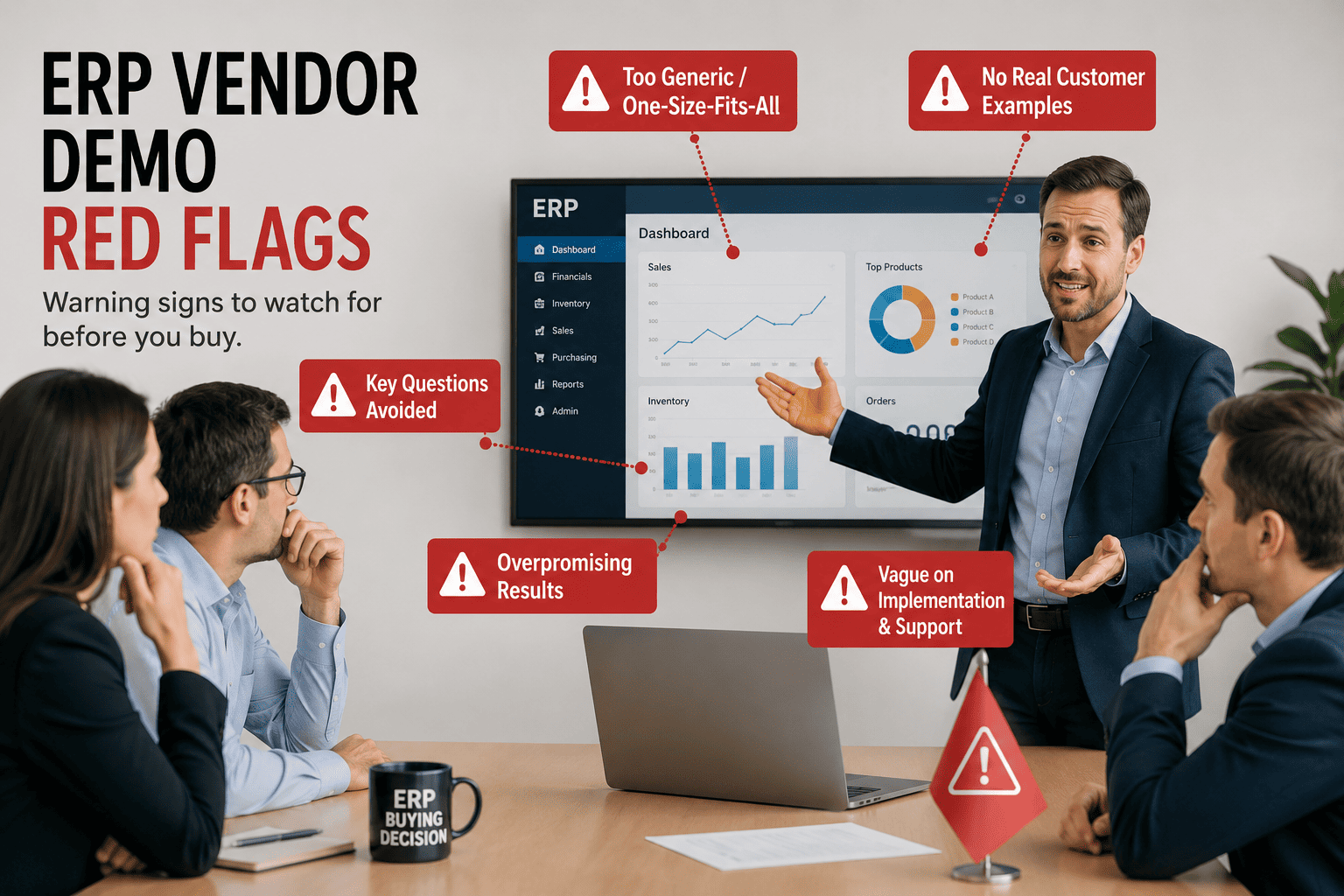
- 5 red flags in ERP vendor demos — what to watch for during demos
- How to choose an ERP in 2026
- Which ERP is right for my business
- How to select an ERP system
Frequently Asked Questions
How many vendors should I evaluate before choosing an ERP?
Most well-run ERP selection processes shortlist 3–5 vendors for deep evaluation, with 2 finalists for reference calls and contract negotiation. Evaluating fewer than 3 means you lose negotiating leverage and confidence in the choice. Evaluating more than 5 wastes your evaluation team's time on platforms that will be eliminated quickly. The discipline is upfront filtering — using your business profile (Question 2) to eliminate tier-mismatched platforms before any vendor call.
How long should ERP selection take?
A disciplined ERP selection process runs 8–16 weeks: 2 weeks of internal requirements work (Questions 1–5), 4–6 weeks of vendor and partner conversations, 2–4 weeks of demo evaluation and reference checks, 2–4 weeks of contract negotiation. Rushing this compresses the evaluation discipline and almost always results in the wrong choice. Dragging it out beyond 6 months typically means the requirements have shifted and the process needs to restart.
Can I do ERP selection without external help?
Yes, but with caveats. Buyers with internal ERP experience, a strong project lead, and disciplined process management can run their own selection. Most first-time ERP buyers underestimate the depth of vendor sales tactics, the cost trap patterns in licence models, and the partner due-diligence required — and end up with avoidable losses. An independent advisor (not affiliated with any vendor) typically pays for themselves on the licence negotiation alone.
What's the biggest mistake buyers make in ERP selection?
Letting the vendor define the problem. Buyers who walk into vendor demos without a written problem statement (Question 1) and a prioritised requirements list (Question 3) get sold the vendor's strongest feature areas regardless of whether those features matter to their business. This is how mid-market services businesses end up evaluating SAP S/4HANA and small businesses end up evaluating NetSuite. Define the problem internally first.
How important is industry-specific ERP fit?
Industry fit matters in proportion to how unusual your operation is. Standard distribution, services, and assembly businesses are well-served by generalist ERPs (NetSuite, Dynamics 365 BC, Acumatica). Process manufacturing, fashion, F&B with traceability, healthcare, and construction often need industry-specific platforms (Infor CloudSuite, Syspro, Acumatica Construction Edition). See our major ERP vendor vs niche ERP guide for the trade-off.
Should I trust analyst rankings (Gartner, Forrester, IDC) when picking an ERP?
Analyst rankings are useful for understanding the competitive landscape but not for choosing your specific ERP. Gartner's Magic Quadrant tells you which vendors are "leaders" in a category — but it does not tell you which leader fits your business profile. A Magic Quadrant leader can be a poor fit for your specific operation, and a "niche player" can be the perfect fit for your industry. Use rankings to filter the candidate set; do not use them to pick the winner.
Take the Next Step
Save this checklist. Print it. Bring it to your next vendor call. Use it to score answers consistently across vendors. The discipline of a written question framework is what separates buyers who get good outcomes from buyers who do not.
And when you are ready to move from "good questions" to "calibrated answer for my business" — that is what the ERPLenz report does, against a 116-point diagnostic specific to your operation.
This checklist is the floor of your evaluation — the report is the ceiling. We built it because no public article can tell you which platform fits your specific business, and we wanted buyers to have an honest path between the two.