Buying Sage Business Cloud: Pricing, Hidden Costs, and the Upgrade Path Buyers Need to Understand
Quick answer: Buy Sage Business Cloud Accounting if you are a UK or Ireland-centric single-entity small business that wants tight HMRC and MTD compliance, an established advisor network, and a familiar Sage feel. Avoid it if you have multi-entity needs, real inventory, complex consolidations, or a clear path past 75 staff — Sage's own answer above that is Intacct, and that is effectively a re-implementation. Realistic Year-1 cost: USD $1,800–$12,000. Best implementation pattern: native Sage Business Cloud plus 2–4 carefully chosen add-ons and no custom development.
Sage's strength is also Sage's most-cited buyer complaint — the product family is huge, fragmented, and confusingly branded. Sage Accounting, Sage 50, Sage 200, Sage 300, Sage Intacct, Sage X3, Sage People, Sage HR — each one a different product, different commercial model, different upgrade path. "Sage Business Cloud" itself has been used as both a product name and a marketing umbrella over time. Buyers regularly sign up for the wrong tier of Sage and then re-implement.
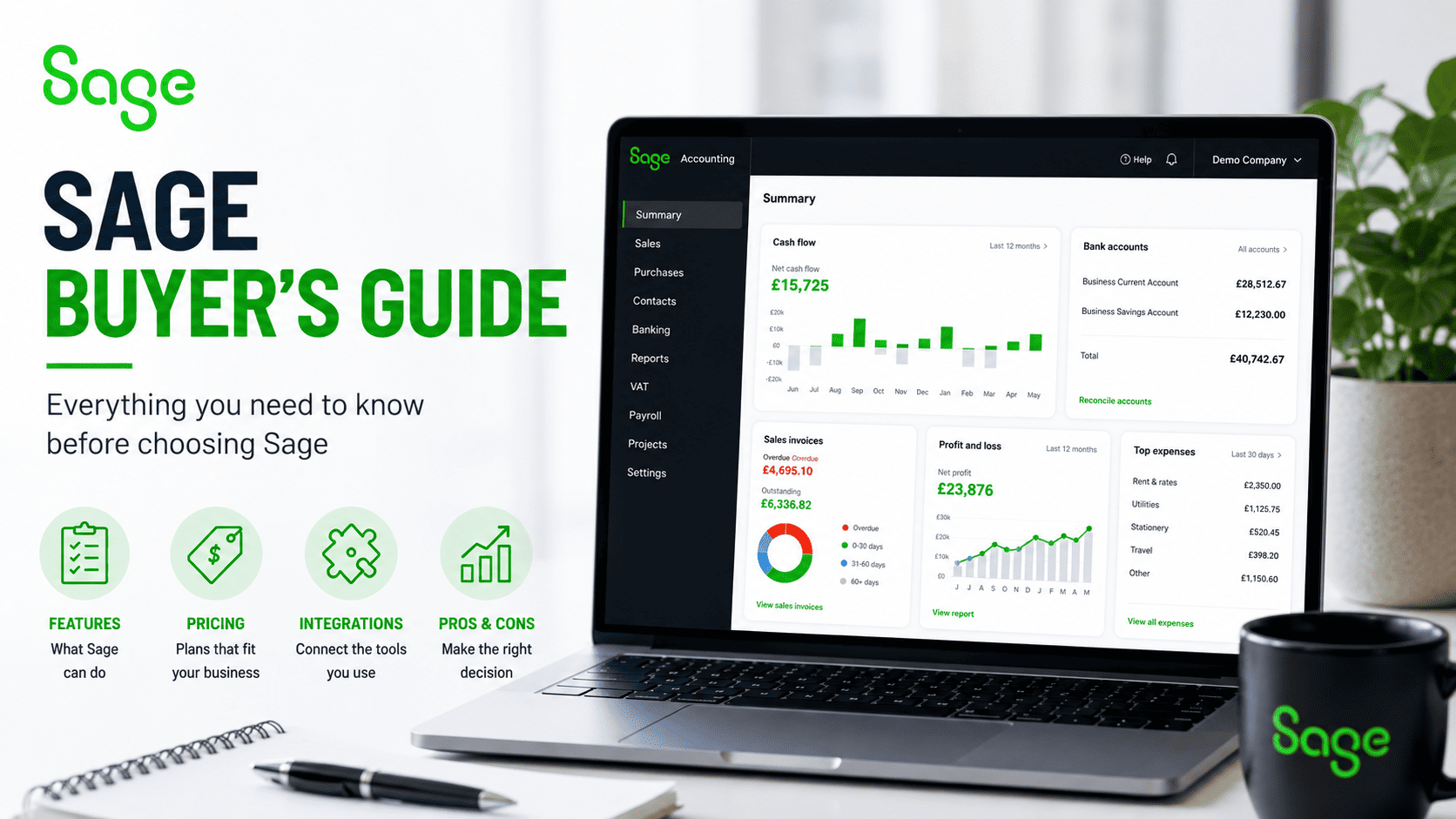
This guide focuses specifically on Sage Business Cloud Accounting (the cloud-native SMB product, sometimes branded "Sage Accounting") — the product Sage now positions as the entry point for small businesses, with Sage Intacct as the mid-market upgrade. The framing applies internationally, with strong UK, Ireland, and South Africa presence; established US, Canada, France, and Spain markets; and limited reach in DACH, Australia, India, and LATAM.
What Is Sage Business Cloud? (And Who's Behind It)
Sage Group plc is a UK-headquartered, FTSE 100-listed software vendor — one of the longest-standing accounting software companies in the world. Sage Business Cloud is the cloud-native product line Sage built (and acquired into) to compete with Xero and QuickBooks at the small-business tier.
The target segment is single-entity micro and small businesses — typically under 50 staff and under USD $10M revenue. Deployment is SaaS only. The on-premises Sage 50 / Sage 100 / Sage 200 products still exist and still have large installed bases, but Sage is actively shifting investment toward the cloud line and toward Intacct at the mid-market.
The strategic context matters. Sage's mid-market answer is Sage Intacct (cloud-native, finance-focused, multi-entity) and its upper-mid-market / international answer is Sage X3 (broader ERP, on-premises or cloud). The upgrade path from Sage Business Cloud to Intacct is not a "tier upgrade" — it is a full migration with new data structures, new pricing model, and typically a new partner. Buyers who assume otherwise get caught.
Sage Business Cloud Pricing in 2026
Sage publishes plan pricing but, like Xero and QBO, the headline number is not the realistic spend once payroll, document capture, and reporting add-ons are layered in. Sage's pricing varies meaningfully by country.
| Cost layer | Range (USD per month) | Notes |
|---|---|---|
| Sage Accounting Start | $15–$25 | Sole trader plan; not for real businesses |
| Sage Accounting Standard | $30–$45 | Mainstream entry plan |
| Sage Accounting Plus | $45–$70 | Adds multi-user and stock tracking |
| Sage Payroll (region-specific) | $15–$60 + per-employee | UK / Ireland / South Africa primarily |
| AutoEntry / Dext | $20–$45 | Document capture |
| Satago | $30–$60 | Debtor management |
| Sicon add-ons (UK) | $40–$200 | Manufacturing / project light extensions |
| Power BI | $10 per user | If using BI on Sage data |
Realistic Year-1 spend for a 15-person UK or AU services firm with payroll and document capture is USD $1,800–$5,000. A 50-person business with stock, debtor management, and reporting add-ons lands USD $6,000–$15,000. For benchmarks across all ERP tiers, see how much does ERP cost.
The pricing is more stable year-on-year than Xero or QBO, but currency volatility and country-specific list price changes still matter. Build a 3-year model that includes annual list-price increases of 5–10% and add-on subscription growth.
Implementation Traps to Know Before You Sign
Sage Business Cloud is typically implemented by an external accountant, bookkeeper, or Sage Business Partner. The traps are different from Xero or QBO because Sage's product family is the trap.
Product fragmentation is the dominant risk. Buyers regularly sign up for "Sage" without clarifying which Sage — Accounting, 50, 200, Intacct, X3 — they actually need. A Sage Business Partner with one product specialisation will tend to recommend that product. Get the specific product name in writing in any proposal.
Legacy product risk is real. Sage 50 and Sage 100 are not being killed, but they are being deprioritised. New investment goes to Sage Business Cloud and Sage Intacct. Buying onto a deprioritised product means slower feature delivery, a shrinking advisor pool, and a forced migration in 5–10 years.
The upgrade from Business Cloud to Intacct is a full migration. This is the single most misunderstood point. Moving from Sage Business Cloud Accounting to Sage Intacct is not a "switch plans" exercise — it is data migration, new chart of accounts, new pricing model (entity-based, not per-user), new partner ecosystem, and typically a 3–6 month project. Plan for it like any other ERP migration. See the ERP data migration guide.
Partner channel quality varies wildly. Sage relies more heavily on its Business Partner channel than Xero or QBO. Some partners are excellent; some are coasting on a 10-year-old Sage 50 practice. Vet specifically against the cloud product, not the partner's broader Sage history.
Native integration depth is thinner than Xero or QBO. Sage has fewer marketplace apps and tends to be configured against a smaller, more carefully selected stack — which is fine, as long as you go in expecting it.
Regional support and localisation are uneven. Sage Business Cloud has full localisation in UK, Ireland, US, Canada, France, Spain, and South Africa. Australia, India, GCC, DACH, and LATAM are weaker — Xero is usually a better fit in those regions.
| Trap | Severity | What it costs you |
|---|---|---|
| Product fragmentation / wrong Sage product | High | Re-implementation cost $5K–$30K |
| Legacy product (Sage 50/100) risk | High | Migration forced within 5–10 years |
| "Upgrade" to Intacct = full migration | High | $30K–$150K project most buyers underestimate |
| Partner channel quality variance | Medium | Project delay, cost overrun, technical debt |
| Limited native integration marketplace | Medium | More expensive custom integration work |
| Regional support and localisation gaps | Medium | Compliance risk in weak-coverage regions |
Partner Questions That Matter
The partner questions for Sage Business Cloud are different from the Xero / QBO playbook. Sage's product family forces these specific clarifications upfront.
- Which Sage product are you recommending — Business Cloud Accounting, Sage 50, Sage 200, Intacct, or X3 — and exactly why this one for our scale and industry? Get the product name in writing.
- What is the upgrade path if we outgrow Sage Business Cloud? Is it Intacct, and what does that migration cost and timeline look like? An honest partner names a real number.
- How deeply do you know this specific Sage product versus the broader Sage family? Sage practices often built up around one product but sell across — confirm specialisation.
- What add-ons or integrations are typically needed for businesses in our industry? Sage's marketplace is smaller; an experienced partner has 3–5 standard recommendations.
- What does your post-go-live support model look like, and what are your SLAs? Sage support is partner-mediated; the partner's SLA is what matters, not Sage's.
If the answer to question one is "Sage" with no product name, you have not yet started a real conversation.
Demo Requests to Insist On
Even at this tier, do not buy on a generic vendor demo. Insist on seeing:
- Bank reconciliation with a representative transaction volume and unmatched items. Watch how exceptions are handled — this is the team's weekly workflow.
- Multi-currency setup and FX revaluation posting. If you trade internationally, get this end-to-end.
- A management reporting pack — P&L, balance sheet, cash flow — built in the native report builder. Sage's reporting depth has improved, but you want to see what you actually get out of the box.
- A new user setup with role-based access controls. Permissions in Sage are configurable but not always intuitive — see the workflow before signing.
If your partner cannot run these live in the demo environment, that gap will show up in the implementation.
Recommended Ecosystem Tools
Sage Business Cloud's ecosystem is smaller than Xero's or QBO's but tighter and more curated. Pick deliberately.
| Tool | What it does | Gap it fills |
|---|---|---|
| AutoEntry / Dext | Document capture, AI-assisted coding | Sage native document handling is limited; these automate AP ingestion |
| Sicon Add-ons (UK) | Manufacturing, projects, budgeting modules for Sage | Sage Business Cloud lacks manufacturing depth; Sicon extends for light production |
| Satago | Debtor management and credit risk scoring | Sage AR chasing tools are basic; Satago adds automated dunning and credit data |
| Sage HR | HR and payroll integration (separate product) | HR capability in Business Cloud is thin; Sage HR fills the gap |
| Power BI | Cross-system dashboards and self-service BI | Sage native reporting is limited; Power BI connects via standard connectors |
| Stripe / GoCardless | Customer payment collection | Sage's native payment options vary by country; these add Direct Debit and card |
Each add-on is a recurring line, an integration risk, and a version-upgrade exposure. The pattern is identical to Xero and QBO — a clean 3–5 tool stack beats a sprawling 10-app stack.
Who Sage Business Cloud Is For (and Who It Isn't)
| Profile | Fit |
|---|---|
| UK / Ireland / SA single-entity small business, 5–40 staff | Strong |
| US / Canada / France / Spain small business | Workable; check partner quality |
| Multi-entity group | Weak — no native consolidation; consider Intacct directly |
| Discrete or process manufacturer | Weak — Sage 200 or X3 is the Sage answer here |
| Distributor with multi-warehouse | Weak — Sage 200 / X3 / Intacct + WMS |
| Australian / Indian / GCC / LATAM small business | Mixed — Xero or local product often stronger |
| Professional services firm needing project costing | Workable with Sicon Projects add-on |
| MTD-driven UK business needing tight HMRC compliance | Strong |
These are general patterns. Your headcount trajectory, geography mix, and industry-specific compliance needs all shift the answer.
Sage Business Cloud vs Alternatives
Within the Micro Business tier, the comparison set is Xero, QuickBooks Online, and Zoho Books. Sage's main strengths over Xero / QBO are UK compliance depth, established advisor presence in Sage's strongest markets, and a coherent upgrade path within the Sage family (Business Cloud → Intacct → X3). The main weaknesses are smaller global advisor pool, smaller marketplace, and the product fragmentation that the Sage brand carries.
For mid-market buyers who have already outgrown the tier — multi-entity, real inventory, manufacturing — the relevant alternatives are not other small-business products. They are Sage Intacct, NetSuite, Business Central, Acumatica, and the rest of the mid-market band. See major ERP vendor vs niche ERP for how to think about the move and how to select an ERP system for the structured evaluation framework.
For capabilities and fit, see the Sage Business Cloud platform profile. Compare it head-to-head: Sage Business Cloud vs Xero, Sage Business Cloud vs QuickBooks Online, Sage Business Cloud vs Sage Intacct.
Frequently Asked Questions
How much does Sage Business Cloud cost in 2026?
Plan pricing runs USD $15–$70 per month per company, before payroll, document capture, and reporting add-ons. A typical 15-person UK or AU services business spends USD $1,800–$5,000 per year all-in. A 50-person business with stock, debtor management, and BI tools lands USD $6,000–$15,000 per year. Sage Intacct, the mid-market upgrade, runs USD $400–$2,000+ per month per entity and is a separate commercial conversation.
Is Sage Business Cloud a real ERP?
No. Sage Business Cloud Accounting is a cloud GL with AR, AP, bank feeds, light stock, and (region-dependent) payroll. It is not an ERP. Sage's actual ERP offerings are Sage Intacct (cloud, finance-focused, multi-entity), Sage 200 (UK / Ireland, broader functional scope), and Sage X3 (mid-market and upper mid-market, multi-country). See when does a business need ERP for the readiness signals.
Who owns Sage?
Sage Group plc is a UK-headquartered, FTSE 100-listed independent software vendor — one of the oldest accounting software companies in the world (founded 1981). It is not owned by a larger group. Sage's recent strategic focus is on cloud-native products (Sage Business Cloud, Sage Intacct) and the migration of legacy on-premises customers onto them.
What is the difference between Sage Business Cloud and Sage Intacct?
Sage Business Cloud Accounting is the entry-level cloud accounting product for single-entity small businesses. Sage Intacct is a true mid-market financial ERP — cloud-native, multi-entity, dimensional accounting, designed for $5M–$100M+ businesses, especially in services and non-profits. Moving from one to the other is a full re-implementation, not a plan upgrade. Most Intacct projects run 3–6 months and USD $30K–$150K in implementation cost.
Can I implement Sage Business Cloud myself?
Yes, and many micro businesses do, especially with a bookkeeper handling chart of accounts setup and opening balances. Typical self-implementation timeline: 1–4 weeks for a single-entity service business. For payroll and add-on integrations, budget 4–10 weeks and USD $2,000–$10,000 in partner fees.
How long does a Sage Business Cloud implementation take?
For a single-entity service business: 1–4 weeks. With payroll and document capture: 4–8 weeks. With Sicon manufacturing or project add-ons plus reporting: 8–16 weeks. See how long does ERP implementation take for tier-wide timelines.
What are the Sage Business Cloud alternatives?
In the same tier: Xero, QuickBooks Online, Zoho Books. One tier up (if you have outgrown small-business accounting): Odoo, ERPNext, Sage 200, Sage Intacct, Business Central, NetSuite. The right alternative depends on which tier your business is actually in, not which one feels familiar.
Will Sage Business Cloud work for a multi-entity group?
Functionally, badly. Each entity is its own subscription. There is no native multi-entity consolidation. For any group with three or more entities, Sage Intacct — designed exactly for this scenario — is the more honest answer, even though the commercial step up is significant.
How ERPLenz Can Help
This guide tells you what Sage Business Cloud is, what it isn't, and where its ceiling sits in general terms. What it cannot tell you is whether Sage — and which Sage product — is the right platform for your business. That depends on geography, entity structure, headcount trajectory, industry, integration footprint, and another hundred variables that only a structured evaluation surfaces.
That is what ERPLenz's reports are built to do. The Essential Report runs your profile against our 116-point evaluation framework and produces a tier-appropriate shortlist with fit scores and a 5-year cost view calibrated to your business. The Deep Report adds regional partner recommendations and a deeper risk-and-readiness breakdown. The vendors above suit different patterns — which one fits your business depends on the variables a proper evaluation surfaces.
Begin your free ERP assessment →
ERPLenz reads "Sage" the way an analyst reads a brand — useful as a signal, useless as a product name. The product name is what you sign for.