Buying Xero: Pricing, Hidden Costs, and the Ceiling Mid-Market Buyers Need to Know
Quick answer: Buy Xero if you run a single-entity, services-led, or light-inventory business under ~50 employees and want clean cloud bookkeeping with a deep app marketplace. Avoid Xero if you have multiple legal entities, manufacturing, complex inventory, or revenue recognition needs — those force a stack of add-ons or a switch to a real ERP. Realistic Year-1 cost with key apps: USD $3,000–$15,000. Best implementation pattern: native plan plus 3–5 carefully chosen ecosystem tools, no custom development.
Xero is the cleanest cloud accounting product in its tier. That is precisely why buyers misuse it. Finance teams adopt Xero at 5 staff, love it, and then try to make it carry the business at 50 staff — at which point the marketplace, the per-entity pricing, and the missing multi-entity consolidation become the operational tax that should have been priced in at year one. This guide is for buyers who want to know what Xero genuinely is, what it costs once the ecosystem is layered in, and where the ceiling sits — so you can decide whether Xero is the right floor for the next three years or whether you are already at the wrong tier.
The framing applies internationally. UK firms come at Xero through MTD compliance; Australian firms through Single Touch Payroll; New Zealand businesses through the platform's home market; US buyers comparing it against QuickBooks Online; and EU, GCC, India, and LATAM buyers usually pair Xero with a regional payroll and tax stack. The traps and the ceiling are the same regardless of geography.
What Is Xero? (And Who's Behind It)
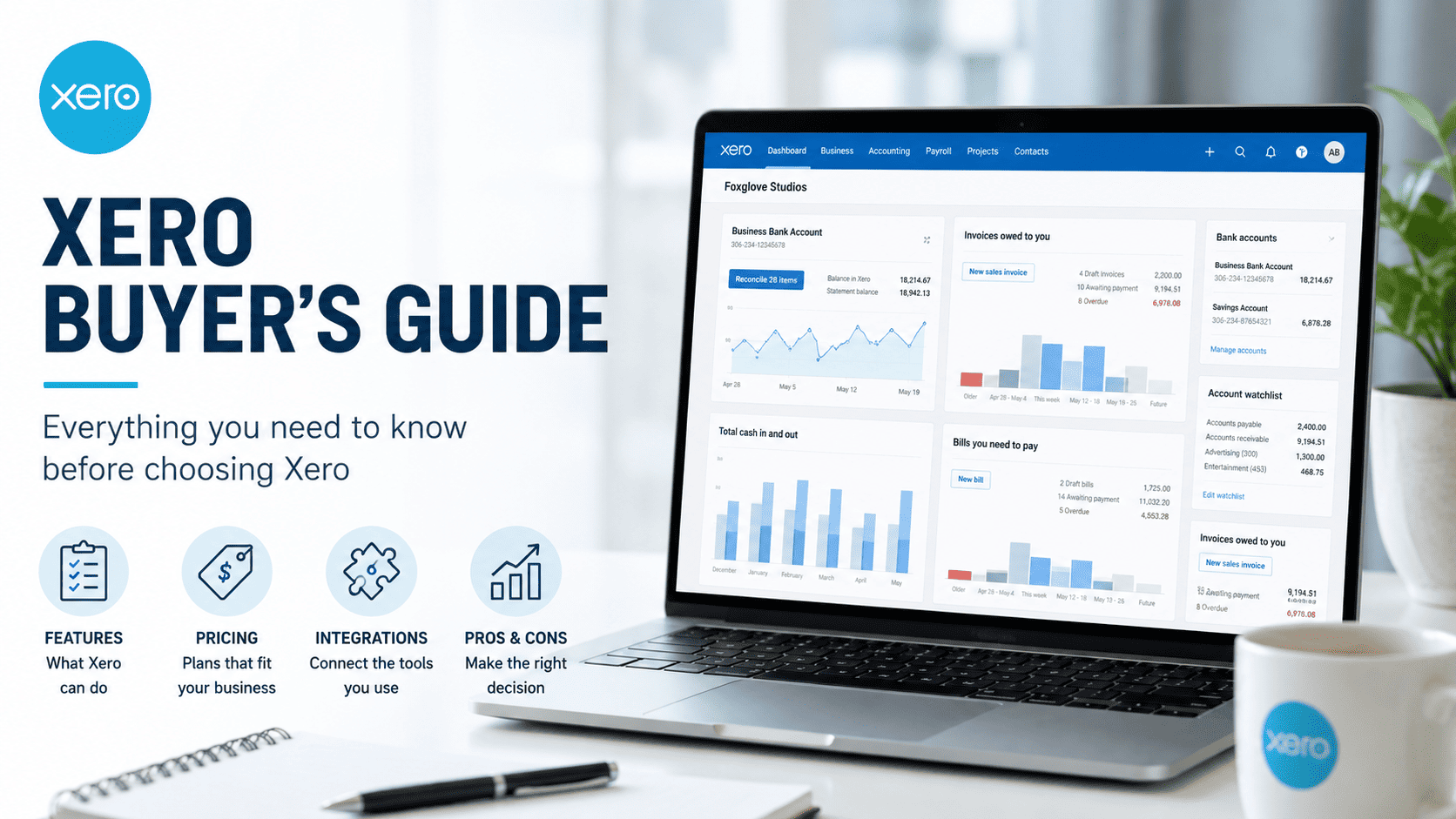
Xero is a cloud accounting platform built in New Zealand and now headquartered in Wellington and Melbourne, listed on the Australian Stock Exchange. It targets micro and small businesses — generally under 50 staff and under USD $10M in revenue — across the UK, Australia, New Zealand, North America, Singapore, South Africa, and selected EU markets.
Deployment is pure SaaS. There is no on-premises version, no private cloud, no enterprise edition. Every customer is on the same multi-tenant platform with a feature set defined by their plan and their country.
Xero's commercial strategy is to be the accounting ledger at the centre of a 1,000+ app marketplace. The platform is deliberately narrow — it does general ledger, AR, AP, bank feeds, light inventory, light payroll (region-dependent), and reporting — and the marketplace is supposed to do everything else. That model is the source of both Xero's strength (composability) and its hidden cost (the bill of apps).
For where this sits in the wider ERP picture, see the Micro and Small Business tiers in the major-vs-niche guide.
Xero Pricing in 2026
Xero publishes plan pricing — a rarity in the ERP world — but the headline plan price is rarely the real number once payroll, inventory, expenses, and reporting add-ons are layered in. Per-entity pricing is the single biggest cost driver as a group grows.
| Cost layer | Range (USD per month) | Notes |
|---|---|---|
| Xero Starter plan | $20–$30 | Capped transaction counts; suits sole traders only |
| Xero Standard / Growing | $40–$70 | The mainstream plan for most micro businesses |
| Xero Established / Premium | $75–$110 | Unlocks multi-currency and project tracking |
| Per-additional-entity | Full plan price again | Each legal entity = separate subscription |
| Payroll (region-dependent) | $10–$50 per pay run / month | UK and AU only natively; US uses Gusto |
| Dext (receipt capture) | $20–$40 | Most firms add this |
| Reporting (Fathom / Spotlight) | $40–$200 | For board-grade reporting |
| Inventory (Cin7 / DEAR) | $200–$600 | Only if doing real stock |
| ApprovalMax | $25–$60 | For PO and invoice approvals |
A realistic Year-1 spend for a 25-person services business with one entity, payroll, expense capture, and decent reporting lands in the USD $3,000–$8,000 range. A 60-person business with two entities, light inventory, and AP approval workflow lands in the USD $10,000–$20,000 range. Add implementation help from a bookkeeper or advisor and you are looking at another USD $3,000–$15,000 for setup. For benchmarks across all tiers see how much does ERP cost.
Xero raises plan prices most years, typically 8–15%. Negotiation leverage is effectively zero — there is no enterprise sales motion at this tier. Build the increase into your three-year model.
Implementation Traps to Know Before You Sign
Xero is not implemented in the way a mid-market ERP is. There is no Statement of Work, no integration partner, no system integrator. But there is a still a meaningful set of traps that catch buyers who treat it as "just accounting software".
Per-entity pricing is the largest hidden cost. Each legal entity is its own subscription with its own users, its own chart of accounts, its own bank feeds. A holding company with three trading subsidiaries pays for four Xero instances and has no native consolidation. The "Xero is cheap" intuition collapses the moment you become a group.
The app marketplace is a budget, not a feature. Xero's headline pricing excludes everything most real businesses need — receipt capture, decent reporting, inventory, AP automation, project costing, and frequently payroll. Each of these is a third-party app with its own user licences, its own integration risk, and its own version-upgrade exposure.
No native multi-entity consolidation. Group reporting must be done in a tool like Fathom, Spotlight, or a spreadsheet. The consolidation is not real-time and it is not auditable to mid-market standards.
Inventory is stock counting, not inventory management. Xero tracks quantities and average cost. It does not do BOMs, work orders, serial or batch tracking, multi-warehouse, or landed cost. The "Xero plus an inventory app" pattern works to about USD $5M of inventory throughput; above that, the integration becomes the single point of failure.
Scaling ceiling is real and arrives quickly. Xero plus add-ons starts breaking around 50–75 staff, multi-entity operations, or any move into manufacturing. The signals are familiar — month-end takes two weeks, the integrations fight each other, the auditor flags reconciliation gaps. At that point you are not "upgrading Xero" — you are migrating to a real ERP. See when does a business need ERP for the readiness signals.
| Trap | Severity | What it costs you |
|---|---|---|
| Per-entity pricing on a group | High | 2–4x subscription cost vs perceived |
| Add-on stack dependency | High | $2K–$15K/year of extra app fees |
| No native multi-entity consolidation | High | Manual close cycle; audit exposure |
| Scaling ceiling at ~50 staff | Medium | Forces full ERP migration earlier than planned |
| App marketplace sprawl | Medium | Integration maintenance burden |
| Annual price increases | Medium | 8–15% per year, no leverage |
| Reporting limits | Watch | Forces Analytics Plus or third-party BI |
Partner Questions That Matter
Most Xero buyers engage a bookkeeper, accountant, or "Xero advisor" rather than a traditional implementation partner. The right questions still apply — they pressure-test whether your advisor has actually scaled a business on Xero or only ever started one.
- How will you handle multi-entity consolidation if we add a second legal entity? Walk me through the manual process and what it costs each month.
- Which third-party apps do you recommend for payroll, inventory, and expenses — and why those specifically over alternatives? An advisor with no opinions has never run the pain.
- What happens to our data if Xero raises prices 30% at renewal? What does a migration to another platform look like?
- Have you implemented Xero for a business in our industry, at our transaction volume? Provide references.
- How do you handle bank feed failures? What is the manual fallback when a feed breaks for a week?
Vague answers ("we'll figure it out", "Xero handles that") are the same red flag as in any mid-market ERP engagement — just at a smaller dollar amount.
Demo Requests to Insist On
Even at this tier, do not buy off a generic vendor demo. Insist on seeing live workflows against realistic data.
- Bank reconciliation with 200+ unmatched transactions. Watch how the matching rules engine performs under volume. This is the workflow your team will do every week.
- Multi-currency invoicing with FX gains/losses posting to the P&L. If you trade internationally, see this end-to-end on the Established / Premium plan.
- Consolidated P&L across two entities. Expect them to say Xero cannot do this natively. Good — that confirms the gap before you sign.
- A live integration to your recommended inventory or AP app. Not a screenshot, not a video — live in the demo environment.
If your advisor cannot run these on the spot, you are buying on faith.
Recommended Ecosystem Tools
Xero's ecosystem is one of the strongest in the SMB accounting world. The risk is layering in five apps when three would do. Pick deliberately.
| Tool | What it does | Gap it fills |
|---|---|---|
| Dext (formerly Receipt Bank) | Receipt and bill capture, AI coding, bank feed integration | Xero's native capture is basic; Dext adds OCR accuracy and approval workflows |
| Fathom / Spotlight Reporting | Board-ready financial reporting, consolidations, KPI dashboards | Xero's reports are functional but limited; these add management and group reporting |
| A2X | Automated ecommerce accounting for Shopify, Amazon, eBay | Xero has no native marketplace settlement accounting |
| Cin7 / DEAR Inventory | Inventory with BOMs, serials, multi-warehouse | Xero inventory is single-warehouse stock counting only |
| ApprovalMax | Multi-step PO and bill approval workflows | Xero has no native approval routing |
| Gusto / Employment Hero | Payroll integrated with Xero | Xero Payroll is region-limited; these handle US, EU, and broader compliance |
| Float / Futrli | Cash flow forecasting and scenario modelling | Xero's projection is rudimentary; these add rolling 13-week and scenario forecasts |
Pricing each app as a recurring annual line item — not a one-off setup cost — is how you build an honest 3-year TCO. For why integration cost is so consistently under-estimated, see ERP integration with existing systems.
Who Xero Is For (and Who It Isn't)
| Profile | Fit |
|---|---|
| Single-entity services business, 5–40 staff | Strong |
| Light retailer with a Shopify store and a 3PL | Strong with A2X + inventory app |
| Multi-entity holding company | Weak — per-entity cost and no consolidation |
| Discrete or process manufacturer | Weak — no MRP, no work orders, no real costing |
| Distributor with multi-warehouse and EDI | Weak — forces a parallel WMS stack |
| Professional services firm needing project costing | Workable with Xero Projects or a third-party PSA |
| Subscription / SaaS company with deferred revenue | Workable only with a billing add-on; ASC 606 / IFRS 15 is not native |
These are general categories, not personalised verdicts. Your industry, geography, deal flow, and integration footprint all shift the answer — which is what a structured evaluation surfaces.
Xero vs Alternatives
Xero, QuickBooks Online, Sage Business Cloud, and Zoho Books all live in the Micro Business tier. They are closer to each other than any of them is to a real ERP. QuickBooks Online has stronger US market depth and broader US-centric integrations; Sage Business Cloud has a stronger UK regulatory pedigree; Zoho Books is dramatically cheaper and works best inside the Zoho One ecosystem.
The genuine "alternative" question for most Xero buyers is not which other accounting tool to pick, but whether they are about to outgrow this entire tier. When that conversation lands, the relevant comparison is not Xero vs QuickBooks — it is Xero vs NetSuite vs Odoo or one of the other true ERP comparisons.
For capabilities and fit, see the Xero platform profile. Compare it head-to-head: Xero vs Zoho Books, Xero vs QuickBooks Online, Xero vs Sage Business Cloud.
Frequently Asked Questions
How much does Xero actually cost in 2026?
Headline plans run USD $20–$110 per month per entity. The true number, once payroll, receipt capture, reporting, and (if relevant) inventory are added, is more like USD $3,000–$20,000 per year for a typical small business. Multi-entity groups multiply the base subscription by entity count. Build a 3-year cost model that includes annual price increases of 8–15% and the realistic add-on stack — not the headline plan price.
Is Xero a real ERP?
No. Xero is a cloud general ledger with strong AR, AP, bank feeds, and a marketplace. It does not do MRP, work orders, advanced inventory, native multi-entity consolidation, or revenue recognition. For any business with manufacturing, complex inventory, or multiple legal entities, Xero is the wrong tier. See when does a business need ERP.
Who owns Xero?
Xero is a publicly listed company headquartered in Wellington, New Zealand and Melbourne, Australia, listed on the ASX (ticker: XRO). It has no single controlling shareholder. The company has been profitable since 2020 and shows no signs of acquisition.
Can I implement Xero myself?
Yes, and most micro businesses do. A bookkeeper or accountant typically sets the chart of accounts, configures bank feeds, imports opening balances, and trains the team — a 1–4 week engagement for USD $1,500–$8,000. Above 25 staff, or for any multi-entity setup, professional setup is the cheaper option in the long run.
How long does a Xero implementation take?
For a single-entity service business: 1–3 weeks. For a small group with two entities and payroll: 4–8 weeks. For a business adding inventory, AP automation, and reporting apps: 8–16 weeks because the bottleneck becomes the ecosystem configuration, not Xero itself. See how long does ERP implementation take for tier-by-tier benchmarks.
What are the alternatives to Xero?
In the same tier: QuickBooks Online, Sage Business Cloud, Zoho Books. One tier up — where you should be looking if you have inventory, manufacturing, or multi-entity needs — Odoo, ERPNext, and SAP Business One sit in the small-business band, with NetSuite, Business Central, and Acumatica in the mid-market band. The right alternative depends on which tier you actually belong in.
Will Xero work for multi-entity businesses?
Functionally, yes — but commercially, badly. Each entity is a separate subscription. Consolidation is manual or via a third-party reporting tool. Intercompany eliminations are not native. By the time a group has three or more entities, Xero plus add-ons usually costs more (in software and finance team time) than a proper mid-market ERP that includes consolidation natively.
Does Xero handle US sales tax or EU VAT properly?
EU VAT, UK VAT (including MTD), and AU GST are handled natively to the extent of standard rates. US multi-state sales tax is not — Xero customers in the US use Avalara or similar. ZATCA e-invoicing, UAE VAT, India GST, and OSS / IOSS regimes require either marketplace add-ons or manual configuration. For tax-heavy international operations, this is a real limitation.
How ERPLenz Can Help
This guide is the educational floor. It tells you what Xero is, what it isn't, and where its ceiling sits in general terms. What it cannot do is tell you, with confidence, whether Xero is the right platform for your business — that depends on your headcount trajectory, your entity structure, your industry, your geographies, and another hundred variables a proper diagnostic surfaces.
That is what ERPLenz's reports are built for. The Essential Report runs your profile against the 116-point evaluation framework and produces a tier-appropriate shortlist with fit scores and a calibrated 5-year cost view. The Deep Report adds regional partner recommendations and a fuller risk-and-readiness breakdown. Use this article to ask better questions; use the report to get a personalised answer.
ERPLenz exists because the loudest voice in an ERP selection should be the buyer's own requirements — not a sales team trained to talk over them.