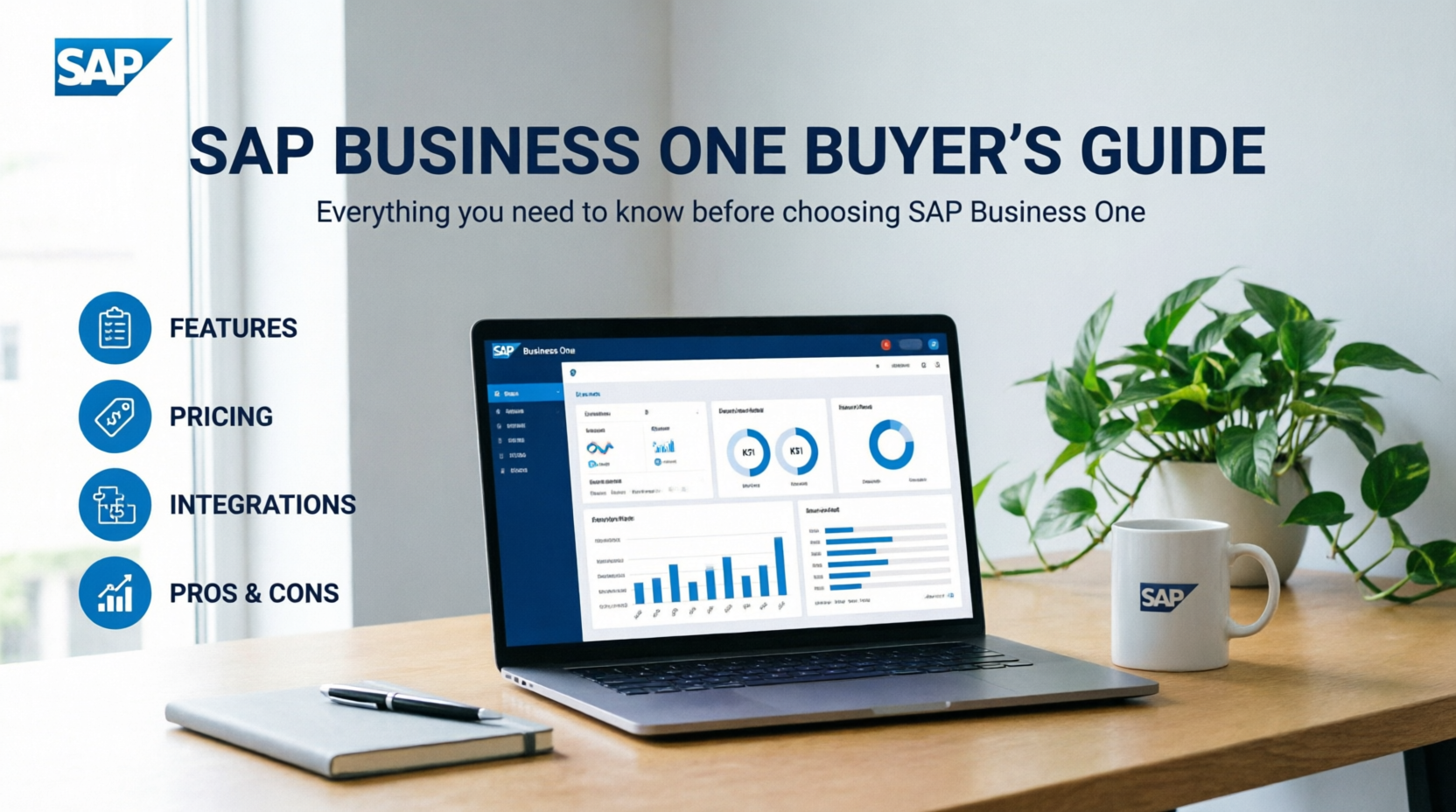
Buying SAP Business One: Pricing, Hidden Costs, and Implementation Traps Before You Sign
Quick answer: SAP Business One (SAP B1) is a mid-market ERP aimed at 75–500 employee businesses with distribution, light manufacturing, or multi-entity finance needs that want the SAP brand without the cost of S/4HANA. Buy SAP Business One if you value an established ERP with a deep partner ecosystem and on-premise or hosted flexibility. Avoid it if you need a modern cloud-native UX, in-house implementation, or fast time-to-value. Realistic Year-1 total: USD 75K–250K. Best implementation pattern: phased, partner-led, with strict customisation governance from day one.
SAP Business One is one of the most-quoted ERPs in mid-market RFPs and one of the most misunderstood. It is not a stripped-down S/4HANA. It is a separate product line that SAP acquired in 2002 (originally TopManage), aimed at businesses too large for QuickBooks or Xero but too small to absorb a multi-million-dollar S/4HANA programme. This SAP Business One buyer's guide covers the pricing reality, the implementation traps the sales deck never mentions, and the partner due-diligence questions that separate a successful deployment from a five-year regret.
If you are still deciding between SAP B1 and a "true" tier-1 SAP product, start with our explainer on how major ERP vendors compare with niche ERPs. For a broader cost framework, our breakdown of how much an ERP really costs maps the line items you will see in every B1 quote.
What Is SAP Business One? (And Who's Behind It)
SAP Business One is SAP's purpose-built ERP for small and mid-sized businesses. SAP sells the product exclusively through a global partner channel — there is no direct-from-SAP sales motion for B1, which is critical to understand because the partner is effectively the vendor. The product is available in three deployment models: traditional on-premise (with the SAP HANA database increasingly required for new deployments), partner-hosted (a partner runs the infrastructure in their data centre or in Azure/AWS), and SAP Business One Cloud (a managed cloud edition with feature parity gaps versus on-premise).
Target segment: businesses turning over roughly USD 10M–100M with operational complexity that QuickBooks Online, Xero, or Zoho Books cannot handle — particularly multi-currency, multi-entity, light manufacturing, or distribution with serial/batch tracking. Geographically, SAP B1 has strong localisation for over 40 countries: UK VAT and Making Tax Digital, EU intrastat reporting, India GST, ZATCA e-invoicing in Saudi Arabia, Brazil's NF-e, and South African VAT among them. This international depth is genuinely a B1 strength relative to QuickBooks or US-centric NetSuite competitors at the same price point.
SAP Business One Pricing in 2026
SAP does not publish list prices for B1. Every quote comes from a partner and is negotiable. The ranges below reflect what mid-market buyers typically see across regions.
| Cost component | Typical range (USD) | Notes |
|---|---|---|
| Per-user licence (Professional, perpetual) | $2,700–3,400 one-off | Plus ~17–22% annual maintenance |
| Per-user licence (Limited, perpetual) | $1,100–1,500 one-off | Read-only / limited transactional roles |
| Per-user subscription (B1 Cloud) | $99–135/user/month | Includes infrastructure |
| Implementation services | 1.5–2.5x licence cost | Partner-delivered; varies by complexity |
| Customisation (certified developer) | $120–220/hour | Mandatory for any deviation from standard |
| Add-on licences (Boyum B1UP, Pepperi etc) | $15–40/user/month each | Multiple add-ons routine |
| Infrastructure (on-prem HANA) | $25K–80K up-front | Plus annual hosting/maintenance |
| Year-1 total (50 users, mid-complexity) | $120K–250K | Excludes hardware and major customisation |
The pattern that catches buyers out: the licence cost looks reasonable, but the partner services and required add-ons routinely double the deal value. Read our full ERP cost breakdown for the categories most quotes underweight, particularly data migration, integration, training, and the post-go-live hypercare period.
Implementation Traps to Know Before You Sign
These are the trap patterns that recur across SAP Business One deployments. None of them are exotic. All of them are well-documented in customer communities and partner retrospectives.
| Trap | Severity | Why it bites |
|---|---|---|
| Implementation cost shock | High | Quotes frequently exceed USD 75K for mid-sized deployments and grow with scope creep |
| Partner dependency (exclusive channel) | High | SAP sells B1 only through partners; you are buying the partner as much as the product |
| Upgrade inertia from customisation | High | Customers stay on old versions for years because customisations make upgrades painful |
| Customisation cost (certified developers) | High | Any deviation requires a certified SAP developer at premium hourly rates |
| Cloud vs on-premise feature split | Medium | SAP B1 Cloud has parity gaps versus on-premise; check your specific functions |
| SAP product family confusion | Medium | Buyers conflate B1 with S/4HANA, RISE, and GROW — there is no upgrade path between them |
| Reporting limitations | Medium | Crystal Reports dependency; advanced analytics require SAP Analytics Cloud at extra cost |
| Cloud scalability ceiling | Medium | Not designed for very high transaction volumes; large operations hit performance issues |
Customisation is the single biggest cost lever
Every B1 partner will quote the licence and base implementation cleanly. The cost that escalates is customisation. B1 customisation typically requires Boyum's B1UP for no-code UI changes or certified SDK development for anything deeper. Both have real costs. More importantly, every custom object you bolt on creates a future upgrade liability. Read our perspective on how much ERP customisation is actually advisable before you sign off on a heavily customised scope.
The partner channel is a feature and a risk
SAP B1's partner-only sales model means every implementation depends on partner quality. SAP grades partners (Silver, Gold, Platinum) but the grading reflects revenue, not necessarily quality. A weak partner can sink a B1 project just as easily as on any other platform. Our guide to choosing an implementation partner versus going vendor-direct walks through the variables that matter.
Upgrade fear is real
B1 customers commonly run versions three or four releases behind current because the cost and risk of upgrading a customised deployment is high. This is not unique to SAP, but it is more pronounced here because of the certified-developer dependency. Plan upgrade strategy at design time, not five years in.
Partner Questions That Matter
A strong B1 partner answers each of these immediately with specifics. Defensive or vague answers are red flags.
- Are you recommending on-premise, partner-hosted, or SAP B1 Cloud, and what is the total 3-year cost difference across the three?
- What is your SAP Business One partner tier, and how many active B1 clients do you currently support in our country?
- B1 customisation requires certified developers at premium rates. Show me your customisation governance process and the last three custom modules you delivered, including how they survived the most recent version upgrade.
- Which add-ons are you recommending for our use case (Boyum, Pepperi, Tasklet, Phocas, others) and what is the total 3-year cost including their licences?
- How do you handle B1 version upgrades for clients with heavy customisations? Show me a recent upgrade plan and the regression test pack.
- What is your Crystal Reports capability? Do you have dedicated report developers or is this subcontracted?
- Can we meet the named lead consultant before signing, and what is their personal B1 implementation track record?
- What is your post-go-live support model, what are your SLAs, and what hourly rate applies to scope outside the SOW?
Demo Requests to Insist On
Vendors love to show their pre-baked demos. Insist on these scenarios live, with your data shapes if possible.
- Bank statement processing and reconciliation. Show automatic matching and exception handling on a real volume — not five rows.
- Manufacturing module with multi-level BOMs. Show a production order, its cost rollup, and variance against standard.
- Crystal Reports built from scratch. Have a developer build a custom financial report live so you can see the development process.
- Service Layer API integration. Show the REST API being called for a scenario relevant to your business (ecommerce, EDI, third-party warehouse).
- SAP Analytics Cloud (SAC) integration. A live dashboard on B1 data, not a marketing slide.
- Add-on coexistence. If they are proposing Boyum B1UP plus another add-on, install both in a sandbox and show them running together.
For more guidance on demo discipline across vendors, see our piece on ERP vendor demo red flags.
Recommended Ecosystem Tools
Almost no SAP B1 deployment runs on the base product alone. The third-party add-on layer is mature and largely unavoidable.
| Tool | What it does | Gap it fills |
|---|---|---|
| Boyum IT B1UP (Usability Package) | UI customisation, workflow automation, no-code forms | B1's standard interface is rigid; B1UP lets admins tailor screens without SDK development |
| Boyum IT B1 Print & Delivery | Automated document distribution and Crystal Report emailing | B1's native document sending is manual; B1 P&D automates invoice and statement runs |
| SAP Crystal Reports | Pixel-perfect financial reports, statements, labels | B1's native reports are basic; Crystal Reports adds formatted print-ready outputs |
| SAP Analytics Cloud (SAC) | Cloud BI, planning, predictive analytics | B1 dashboards are limited; SAC adds self-service BI plus planning and forecasting |
| Power BI | Interactive dashboards via the B1 connector | Strong choice for Microsoft-centric shops needing modern visualisation on B1 data |
| Tasklet Factory | Mobile warehouse management and barcode scanning | B1 WMS lacks mobile scanning depth; Tasklet adds industrial scanning workflows |
| Pepperi | Field sales and B2B ecommerce app | B1 has no native field sales app; Pepperi syncs orders from tablets directly to B1 |
| Phocas | Sales analytics and BI for distributors | Strong pairing for B1 distribution customers needing sales and inventory analytics |
Who SAP Business One Is For (and Who It Isn't)
| Dimension | Strong fit | Weak fit |
|---|---|---|
| Size | 75–500 employees, USD 10M–100M revenue | <50 employees (over-engineered); >500 employees (consider S/4HANA Public Cloud / GROW) |
| Industry | Distribution, wholesale, light discrete manufacturing, multi-entity holding groups | High-velocity ecommerce-only, complex process manufacturing, project-based services |
| Complexity | Multi-currency, multi-country, serial/batch inventory, light production | Pure services, subscription billing, advanced revenue recognition (look at Sage Intacct or NetSuite) |
| Geography | Strong outside the US — UK, EU, APAC, GCC, LATAM all well-localised | US-only buyers may find Acumatica or Dynamics 365 Business Central a better fit |
| IT posture | Comfortable with partner-led delivery and a Windows/HANA infrastructure footprint | Cloud-only buyers wanting iPad-native UX may find B1 dated |
These are general categories. Whether SAP Business One is the right answer for your specific operating model, vertical, and regional footprint depends on dozens of variables that only a structured evaluation surfaces.
SAP Business One vs Alternatives
The most common comparisons at this scale are SAP B1 vs Microsoft Dynamics 365 Business Central, SAP B1 vs NetSuite, SAP B1 vs Acumatica, and SAP B1 vs Odoo Enterprise (for smaller mid-market). SAP Business One is the prototypical "major vendor" product — global brand, deep partner ecosystem, conservative roadmap. Read our framework on major ERP vendor versus niche ERP for the trade-off pattern. If you are running multi-entity, multi-country operations with a small central finance team, also see our coverage on cloud versus on-premise ERP — B1's hybrid options matter here.
For capabilities and fit, see the SAP Business One platform profile. Compare it head-to-head: SAP Business One vs Odoo, SAP Business One vs ERPNext, SAP Business One vs NetSuite, SAP Business One vs Syspro, SAP Business One vs Dynamics 365 Business Central, SAP Business One vs Acumatica.
Frequently Asked Questions
How much does SAP Business One cost?
Realistic Year-1 totals for a 50-user mid-complexity SAP Business One deployment fall in the USD 120K–250K range, including perpetual licences, implementation services, add-ons (typically Boyum B1UP and Crystal Reports), and one round of data migration. Subscription-model SAP B1 Cloud changes the licensing pattern but rarely reduces total Year-1 spend by much because implementation services dominate. There is no published list price — every quote is partner-negotiated. Budget approximately 1.5–2.5x the licence figure for implementation depending on complexity and customisation scope.
Is SAP Business One good for manufacturing?
SAP Business One handles light discrete manufacturing well: BOMs, production orders, work orders, basic shop floor reporting, serial and batch tracking. It is competitive with Microsoft Dynamics 365 Business Central in this band. It is not a fit for complex process manufacturing (chemicals, food and beverage with formula management at scale), repetitive high-volume operations, or shops needing advanced MES integration. For those, SAP S/4HANA, Syspro, or a dedicated process-manufacturing ERP is a stronger answer.
Who owns SAP Business One?
SAP SE owns SAP Business One. SAP acquired the product (then called TopManage) in 2002 and has developed it as a separate product line from SAP ECC and S/4HANA. SAP sells B1 exclusively through certified partners worldwide. There is no direct SAP sales motion for B1, which means your partner is effectively your vendor for the lifetime of the system.
Can I implement SAP Business One myself?
Practically, no. SAP B1 is sold and delivered through certified partners, and the product is not designed for self-implementation. Any customisation requires SAP-certified developers, and the product configuration assumes a partner-led data migration, training, and cutover process. Even shops with strong internal IT typically engage a partner for the build and go-live, then optionally bring some maintenance in-house afterwards. Compare this with Odoo or ERPNext, where partial self-implementation is feasible for smaller operations.
How long does an SAP Business One implementation take?
Realistic timelines for a mid-market SAP Business One deployment run 4–9 months from kick-off to go-live for a single-entity, single-country implementation. Multi-entity, multi-country deployments stretch to 9–18 months. Our detailed view on how long ERP implementation takes covers the variables that compress or expand these ranges, including data quality, customisation scope, integration count, and change-management readiness.
What are the main SAP Business One alternatives?
The most common alternatives in the same mid-market band are Microsoft Dynamics 365 Business Central (similar feature footprint, Microsoft ecosystem, ISV-heavy), NetSuite (cloud-native, stronger for services and subscriptions, more expensive), Acumatica (consumption pricing, US/UK/AU concentration), Sage Intacct (finance-only, no inventory or manufacturing), Odoo Enterprise (cheaper, more flexible, less mature for complex compliance), and Syspro (manufacturing-led, smaller talent pool). The right alternative depends on industry, geography, and operating complexity.
Why is SAP Business One sold only through partners?
SAP's commercial model for B1 is a deliberate channel strategy. SAP focuses direct sales on S/4HANA and enterprise products; B1 reaches mid-market buyers more efficiently through regional and vertical partners. The trade-off for buyers is that partner quality becomes the single largest variable in project outcomes. Two partners delivering the same B1 product can produce very different results, which is why partner due-diligence (certifications, references, named consultant track record) matters more for B1 than for vendor-direct platforms.
Does SAP Business One support multi-entity and multi-currency operations?
Yes — multi-entity and multi-currency are core strengths of SAP B1. The intercompany add-on supports cross-company transactions and consolidation, and the platform handles 40+ country localisations natively (VAT, GST, e-invoicing, statutory reporting). For groups with two to a dozen subsidiaries across multiple countries, B1 is competitive with NetSuite OneWorld and stronger than Acumatica's multi-entity model. For 20+ entities or very high transaction volumes, S/4HANA Public Cloud becomes the more appropriate SAP product.
How ERPLenz Can Help
This guide gives you the SAP Business One landscape: pricing patterns, trap matrix, partner questions, demo discipline, and the ecosystem you will need to layer on. What it does not tell you is whether SAP Business One is the right answer for your specific business — your industry, transaction volumes, geographic footprint, integration map, and operating complexity. That answer comes from a structured evaluation against the 100+ variables that determine fit.
ERPLenz runs that evaluation. Our 116-point diagnostic produces a ranked shortlist of three platforms calibrated to your business, with risk flags per platform, a five-year TCO modelled on your scale and geography, and (in the Deep Report) partner recommendations in your region.
ERPLenz exists because ERP buyers deserve calibrated answers, not vendor brochures. Every platform in this guide has customers who love it and customers who regret it — the difference is whether the fit was diagnosed before the contract was signed.