Buying Sage Intacct: Pricing, Hidden Costs, and the Inventory Gap Mid-Market Buyers Miss
Quick answer: Sage Intacct is a finance-first cloud accounting platform built for services-led, multi-entity organisations — SaaS, non-profits, professional services, financial services. Buy Sage Intacct if you need deep multi-entity consolidation, dimensional reporting, and ASC 606 / IFRS 15 revenue recognition without inventory or manufacturing. Avoid it if you carry stock, run a warehouse, or build product. Realistic Year-1 cost for a 50–150 user deployment lands in the USD $90K–$280K range. Best implementation pattern: phased, finance-first, with a separate operational stack bolted on.
Sage Intacct is one of the most polished finance products in the mid-market — and one of the most consistently mis-sold. It is positioned in many demos as an "ERP". It is not. It is best-in-class accounting and financial management software with a thin operational surface, and that distinction quietly destroys budgets when product-led businesses sign on the assumption that inventory, fulfilment, and manufacturing will somehow be there at go-live.
This Sage Intacct buyer's guide walks through pricing in 2026, the implementation traps that catch buyers off guard, the partner questions that separate good consultancies from mediocre ones, and where Intacct genuinely shines versus where you need a different platform entirely.
What Is Sage Intacct? (And Who's Behind It)
Sage Intacct is the flagship cloud financial management product within the Sage Group plc portfolio, originally founded as Intacct Corporation in 1999 and acquired by Sage in 2017 for around USD $850M. It sits above Sage Business Cloud Accounting and below Sage X3 in Sage's product hierarchy, and Sage actively positions it as the upper end of their mid-market cloud finance offering.
It is a true multi-tenant SaaS product (unlike some legacy Sage tools), is AICPA-preferred for accounting firms in the US, and has strong adoption in SaaS, non-profit, professional services, healthcare, and financial services verticals. Global coverage is strongest in the US, with growing presence in the UK, Australia, and Canada. Localisation outside those geographies — India GST, GCC e-invoicing, ZATCA, LATAM tax regimes — is thinner and typically depends on partner add-ons.
The product family includes core General Ledger, AP/AR, multi-entity consolidation, dimensional accounting, project accounting, contract and subscription billing, and an open API. What it does not include — natively — is inventory management, warehouse management, manufacturing, MRP, or CRM. Those gaps define everything that follows in this guide.
Sage Intacct Pricing in 2026
Sage Intacct uses entity-based and module-based pricing, not user-based pricing in the traditional sense. This is critical: the cost driver is how many legal entities and modules you light up, not the number of accountants logging in. For a fuller picture of mid-market ERP cost components, see our breakdown of how much ERP really costs.
Indicative 2026 ranges (USD, list — almost always negotiable through partners):
| Component | Range | Notes |
|---|---|---|
| Base subscription (single entity, core financials) | $5,000–$15,000 / year | "Starter" deployments rarely stay here once dimensions, AP automation, and reporting modules are added |
| Per additional entity | $2,500–$6,000 / year | Compounds quickly for groups with 5+ subsidiaries |
| Project Accounting module | $4,000–$10,000 / year | Standard for professional services buyers |
| Contracts / Subscription Billing | $8,000–$20,000 / year | Common for SaaS deployments |
| Implementation (mid-complexity, single region) | $40,000–$150,000 | 1.5–3x annual licence is a sensible planning multiplier |
| Implementation (complex, multi-entity, multi-currency) | $150,000–$400,000+ | Salesforce integration and Adaptive Insights push this higher |
| Typical Year-1 total (mid-market) | $90,000–$280,000 | Excludes ecosystem tools listed below |
A few things buyers consistently underestimate. Pricing is not transparent — every quote is negotiated, and renewal escalators of 5–10% per year are common unless capped at signing. Multi-entity cost compounds linearly: a 12-entity not-for-profit federation can spend more on Intacct subscription alone than a single-entity SaaS company spends on its full stack. And because Intacct doesn't carry inventory or operations, you are usually buying two products — Intacct plus an operational system — so always model the combined TCO.
Implementation Traps to Know Before You Sign
Sage Intacct implementations fail less dramatically than NetSuite or S/4HANA implementations, but they fail expensively — usually by going live with a finance system that the operations side of the business cannot use. The traps below repeat across deployments.
| Trap | Severity | What Happens |
|---|---|---|
| "Not a full ERP" mis-sell | High | Buyers assume inventory, fulfilment, manufacturing are included or coming. They are not. Operations end up on a parallel system. |
| Per-entity cost escalation | High | Multi-subsidiary groups discover Year-3 subscription is 2–3x Year-1 as new entities go live. |
| Industry fit constraints | High | Product, manufacturing, retail, and distribution businesses force-fit Intacct and live with painful workarounds. |
| Implementation consulting dependency | Medium | Intacct is not a DIY platform. Internal finance teams cannot implement it without a partner. |
| Dimensional accounting complexity | Medium | The dimensional model is powerful, but badly designed dimensions create a reporting nightmare that's hard to unwind. |
| Premium pricing vs perceived peers | Medium | Buyers comparing to QuickBooks or Xero get sticker shock; comparing to NetSuite, Intacct looks like a bargain. |
| CRM gap | Medium | No native CRM. Salesforce is the standard pairing but adds integration cost and complexity. |
| Security and roles complexity | Watch | User roles, entity permissions, and dimension visibility interact in ways that surprise auditors. |
The single biggest one is the first. If you are a product company evaluating Intacct because your accountant likes it, stop and read our piece on major ERP vendor vs niche ERP — Intacct is a finance-niche product, not a horizontal ERP, and the consequences of treating it like one are structural.
Partner Questions That Matter
Sage Intacct partners range from boutique finance specialists to large generalist consultancies. The quality variance is significant. Before signing a Statement of Work, push on these questions and listen for specifics, not slogans.
- Since Intacct is finance-only, what is your recommended operational stack for our industry, and how will those systems integrate with Intacct? A good partner will name specific products (Cin7, Extensiv, Salesforce, Adaptive Insights), describe the integration pattern, and have references for the combined stack — not just for Intacct alone.
- How does entity-based pricing behave as we add subsidiaries over the next five years? Walk us through the cost model. Vague answers here usually mean the partner has only ever sold single-entity deployments.
- How many Intacct implementations in our specific vertical — SaaS, non-profit, professional services, financial services — have you delivered, and can we speak to two of those clients? Generic references do not count.
- What is your experience with Intacct's Salesforce integration? What does that implementation cost and timeline look like as a separate workstream? Salesforce-Intacct integrations frequently double the implementation budget.
- What is your reporting approach — are you using native Intacct dimensional reports or a third-party BI tool like Adaptive Insights, Power BI, or Workday Adaptive? Partners who lean exclusively on native Intacct reporting often hide its limits.
- What is your governance model for dimension structure? Once we go live, how do we add or restructure dimensions without breaking reports? Dimensional accounting decisions made in week three of an implementation echo for a decade.
For more on the partner-vs-vendor channel pattern across ERP, see our guide on implementation partner vs vendor-direct.
Demo Requests to Insist On
Vendor sales decks always look good. Insist on these live, against your own data where possible.
- Multi-entity consolidation with intercompany eliminations. Time it. A clean consolidation should take seconds, not minutes, for a mid-sized group. If they have to "configure the demo environment first", that is a red flag.
- ASC 606 / IFRS 15 revenue recognition for a subscription billing scenario. Show a contract with multiple performance obligations, modifications mid-term, and the revenue schedule that results.
- Dimensional reporting — build a P&L by department, location, and project in the same view, live. This is Intacct's signature capability. If it takes longer than two minutes, the demo team is not strong.
- Salesforce-to-Intacct integration end-to-end. Create an opportunity in Salesforce, push it through to a customer, contract, invoice, and revenue schedule in Intacct. Watch for manual steps.
- AP automation from email-received invoice to approved payment. Including OCR, coding suggestions, and the multi-step approval workflow.
- The user provisioning and entity-permission model. Add a new user, assign them to two of five entities with read-only access to one and full access to the other, and run a report showing only what they should see.
Recommended Ecosystem Tools
Almost every Intacct customer ends up with a stack — Intacct sits at the centre and surrounding tools fill the operational, planning, and integration gaps. The most common pairings:
| Tool | What It Does | Gap It Fills |
|---|---|---|
| Salesforce | CRM and revenue operations | Intacct has no native CRM; this is the dominant pairing for mid-market services and SaaS |
| Adaptive Insights (Workday) | FP&A, planning, budgeting, rolling forecasts | Intacct's native budgeting is limited; Adaptive adds collaborative planning |
| Expensify or Concur | Travel and expense management | No native T&E; Expensify is the most common pairing |
| Avalara | Sales tax automation | Native tax engine cannot handle US multi-state, UK MTD, EU VAT, AU GST, or India GST complexity at the level required |
| Stampli | AI-driven AP automation | Layered on top of native AP for high-volume invoice processing |
| Floqast | Close management and reconciliations | Adds structured task management to the month-end close |
| Cin7 / Extensiv | Inventory, WMS, fulfilment | The big one — Intacct has no inventory; these tools fill it for product businesses |
That last row is the entire conversation. If you need inventory, you are buying two systems and integrating them. Budget for it.
Who Sage Intacct Is For (and Who It Isn't)
Sage Intacct is purpose-built for finance teams in services-led, multi-entity, dimensionally-complex businesses. It is excellent for them and weak for everyone else.
| Profile | Fit | Why |
|---|---|---|
| SaaS companies, 75–500 employees | Strong | Subscription billing, revenue recognition, dimensional reporting all align |
| Non-profits and federated charities | Strong | Multi-entity, fund accounting, grant tracking are well-served |
| Professional services firms | Strong | Project accounting, time-to-cash, dimensional P&L by client and engagement |
| Financial services and PE-backed portfolio companies | Strong | Consolidation, audit trail, dimensional reporting suit reporting-heavy operating models |
| Distribution and wholesale | Weak | No native inventory — forces a parallel WMS investment |
| Discrete or process manufacturing | Poor | Not designed for BOMs, MRP, shop floor, or production costing |
| Retail with multi-location stock | Poor | No POS, no native inventory, retail vertical functionality absent |
| Construction with project field operations | Mixed | Project accounting is strong but field ops, equipment, and union payroll require add-ons |
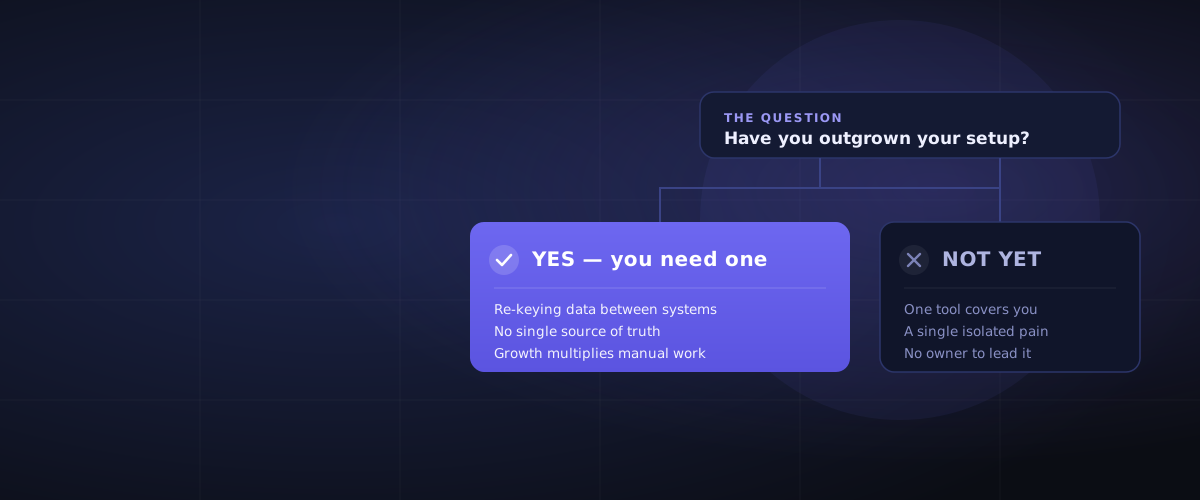
If your business has inventory, your shortlist should not start with Intacct. It might include Intacct plus an operational system, but a unified mid-market ERP — NetSuite, Acumatica, Dynamics 365 Business Central, or an industry vertical — is usually the better path.
Sage Intacct vs Alternatives
The most common Intacct comparisons:
- Sage Intacct vs NetSuite — Intacct is the deeper finance product; NetSuite is the broader operational ERP. Services and non-profit buyers tend to prefer Intacct; product, multi-channel, and global buyers tend to prefer NetSuite.
- Sage Intacct vs QuickBooks Online — different categories. QuickBooks is for sub-$10M single-entity businesses; Intacct is for $10M–$100M multi-entity finance teams.
- Sage Intacct vs Microsoft Dynamics 365 Business Central — BC is a full ERP with inventory and light manufacturing. Intacct is a finance-first product. Product-led businesses lean BC; services-led multi-entity finance teams lean Intacct.
- Sage Intacct vs Workday Financial Management — Workday plays at the upper-mid and enterprise end and bundles HR; Intacct plays squarely in the mid-market finance space.
For the broader question of when to pick a horizontal mid-market ERP versus a finance-niche or industry-niche product, see our major vendor vs niche ERP guide. For deployment trade-offs, see our cloud vs on-premise ERP breakdown.
For capabilities and fit, see the Sage Intacct platform profile. Compare it head-to-head: Sage Intacct vs Sage Business Cloud, Sage Intacct vs NetSuite, Sage Intacct vs Dynamics 365 Business Central.
Frequently Asked Questions
How much does Sage Intacct cost in 2026?
For a mid-market deployment, expect Year-1 totals between USD $90,000 and $280,000, with annual subscription typically running $20K–$80K depending on entities and modules. Pricing is entity- and module-based rather than user-based, so the cost driver is how many legal entities and capabilities you light up. Implementation usually adds 1.5–3x annual licence. Renewal escalators of 5–10% are common unless capped at contract. Multi-entity groups with 5+ subsidiaries and Salesforce integration routinely exceed $200K in Year 1.
Is Sage Intacct a full ERP?
No. Sage Intacct is a cloud financial management and accounting platform, not a horizontal ERP. It has no native inventory management, warehouse management, manufacturing, MRP, or CRM. Sage positions it as the financial core of a best-of-breed stack, with operations handled by adjacent tools (Cin7, Extensiv, Salesforce, etc.). For services-led businesses, this is a feature; for product-led businesses, it is a structural disqualifier. Always confirm whether your operational requirements can be met by integration before signing.
Who owns Sage Intacct?
Sage Intacct is owned by Sage Group plc, a UK-listed business software company headquartered in Newcastle, England. Sage acquired Intacct Corporation in 2017 for approximately USD $850M. Intacct is positioned as Sage's flagship cloud financial management product in the mid-market and is the company's primary growth product alongside Sage X3. The acquisition has been a commercial success for Sage and Intacct has retained its product identity and development cadence post-acquisition.
Is Sage Intacct good for SaaS companies?
Yes — SaaS is one of Intacct's strongest verticals. The combination of contract and subscription billing, ASC 606 / IFRS 15 revenue recognition, dimensional reporting (revenue by product line, region, customer segment), and clean Salesforce integration makes it a natural fit for venture-backed and PE-backed SaaS businesses in the 75–500 employee range. Most growth-stage SaaS finance teams pair Intacct with Salesforce, Adaptive Insights for planning, Expensify for T&E, and Stampli or similar for AP automation.
Can I implement Sage Intacct myself?
Not realistically. Sage Intacct is sold and implemented exclusively through partners, and the platform is configuration-heavy enough that internal finance teams cannot stand it up alone. Even small single-entity deployments typically run 8–16 weeks with a partner. Multi-entity implementations with Salesforce integration and Adaptive Insights are 4–9 month programmes. Choose a partner with deep references in your specific vertical — generalist partners struggle with the dimensional model and industry-specific revenue recognition patterns.
How long does a Sage Intacct implementation take?
Single-entity, finance-only deployments typically go live in 8–16 weeks. Multi-entity deployments with consolidation, intercompany eliminations, and Salesforce integration usually take 4–9 months. Adding Adaptive Insights or a third-party BI layer extends timelines further. The biggest schedule risk is dimensional design — partners who rush this phase to hit a sales-driven go-live date create reporting problems that linger for years. Plan for 3–6 weeks of post-go-live hypercare regardless of project size.
What are the main alternatives to Sage Intacct?
For services and finance-first buyers: Workday Financial Management (upper mid-market and enterprise), NetSuite (broader ERP coverage), Oracle Fusion Cloud ERP (enterprise scale). For product-led mid-market buyers Intacct doesn't suit: NetSuite, Acumatica, Microsoft Dynamics 365 Business Central, SAP Business One, or an industry-vertical ERP. For smaller services businesses: Xero plus a planning tool. The right alternative depends on your operational complexity, entity structure, and industry, which is exactly what a structured evaluation surfaces.
Does Sage Intacct work outside the US?
Yes, but unevenly. Intacct has strong product coverage in the US, UK, Australia, and Canada, with growing capability in continental Europe. Localisation in India (GST), the GCC (ZATCA e-invoicing), LATAM, and parts of APAC is thinner and often relies on partner-built tax modules. Multi-currency and consolidation are solid. If your business has significant operations outside the core English-speaking markets, validate localisation depth carefully in the demo — including statutory reporting, tax filing, and local banking integration (SEPA, ACH, Faster Payments, NPP, UPI).
How ERPLenz Can Help
This guide gives you the structural map of Sage Intacct: where it shines, where it quietly hurts, and what to ask before signing. What it does not do — and cannot do — is tell you whether Intacct fits your specific multi-entity structure, vertical, growth plan, and operational complexity. That is the job of a calibrated evaluation.
ERPLenz runs a 116-point diagnostic against your business profile and produces a ranked shortlist of three platforms, vendor-by-vendor risk flags, a 5-year TCO calibrated to your scale, and (in the Deep Report) partner recommendations in your region. If Sage Intacct is on your shortlist, the report tells you whether its finance-first model is a strength or a structural mismatch for the way your business operates.
Sage Intacct is a brilliant finance product — and an incomplete ERP. Knowing which of those statements matters for your business is the entire decision.