Buying ERPNext: Pricing, Hidden Costs, and Implementation Traps — The Honest 2026 Guide
Quick answer: ERPNext is a genuinely open-source ERP from Frappe Technologies that suits small businesses (10–75 employees, $1M–$10M revenue) with in-house technical capability and a tolerance for less-polished UX. Buy ERPNext if you want true open-source freedom, a transparent codebase, and the lowest licence cost in the small business tier. Avoid it if you need a deep partner ecosystem, polished out-of-box modules for complex jurisdictions, or zero DevOps involvement. Realistic Year-1 total: $25,000–$120,000 for a small business. Best implementation pattern: phased modular on Frappe Cloud with light customisation.
What Is ERPNext? (And Who's Behind It)
ERPNext is a fully open-source, GPL-licensed ERP built on the Frappe Framework by Frappe Technologies, an Indian software company founded by Rushabh Mehta. Unlike Odoo, where the Community edition is a deliberately stripped subset of the commercial product, ERPNext is the same code whether you self-host or pay Frappe for managed hosting on Frappe Cloud.
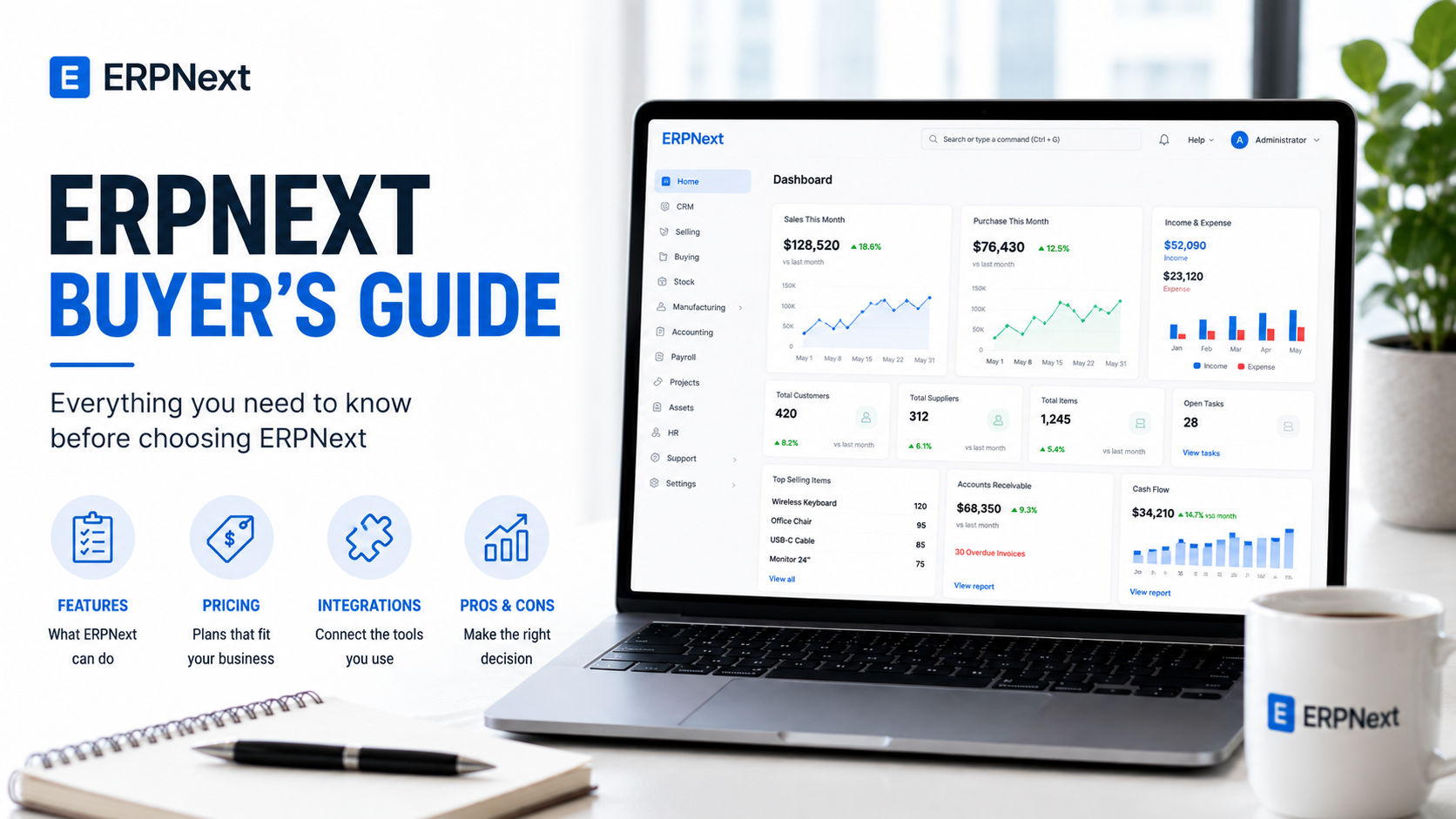
The product covers the classic ERP footprint: accounting, inventory, manufacturing, buying, selling, projects, CRM, HR, payroll, assets, quality, and a growing list of newer apps including Helpdesk, LMS, and a healthcare module. The Frappe Framework underneath is a full low-code platform — DocTypes, workflows, custom scripts, and a REST API are all first-class citizens.
ERPNext competes squarely in the small business ERP tier: 10–75 employees, $1M–$10M USD revenue. Adoption is strongest in India, the GCC, parts of Africa, Southeast Asia, and increasingly in Europe and Latin America. North American adoption is meaningful but the partner network is thinner than Odoo's.
ERPNext Pricing in 2026
ERPNext's licence model is the most transparent in the small business ERP tier: the software itself is free under the GPLv3. You pay for hosting, support, and any custom development.
| Component | Typical range (USD) | Notes |
|---|---|---|
| ERPNext licence | $0 | GPLv3 — same code, hosted or self-hosted |
| Frappe Cloud (managed hosting) | ~$10–50 per user/month equivalent | Bench-based; you pay for resources and apps |
| Self-hosting (cloud infrastructure) | $50–500/month | Plus DevOps time — the real cost |
| Implementation (partner-led) | 1–2.5x annual hosting + support | Lower than Odoo, lower still than NetSuite |
| Customisation (Python/JS apps) | $5,000–$50,000+ | Highly dependent on partner rates and scope |
| Support contract (Frappe or partner) | $5,000–$30,000/year | Critical for production workloads |
| Year-1 total (small business) | $25,000–$120,000 | Hosting choice and customisation drive the range |
These ranges are consistent with the patterns in our ERP cost breakdown. ERPNext's headline cost is the lowest of any real ERP in this tier, but the implementation talent pool is small and that drives partner rates up locally.
Implementation Traps to Know Before You Sign
ERPNext's openness is a genuine strength. It is also where the traps live.
Implementation expertise shortage
The global pool of seasoned ERPNext implementation partners is small compared to Odoo, Dynamics 365 Business Central, or NetSuite. In some regions you have two or three credible partners, and beyond that you are taking project risk. This is the single biggest reason ERP implementations fail on ERPNext.
Module depth gaps in complex jurisdictions
Core accounting and inventory are solid. Payroll, statutory compliance, and tax handling vary widely by country. India and GCC compliance are mature; UK MTD, EU VAT, AU GST, and US multi-state sales tax require either custom apps or third-party integrations.
Customisation lock-in
Heavy customisation through custom apps or modifications to the framework makes future upgrades and partner switches difficult. This is a universal ERP risk, not unique to ERPNext — see our customisation guidance — but the smaller talent pool magnifies the cost of unwinding bad decisions.
UI/UX maturity
The interface has improved significantly with v14 and v15 but still trails the polish of commercial competitors. User adoption can suffer in organisations where staff have come from Xero, QuickBooks, or Dynamics 365 Business Central.
Self-hosting DevOps burden
Self-hosted ERPNext is not "set and forget". You manage Linux, Bench, MariaDB or PostgreSQL, backups, version upgrades, and security patches. Frappe Cloud removes most of this, at a real cost.
Enterprise support gap on community installs
There is no official paid Frappe support unless you are on Frappe Cloud or have a Frappe Care contract. On a self-hosted instance with no partner contract, you are on community forums and Stack Overflow — fine for a hobbyist deployment, dangerous for production.
Scalability ceiling
Performance degrades at high transaction volumes without careful optimisation — indexing, background job tuning, and bench scaling. Most small businesses never hit this, but it is real.
Trap severity summary
| Trap | Severity | Why it matters |
|---|---|---|
| Implementation partner scarcity | High | Smallest credible partner pool in the tier |
| Module depth in some jurisdictions | High | UK, EU, US tax and payroll require effort |
| Customisation lock-in | High | Small talent pool magnifies unwind cost |
| UI/UX polish | Medium | Adoption resistance in some teams |
| Self-hosting DevOps burden | Medium | Real cost if you go off Frappe Cloud |
| Community-only support | Medium | Dangerous for production without a contract |
| Scalability without tuning | Watch | Surfaces only at higher transaction volumes |
These trap patterns repeat across many ERPNext implementations. Which ones will hit your deployment is what a calibrated assessment surfaces against your specific operational profile.
Partner Questions That Matter
Get these answers before you sign anything:
- Are you recommending self-hosted, Frappe Cloud, or a managed third-party provider — and what is the full annualised infrastructure cost? This is the single biggest cost variable.
- How do you handle version upgrades on heavily customised ERPNext instances? Frappe releases major versions roughly annually. Ask for examples of upgrades they have managed on production systems with custom apps.
- What is your support SLA, and how do you handle critical production issues outside business hours? ERPNext does not have a 24/7 vendor desk — your partner is the desk.
- What is your version control standard for custom development? Git, branching strategy, code review, deployment process. Informal answers here predict pain later.
- Which ERPNext modules in our industry do you typically supplement with third-party tools? Honest partners will tell you which modules they would not deploy as-is for your use case.
- Can you provide three references at our size and industry whose ERPNext is still in production after two years? Long-running production references are the only meaningful test.
A serious ERPNext partner answers these crisply. Hand-waving on hosting or support is a partner red flag.
Demo Requests to Insist On
Make them prove it in your environment, not theirs.
- Full procure-to-pay cycle. Three-way PO matching, supplier invoice, payment, automatic journal entries. Watch the GL postings live.
- Payroll for your jurisdiction. Built-in compliance vs custom configuration — for any country outside India and the GCC, this will surface gaps quickly.
- Build a custom P&L by cost centre from scratch. Tests the native report builder and the partner's familiarity with it.
- Live version upgrade on a test instance with custom apps installed. This is the single best test of upgrade discipline.
- Bank reconciliation with a representative transaction volume. Show the matching engine and exception handling.
If they cannot demo any of these live, treat the gap as confirmed.
Recommended Ecosystem Tools
Almost every production ERPNext deployment leans on a few third-party tools.
| Tool | What it does | Gap it fills |
|---|---|---|
| Frappe Cloud | Managed hosting with backups and upgrades | Removes the DevOps burden of self-hosting |
| Power BI / Metabase | Advanced BI | Native reports work but the report builder is technical; BI tools add self-service |
| Stripe / Razorpay / Adyen | Payment gateways | Native options vary by region; gateway integrations improve checkout reliability |
| Twilio | SMS automation | Trigger order updates, invoice reminders, alerts |
| WooCommerce / Shopify connector | Ecommerce sync | Native ecommerce exists but external storefronts handle complex channel management better |
| Country-specific tax apps | Localised compliance | Fills MTD, VAT, GST, sales-tax gaps outside India/GCC |
Plan for these in Year-1, not as a Year-2 surprise.
Who ERPNext Is For (and Who It Isn't)
| Dimension | Strong fit | Weak fit |
|---|---|---|
| Headcount | 10–75 employees | 200+ at high transaction volume without tuning |
| Revenue | $1M–$10M USD | <$1M (over-engineered); >$25M (depth gaps) |
| Industry | Distribution, light manufacturing, services, education, healthcare admin | Complex process manufacturing, regulated pharma, large multi-entity finance |
| Geography | India, GCC, AU, parts of EU, Africa, SEA; cautious in US/UK | Heavy US multi-state sales tax without ecosystem tools |
| Technical maturity | In-house IT or a credible partner | Zero-IT, zero-partner shops |
| Customisation appetite | Disciplined and version-controlled | Anything goes |
ERPNext rewards businesses that approach it as a real platform requiring real governance. It punishes businesses that treat "open source" as "free".
ERPNext vs Alternatives
The natural peers at the small business tier are Odoo (broader app catalogue, larger partner ecosystem, per-app pricing) and Zoho One (broader suite, lighter ERP depth, all-or-nothing licensing). Dynamics 365 Business Central and SAP Business One sit one tier up — far more polished and far more expensive.
For an honest read on horizontal versus industry-niche platforms, the major-vendor vs niche-ERP guide lays out the trade-offs. If you're comparing ERPNext against NetSuite or Dynamics 365, you're really weighing licence-cost savings against partner-ecosystem depth — both are legitimate trade-offs depending on your situation.
The right way to read this comparison space is structurally: each platform suits different patterns, and which one fits your business depends on dozens of variables a proper evaluation surfaces.
For capabilities and fit, see the ERPNext platform profile. Compare it head-to-head: ERPNext vs Odoo, ERPNext vs SAP Business One, ERPNext vs Syspro.
Frequently Asked Questions
How much does ERPNext cost?
The software is free under GPLv3. You pay for hosting and support. Frappe Cloud, the official managed service, costs roughly $10–50 per user per month equivalent depending on resources and apps. Self-hosting is cheaper in licence terms but costs real DevOps time. A typical small business Year-1 total — hosting plus implementation plus customisation — runs $25,000–$120,000 USD. That is the lowest of any genuine ERP in the small business tier, but partner rates in regions with thin ERPNext supply can erode the saving.
Is ERPNext truly open source?
Yes. ERPNext is licensed under the GNU GPLv3. The codebase is hosted publicly on GitHub, the Frappe Framework underneath is also GPLv3, and there is no "Community vs Enterprise" feature gap as exists with Odoo. The same code runs on Frappe Cloud and on your own server. Frappe Technologies, the vendor, makes its money from hosting, support contracts, and partner enablement — not from gating features behind a commercial licence.
What are ERPNext's main pros and cons?
Pros: genuinely open source, transparent codebase, no licence cost, broad ERP footprint, strong India and GCC compliance, decent low-code framework, lowest Year-1 cost in the small business tier. Cons: small global partner pool, uneven module depth across jurisdictions, UI polish trails commercial competitors, self-hosting requires real DevOps, community-only support without a paid contract, and customisation lock-in is magnified by partner scarcity. Open-source freedom is also its biggest discipline test.
Who owns ERPNext?
ERPNext is developed and maintained by Frappe Technologies, a privately held software company based in Mumbai, India, founded by Rushabh Mehta in 2008. Frappe also makes the Frappe Framework, Frappe Cloud, and a growing suite of apps including Frappe HR, Frappe CRM, and Frappe Insights. Unlike Odoo S.A. or Oracle (NetSuite), Frappe Technologies is a small, focused company — under 200 employees as of 2026 — which is both a charm and a risk depending on your appetite.
Can I implement ERPNext myself?
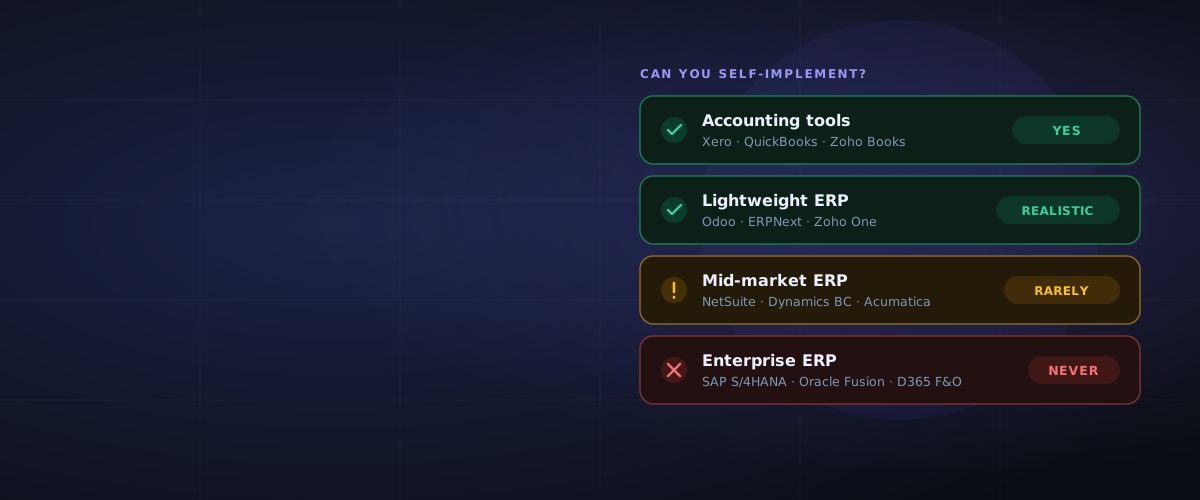
For a single-entity, low-complexity small business, technically yes — and a meaningful fraction of ERPNext users do exactly this on Frappe Cloud. The risk of DIY is not the install; it is the chart of accounts design, the localisation, the workflows, and the security model becoming expensive to unwind later. For anything beyond a 5-user finance-only deployment, a credible partner pays for itself. The phased modular rollout pattern suits ERPNext well.
How long does ERPNext implementation take?
A small business ERPNext implementation typically runs three to five months for finance plus one operational module, and six to nine months for a fuller multi-module rollout. Manufacturing scopes and heavily-customised payroll add time. Frappe Cloud removes infrastructure setup from the critical path. Realistic ERP timelines across vendors are in how long ERP implementation takes. The biggest schedule risk on ERPNext is custom app development scope creep.
What are ERPNext's main alternatives?
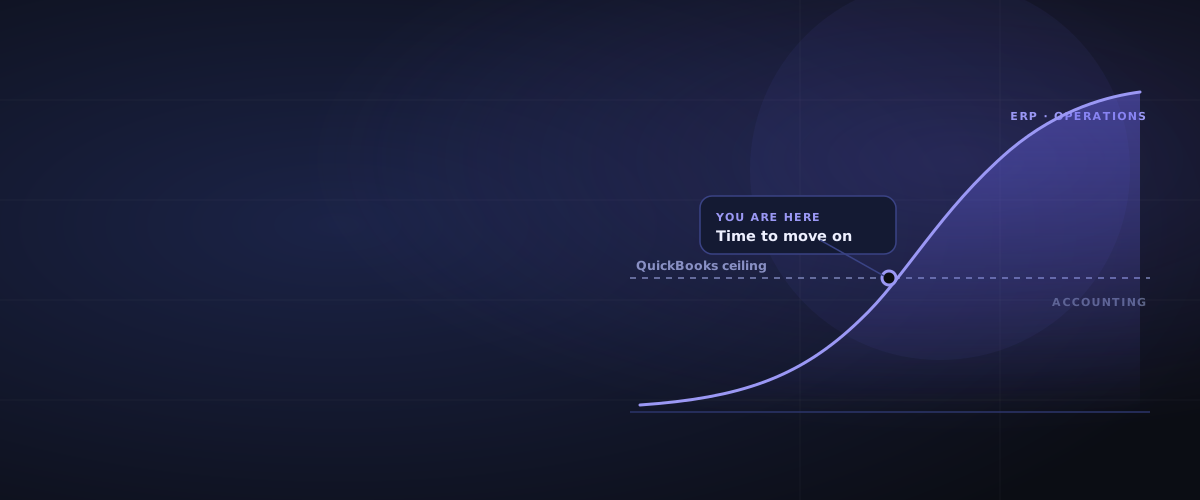
At the same tier, Odoo is the most common direct comparison (broader partner ecosystem, per-app pricing, annual major releases). Zoho One sits adjacent (broader suite, lighter ERP depth, all-or-nothing user licensing). One tier up, Dynamics 365 Business Central and SAP Business One offer more polish and far more partner depth at significantly higher cost. For pure accounting, Xero, QuickBooks Online, and Zoho Books sit below it — but they are not ERPs and stop being viable once you have multiple entities or real inventory complexity.
Does ERPNext work for international businesses?
Yes, but compliance depth varies. India, GCC, Saudi ZATCA, and increasingly UAE VAT are mature. UK MTD, EU VAT (including OSS/IOSS), AU GST, and US multi-state sales tax typically require either a custom app, a community module, or a third-party integration. Multi-currency and multi-company are core features and do work. The bigger international constraint is partner depth: in some regions there are simply few credible ERPNext implementers, which limits your local delivery options.
How ERPNext Can Help
ERPLenz is not a Frappe partner. We do not earn referral fees from Frappe Technologies, from Frappe Cloud, or from any ERPNext implementer. We help small and mid-sized businesses run a structured evaluation against their specific operational profile so the choice — ERPNext, Odoo, Business Central, NetSuite, or none of the above — is calibrated rather than guessed.
The ERPLenz diagnostic takes your business through a 116-point assessment and produces a ranked shortlist of three platforms with fit scores, a 5-year TCO calibrated to your situation, and risk flags per platform. Read this guide as the floor of your evaluation, not the ceiling.
We earn nothing if you choose ERPNext, nothing if you choose Odoo, and nothing if you decide to stay on Xero for another two years — our only output is a defensible answer for your specific business.