Buying Odoo: Pricing, Hidden Costs, and Implementation Traps to Know Before You Sign
Quick answer: Odoo is a modular open-source ERP suited to small businesses (10–75 employees, $1M–$10M revenue) that need genuine ERP breadth at a far lower licence cost than NetSuite or Dynamics 365. Buy Odoo if you have disciplined in-house IT, a strong partner, and the appetite to govern customisations through major version upgrades. Avoid it if you need turnkey configuration, deep manufacturing costing, or a stable platform you will not touch for five years. Realistic Year-1 total: $40,000–$180,000 for a small business deployment. Best implementation pattern: phased modular, starting with finance and one operational module.
What Is Odoo? (And Who's Behind It)
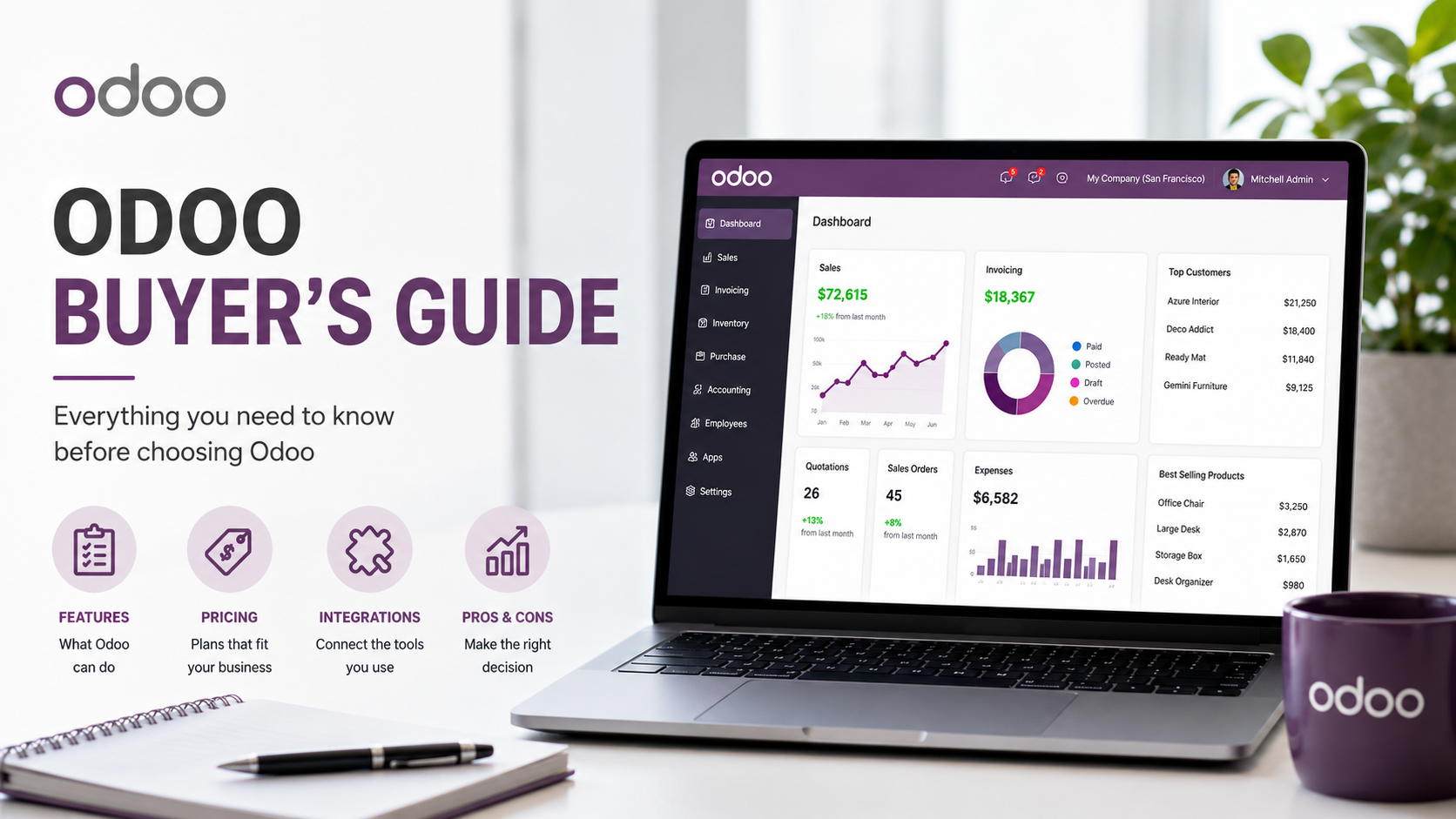
Odoo is a Belgian-headquartered ERP suite owned by Odoo S.A., now used by reportedly over twelve million users globally. It started life as TinyERP in 2005, rebranded to OpenERP, and is now one of the most widely deployed open-source business platforms on the market.
Odoo ships in two editions:
- Odoo Community — free, open-source, capped feature set, self-hosted
- Odoo Enterprise — paid, includes accounting localisations, multi-company, studio, mobile, and most "real ERP" features
Both editions share a modular architecture: you activate apps (Accounting, Inventory, Manufacturing, CRM, HR, Project, Ecommerce, Helpdesk, and dozens more) as you need them. This modularity is Odoo's biggest selling point and the source of most of its hidden costs.
Odoo competes in the small business ERP tier: 10–75 employees, $1M–$10M USD revenue. It is widely deployed across Europe, Latin America, India, Africa, Australia, and the Middle East, with thinner partner coverage in North America compared to NetSuite or Dynamics 365 Business Central.
Odoo Pricing in 2026
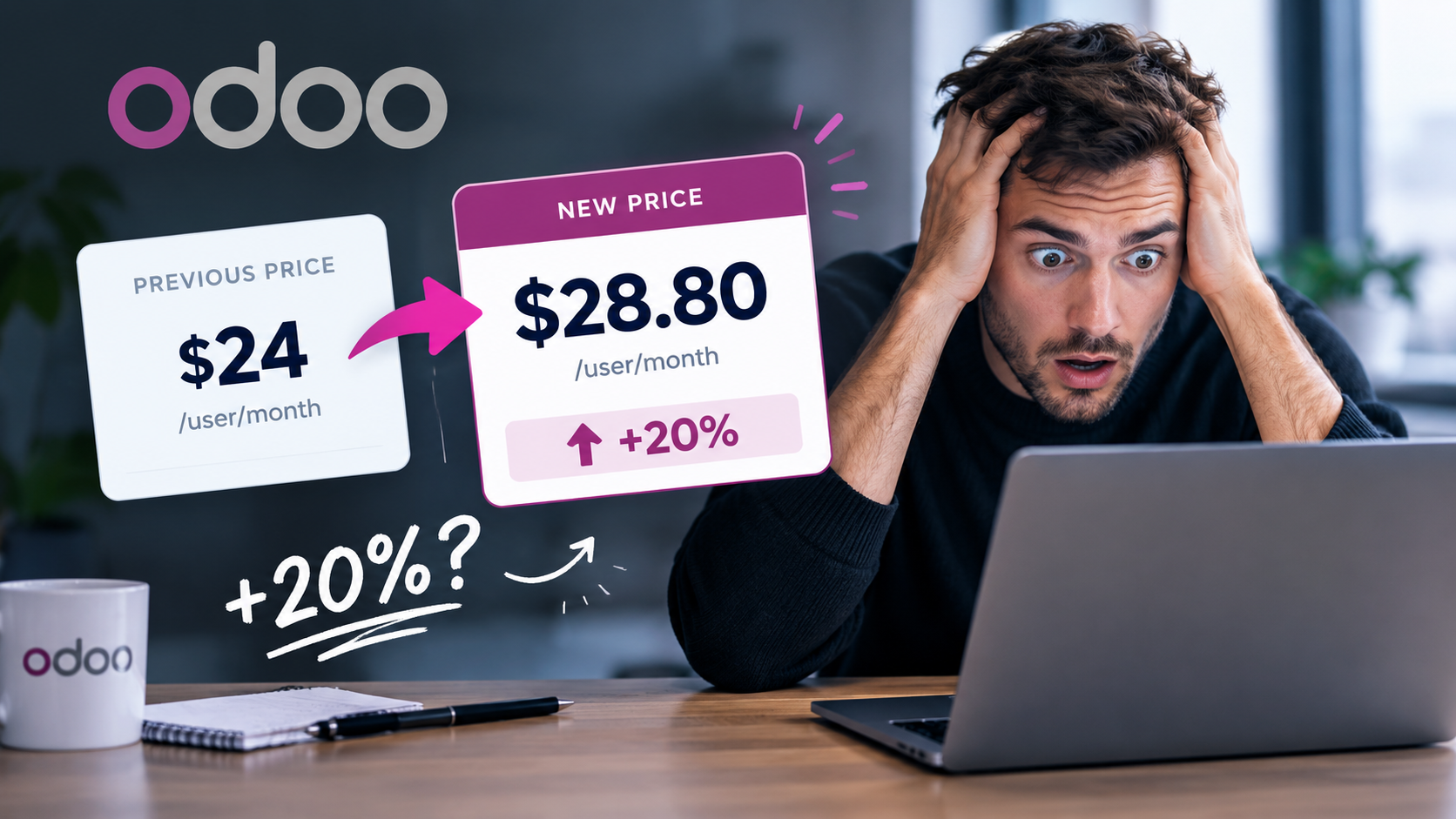
Odoo publishes list prices, which makes it unusual among ERPs. The Enterprise edition is sold per user per month, plus a per-app charge above the "Standard" bundle, plus hosting if you take Odoo.sh or a partner-managed instance. Community remains free to download but is rarely used in production for serious businesses because the missing features end up costing more in workarounds than the Enterprise licence would.
| Component | Typical range (USD) | Notes |
|---|---|---|
| Odoo Community licence | $0 | Self-hosted only; no official vendor support |
| Odoo Enterprise — Standard plan | ~$25–35 per user/month | All apps included on Odoo Online hosting |
| Odoo Enterprise — Custom plan | ~$38–58 per user/month | Required for Odoo.sh or on-premise + Studio + external API |
| Implementation (partner-led) | 1.5–3x annual licence | Lower multiplier than mid-market ERPs, higher than QuickBooks |
| Customisation (Python/XML modules) | $8,000–$60,000+ | Depends on scope and partner rates |
| Version upgrade (every 1–2 years) | $5,000–$40,000 | Significant if you carry custom modules |
| Year-1 total (small business) | $40,000–$180,000 | Broad range driven by users, apps, customisation |
These ranges align with the patterns in our full ERP cost breakdown. Odoo's published list price is genuinely lower than most competitors at the small business tier, but version-upgrade costs and partner quality variance are where total cost of ownership balloons.
Implementation Traps to Know Before You Sign
Open-source does not mean free, and modular does not mean simple. Odoo has its own trap matrix that experienced buyers either price in or get burned by.
Community vs Enterprise gap
Critical features are locked behind Enterprise: multi-company, advanced accounting, Studio for low-code customisation, mobile apps, official localisations, and most premium app variants. Many businesses are sold Community as the "free start", discover the feature gap six months in, and then pay to migrate up.
Per-app pricing creep
On the Custom plan, Enterprise pricing is per user and per app above the base. A 20-user business that activates Accounting, Inventory, Manufacturing, Purchase, Sales, CRM, HR, Project, Studio, and Helpdesk can quickly find its monthly bill triple the headline per-user rate.
Version-upgrade pain
Odoo ships a major release annually (15 to 16 to 17 to 18 and so on). Each upgrade can break custom Python/XML modules. Businesses that customise heavily and skip several versions face a project-sized re-engineering exercise to catch up. This is the single biggest source of ERP customisation regret on Odoo.
Partner quality variance
The Odoo partner ecosystem is enormous and inconsistent. A "Gold" badge does not guarantee competent delivery — it largely reflects sales volume. Two partners quoting the same scope can deliver vastly different outcomes.
Manufacturing and costing depth
Odoo's manufacturing module is functional and improving, but for complex discrete or process manufacturing — multi-level routings, capacity planning, actual-vs-standard variance analysis at granular cost centre level — it lags purpose-built mid-market ERPs.
Reporting immaturity
Native financial reporting is weaker than NetSuite or Sage Intacct. Most serious Odoo users pipe data into Power BI or Tableau via ODBC for board-level reporting.
Trap severity summary
| Trap | Severity | Why it matters |
|---|---|---|
| Community vs Enterprise feature gap | High | Multi-company and Studio locked behind paid tier |
| Customisation technical debt | High | Python/XML modules block upgrades over time |
| Version upgrade fragility | High | Breaks custom code; annual cadence is aggressive |
| Partner quality variance | High | Largest single risk to project success |
| Per-app pricing compounding | Medium | Total Enterprise cost often 2–3x headline |
| Manufacturing depth limits | Medium | Insufficient for complex production scenarios |
| Self-hosting DevOps burden | Medium | Real cost if you go off Odoo.sh |
| Reporting immaturity | Watch | Solvable with BI tool, but adds stack complexity |
These trap patterns repeat across many Odoo implementations. Which ones will hit your deployment depends on your industry, your customisation appetite, and the specific partner you choose.
Partner Questions That Matter
Before you sign a Statement of Work with any Odoo partner, get clear answers to these:
- Community or Enterprise — and why? Make them justify the recommendation against your specific feature requirements, not your hypothetical future ones.
- What is the per-user, per-app, per-year total licence cost over three years? Get the line items, not just the monthly figure.
- How many Odoo major version upgrades have you personally led, and what was the average customisation migration effort? This separates partners who have lived through 15-to-16-to-17 from partners who have only ever done greenfield builds.
- What is your governance policy for custom module development? A serious partner uses Git, code review, automated testing (Runbot or equivalent), and documented module manifests. An informal partner edits Python on a production server.
- Who specifically is the lead consultant, and how many Odoo implementations have they personally delivered? Meet that human before you sign. Partner red flags around delivery teams are covered in the partner vs vendor-direct guide.
- What is your certified Odoo partner tier, and how many active production clients do you currently support at our size? Logos on a website are not references.
A strong Odoo partner answers these immediately with specifics. Vague answers — "we'll figure that out in discovery" — are a red flag.
Demo Requests to Insist On
Vendors and partners default to a polished script. Force them off it.
- Bank reconciliation with 300 transactions. Show the automatic matching rate live, not a curated set of perfectly matched lines. Look at the manual fallback for unmatched items.
- Multi-company consolidation with intercompany eliminations. This is where many Community-edition users discover they are on the wrong tier.
- Live version upgrade on a test environment. Move from the current version to the latest with their proposed customisations installed. Watch what breaks.
- Manufacturing with multi-level BOMs, work orders, and production costing. If you make anything, the demo BOM should resemble your actual product.
- Build a custom field in Studio live. Show the field flowing through to a report. This tests both Studio's real power and the partner's familiarity with it.
If they cannot demo any of these live, assume the gap is real and price it into your decision.
Recommended Ecosystem Tools
Almost every serious Odoo deployment ends up with a few third-party tools layered on. Budget for them upfront rather than discovering them in month nine.
| Tool | What it does | Gap it fills |
|---|---|---|
| Cleverence / Scandit | Mobile barcode warehousing | Odoo's WMS scanning is functional but slow; dedicated scanners add speed and offline resilience |
| Odoo Localisation Packs | Country-specific tax, VAT, chart of accounts | Base Odoo is generic — UK MTD, EU VAT, AU GST, India GST, ZATCA all need local packs |
| OCA modules | Open-source community add-ons | Fills functional gaps without Enterprise pricing; check version compatibility carefully |
| Stripe / Adyen / Razorpay | Payment gateways | Native support exists; configuration is non-trivial for SEPA, ACH, NPP, UPI |
| Runbot (Odoo testing) | Automated CI for custom modules | No native CI/CD; Runbot tests custom code before deployment |
| Power BI / Tableau via ODBC | Advanced BI dashboards | Native reporting lacks visual depth and consolidated cross-module views |
| Cognito Forms / JotForm | External form data capture | Native portal forms are limited for complex public-facing capture |
Plan these into Year-1 total cost of ownership, not as a Year-2 surprise.
Who Odoo Is For (and Who It Isn't)
| Dimension | Strong fit | Weak fit |
|---|---|---|
| Headcount | 10–75 employees | 200+ employees pushing transaction volumes |
| Revenue | $1M–$15M USD | <$1M (over-engineered) or >$30M (depth gaps) |
| Industry | Distribution, light manufacturing, services, ecommerce | Complex process manufacturing, regulated pharma, multi-billion enterprise |
| Geography | EU, LATAM, India, AU, MENA, Africa, parts of US | Heavy US multi-state sales tax without Avalara |
| Technical maturity | In-house IT or strong partner | Zero-IT shop wanting turnkey SaaS |
| Customisation appetite | Disciplined, governed | Anything goes |
Odoo rewards businesses that treat it as a serious platform with proper governance. It punishes businesses that treat it as a cheap shortcut.
Odoo vs Alternatives
If you're weighing Odoo against bigger platforms, the most common comparison is with NetSuite — we cover that head-to-head in NetSuite vs Odoo.
Other realistic comparisons at the small business tier include ERPNext (more open, fewer partners, less polished), Zoho One (broader app suite, weaker ERP depth, all-or-nothing licensing), and Dynamics 365 Business Central (more turnkey, much higher licence cost, Microsoft ecosystem lock-in).
For the broader landscape of major-platform versus industry-niche choices, the major-vendor vs niche-ERP guide lays out the trade-offs.
For capabilities and fit, see the Odoo platform profile. Compare it head-to-head: Odoo vs ERPNext, Odoo vs SAP Business One, Odoo vs Dynamics 365 Business Central, Odoo vs Zoho One.
Frequently Asked Questions
How much does Odoo cost?
Odoo Community is free to download. Odoo Enterprise lists at roughly $25–35 per user per month on the Standard plan and $38–58 per user per month on the Custom plan, before implementation. A typical small business Year-1 total — licence plus implementation plus customisation — ranges from $40,000 to $180,000 USD, with version upgrades adding $5,000–$40,000 every one to two years. Your actual number depends on user count, app footprint, hosting choice, and partner rates.
Is Odoo a real ERP or just a free alternative?
Odoo Enterprise is a genuine ERP — accounting, inventory, manufacturing, purchasing, sales, HR, projects, and CRM all live in one data model. Community is a more limited subset. The "real ERP" question is less about Odoo and more about how it is deployed: a well-implemented Odoo Enterprise instance can run a $5M business comfortably; a badly configured one will frustrate everyone. It is not a fit for complex process manufacturing or businesses with deep US sales-tax exposure without ecosystem tools.
What are Odoo's main pros and cons?
Pros: published pricing, modular architecture, broad functional coverage, large partner ecosystem, active development cadence, low entry licence cost compared to mid-market ERPs. Cons: annual version upgrades that can break customisations, highly variable partner quality, per-app pricing that compounds, weaker native reporting, manufacturing and costing depth that lags purpose-built ERPs, and the Community vs Enterprise feature gap that catches buyers out. Open-source flexibility is also its biggest discipline problem — every customisation is a future maintenance cost.
Who owns Odoo?
Odoo is owned by Odoo S.A., a private Belgian software company headquartered in Grand-Rosière, Belgium. It was originally founded as TinyERP by Fabien Pinckaers in 2005, became OpenERP, and rebranded to Odoo in 2014. The company has taken external investment rounds but remains privately held and product-led. Unlike Oracle (NetSuite) or Microsoft (Dynamics 365), Odoo S.A. is not part of a larger software empire — it is a focused ERP vendor.
Can I implement Odoo myself?
Technically yes, especially for Community on a single-entity, low-complexity business. In practice, most production deployments above a few users go through a certified Odoo partner. The risk of DIY is not the install — it is the data model, the chart of accounts design, the localisation, and the security and access patterns that become extremely expensive to unwind later. A partner-led implementation for a 20-user business typically takes three to six months. The phased modular rollout pattern suits Odoo well.
How long does Odoo implementation take?
A small business Odoo Enterprise implementation typically runs three to six months for a phased rollout starting with finance and one operational module, then nine to twelve months for a fuller multi-module deployment. Manufacturing-heavy scopes run longer. Realistic timelines for ERP projects across vendors are covered in how long ERP implementation takes. The biggest schedule risk on Odoo is custom module development scope creep mid-project.
What are Odoo's main alternatives?
At the same small business tier, ERPNext (open source, smaller ecosystem) and Zoho One (broader suite, lighter ERP depth) are the closest peers. One tier up, Dynamics 365 Business Central and NetSuite are common upgrade paths once a business outgrows Odoo's depth limits. For pure accounting without ERP breadth, Xero, QuickBooks Online, and Zoho Books sit below it. The comparison that comes up most often in evaluations is NetSuite vs Odoo — particularly for businesses growing past the $5M revenue line.
Does Odoo work for international businesses?
Yes, with caveats. Odoo has official localisation packs for most major regimes — UK MTD, EU VAT (including OSS/IOSS), AU GST, India GST, ZATCA in Saudi Arabia, and many more. Multi-currency and multi-company are Enterprise-tier features. The catch is local partner depth: Odoo's partner coverage is uneven, especially in North America and parts of Asia, so a global rollout requires either a centralised partner with regional capability or careful partner curation per region.
How ERPLenz Can Help
We are not Odoo partners and we do not earn commissions from any vendor. Our job is to help small and mid-sized businesses run a structured evaluation against their actual operational profile — so that if Odoo is the right answer, you can sign with confidence, and if it isn't, you find that out before you commit.
The ERPLenz assessment runs your business through a 116-point diagnostic and produces a ranked shortlist of three platforms with fit scores, a 5-year TCO calibrated to your specific situation, and risk flags per platform. Use this article as the floor of your evaluation, not the ceiling.
Get your free ERP budget reality check →
We have no Odoo reseller agreement, no partner referral fee, and no incentive to push you toward any single platform — only toward the one that actually fits.