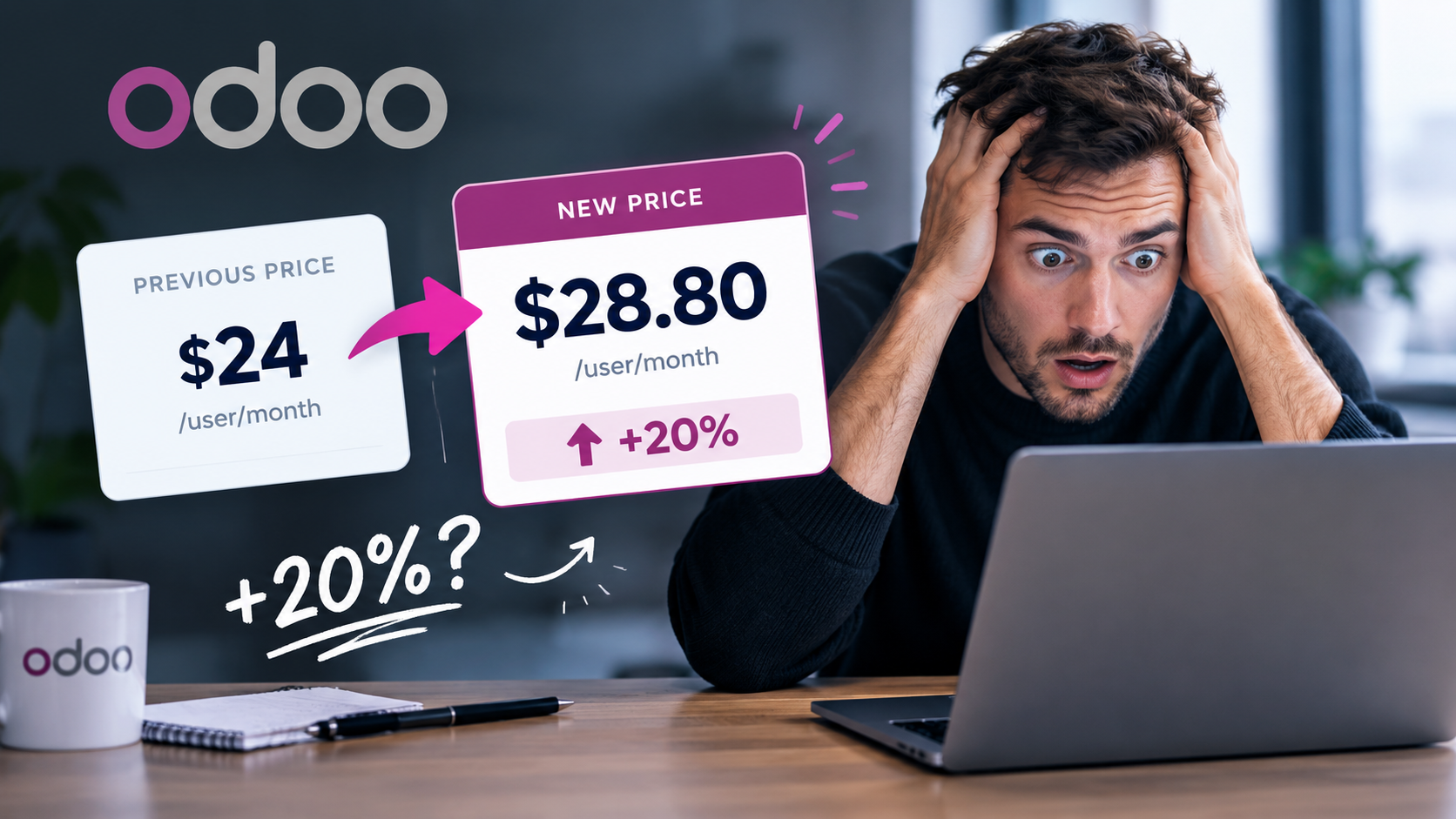
At Odoo Experience 2026, alongside the launch of Odoo 20, Odoo confirmed its first major pricing change since 2022: a roughly 20% increase to its Custom plan (steeper in some regions). The Standard plan is unchanged, and the increase applies to licenses only, not hosting fees. Because Odoo prices vary by country, your exact figure depends on where you are, but the direction and the size are clear, and if you run Odoo on Custom, it hits you.
Here is what actually changed, and the honest version of whether locking in a multi-year deal is the right move.
What changed, precisely
- Custom plan up around 20%. Odoo attributes it to inflation and continued product investment. The exact percentage varies by region, so check your own number against Odoo's pricing page.
- Standard plan untouched. If you are on Standard, this does not hit you directly, but Standard has real limits (more below).
- Licenses only. Hosting fees are not part of this increase.
- A new Light User license. Odoo added a lower-cost tier for staff who only need self-service functions such as leave, expenses, attendance and read-only access. If you have users who barely touch the system, moving them to this tier can offset part of the increase.
- Existing renewals are capped. Current annual customers face a maximum 7% increase per year until they reach the new list price, rather than the full jump at once.
- The first-year discount is a planning trap. Odoo's promotional pricing applies only to the first 12 months and only to the first users you order. Budget from the renewal price, not the headline, or year two will surprise you.
Who this actually affects
The increase lands on the Custom plan, and Custom is the plan you need if you require any of the following: multiple companies in one database, Odoo Studio for configuration, external API access, or custom and third-party modules. In practice, anyone running Odoo as a genuine ERP rather than lightweight accounting is on Custom, and is therefore exposed.
Standard is cheaper and unaffected, but you give up multi-company, Studio, API access and custom modules. For a business with real operational complexity, downgrading to dodge the increase usually swaps a pricing problem for a capability problem.
The multi-year lock-in: the real trade
This is the lever most Odoo partners are steering customers toward, and it is a legitimate one. Where Odoo offers it, committing to a multi-year contract (typically two to five years) secures an additional discount and freezes your rate for the term.
The contrast is what makes it compelling. Stay on annual renewals and you lose the first-year discount, then absorb the 7% annual increase until you reach full list price. A multi-year deal trades flexibility for budget certainty and a lower effective rate. The catch: payment is upfront and Odoo does not offer instalment plans, so the cash-flow impact is real and immediate.
For a business that already knows Odoo is the right platform, locking in before the next renewal cycle is a sound, defensible decision.
The honest caveat most partners will not lead with
A multi-year contract is only a saving if you are buying the right system. If Odoo is not the right fit, a two-to-five-year lock-in does not protect your budget. It commits you to years of the wrong ERP, paid upfront, with limited exit. The discount becomes the most expensive money you ever saved.
This is the exact point where the incentive of whoever is quoting you diverges from your interest. A partner earns from the multi-year commitment. You only win if the platform genuinely fits your operations, your integrations, your growth path, and your team's ability to run it.
So before you sign anything multi-year, be honest about three things:
- Fit. Does Odoo cover your core processes natively, or are you leaning on custom modules and Studio work to make it behave? Heavy customization is a cost and a risk that a licence discount will not offset.
- Alternatives. Have you compared total cost of ownership against the platforms Odoo actually competes with for your profile? A lower headline rate is not the same as a cheaper system.
- Exit. What does year four look like if your requirements change? Model it before you commit to it.
What to do this month
- Confirm which plan you are on, and whether you genuinely need Custom or could run Standard plus the new Light User tier for some staff.
- Ask for both a standard annual renewal quote and a multi-year quote, and model the renewal price in each, not the first-year promo.
- Pressure-test whether Odoo is genuinely your best-fit ERP before you lock in years of it.
A price increase is a useful forcing function. It makes you re-examine a decision you might otherwise have renewed on autopilot. Use it that way.
ERPLenz is a vendor-agnostic ERP selection tool built from real implementation experience. Before you commit to a multi-year Odoo contract, take the free assessment to score Odoo against the other major platforms for your exact requirements. No commissions, no vendor payments, no sales calls.