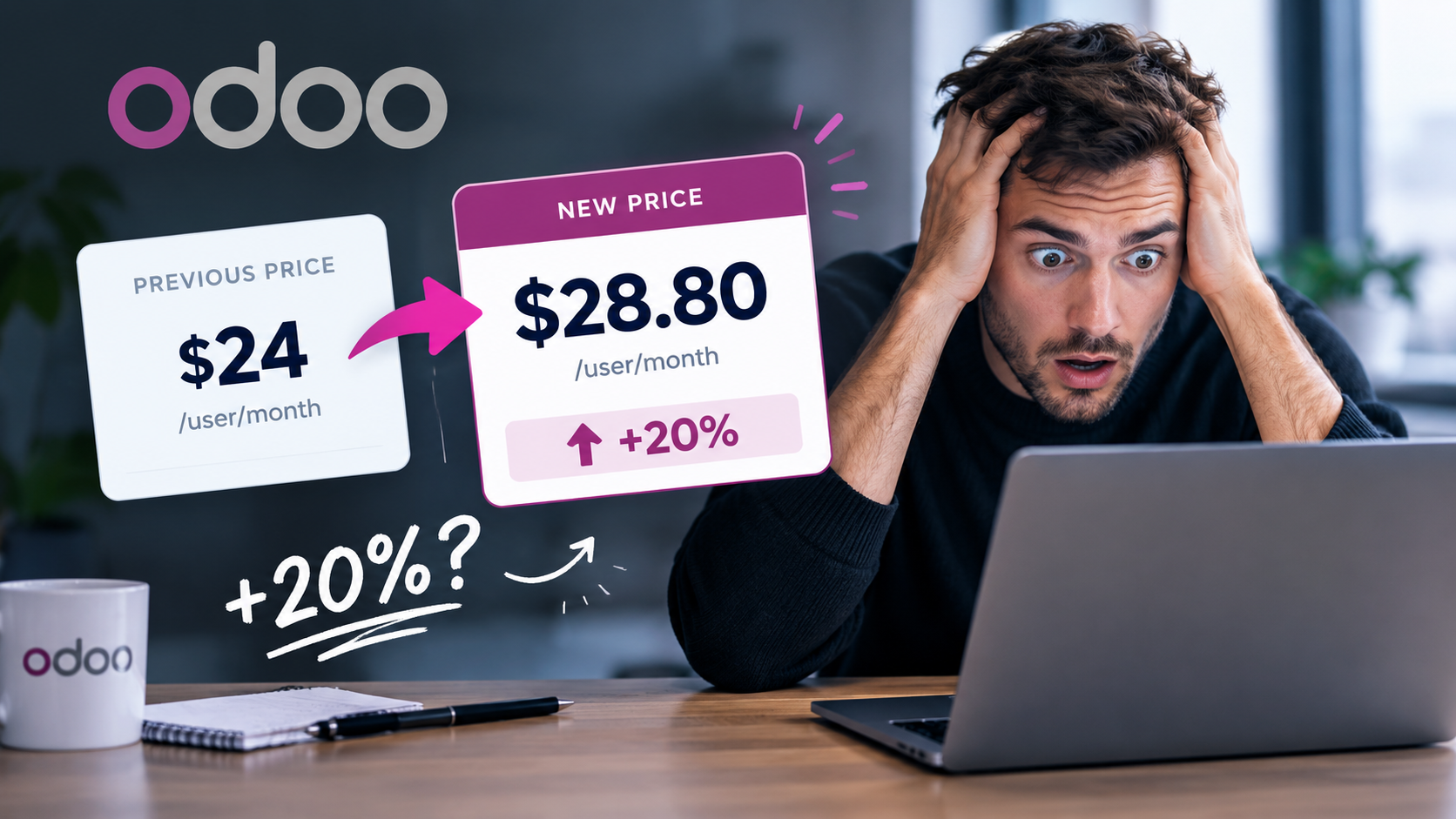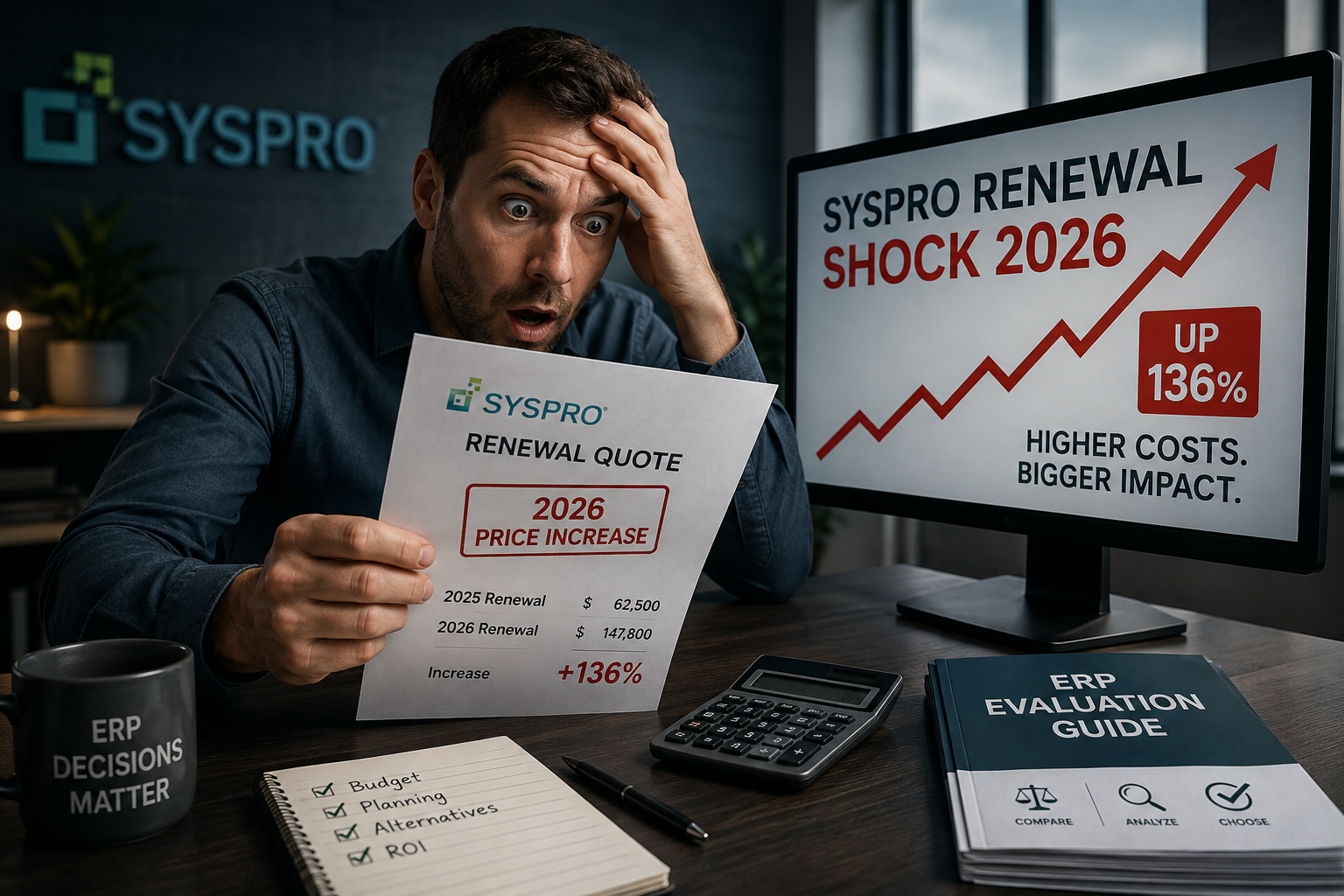
A renewal quote lands in a finance director's inbox. Same system, roughly the same team, one more year — and the number has climbed sharply. Not by a little. A few extra users have been added, sure, but nothing that explains the jump. The reflex is to assume someone made a mistake. Usually, nobody did. The rules changed underneath them.
I've spent close to a decade inside ERP implementations, and this is becoming a familiar pattern across the market for Syspro customers. It's worth explaining plainly, because if you run Syspro — or you're about to sign a renewal — the reasons behind the increase matter more than the increase itself.
What actually changed at Syspro
Two things happened, and it's easy to conflate them.
Ownership. In late 2024, the global private equity firm Advent International took a majority stake in Syspro. The co-founder retired, and an experienced enterprise-software executive — previously president of SAP SuccessFactors — joined as chairman of the board. Around the same time, Syspro acquired a UK-based manufacturing and distribution software specialist, and it now runs headquarters in both the UK and South Africa. None of this is scandalous. It's a South African-founded company being positioned for global growth, with the USA and UK named as priority markets.
But when private equity buys an established software business, the playbook is well understood: sharpen the commercial model and grow revenue per customer. That's not a conspiracy — it's the job. The question for you is simply whether your account is on the receiving end of it.
Licensing. Syspro has been moving customers toward a subscription model with two consequential changes bundled together:
- From per-module to all-in. Historically you licensed the modules you actually used. The newer model gives you the full product — every active module, plus newer AI and analytics capabilities and support — as a single entitlement. That sounds generous, and for some businesses it is. But "you now get everything" also means "you now pay for everything," including modules you never asked for and may never switch on.
- From concurrent to named users. Under a named-user model, every individual who needs access needs their own licence. Businesses that previously shared a pool of concurrent licences across shifts or occasional users can see their required licence count — and therefore their bill — rise sharply, even with the same headcount.
Stack those two shifts on top of a PE owner with growth targets, and the doubled renewal stops looking like an error and starts looking like the new normal.
What this looks like in the market
You don't have to look hard to find the pattern. Across the mid-market, manufacturers are opening renewal quotes to find the figure has climbed steeply — often well beyond what a modest change in headcount could ever account for. Move a business from concurrent to named-user licensing, hand it every module whether it asked for them or not, and the arithmetic does the rest. A slightly larger team on the new model can pay dramatically more than a slightly smaller team did on the old one, for the same day-to-day work.
If that shape looks familiar, you're not imagining it, and you're not being singled out. You're watching a commercial strategy roll out across an entire customer base.
The frustrations that were already there
Here's where I want to be fair, because this is exactly where most "switch your ERP" articles get dishonest.
The renewal is rarely the whole story. When a business seriously re-evaluates its ERP, the price increase is usually the trigger, not the root cause. The root cause is friction that built up quietly for years. With Syspro, the two I hear most often are:
- Customisation feels heavy. Making changes — even small ones — often can't be done in-house and requires going back to a partner. Every tweak becomes a quote, a queue and a cost.
- The skills are scarce and the depth is real. Syspro is a genuinely powerful, deep manufacturing ERP. It is designed for complex enterprise operations. But that depth demands specialist knowledge, and good Syspro talent is thin on the ground in South Africa.
And now the honest part: some of that frustration isn't the software's fault. Partner-dependency and "we can't change anything ourselves" is frequently a skills and implementation problem, not a product defect. I've seen companies convinced their ERP was a dead end when the real issue was that its capabilities were never properly unlocked — by them or by whoever set it up. Before you conclude the system is wrong, it's worth asking whether the implementation was ever right.
That distinction is the single most important one in this entire decision, and it's the one vendors on both sides will never volunteer.
Why Odoo keeps coming up — and where it doesn't
When a Syspro customer starts looking, Odoo is often the first alternative on the table — and it's worth being precise about why, because the two systems aren't really competing on the same ground.
Let me say the unfashionable thing first: for pure manufacturing depth, Syspro is the stronger system. It was built for the shop floor, and in complex production environments that pedigree shows. If manufacturing is the entire universe of what you do, that counts for a great deal.
But most businesses are not only a shop floor — and this is where Odoo pulls ahead. Not by beating Syspro at manufacturing, but by refusing to stop there. Odoo is a genuinely integrated business suite: manufacturing sits alongside sales, CRM, inventory, e-commerce, accounting, projects and HR, in one system that talks to itself. For a company that wants its whole operation on a single platform — rather than a manufacturing core with everything else bolted around the edges — that breadth is the real draw. Add a far more approachable customisation model, where you can adapt the system without a specialist and a quote for every small change, and lower entry pricing, and you can see why a frustrated, over-charged customer takes the meeting.
The honest caveats still stand, because pretending otherwise would make me the kind of salesperson I built ERPLenz to counter. Odoo's flexibility can become its own trap — over-customise it and you inherit the upgrade pain you were trying to escape. Partner quality matters enormously. And if your manufacturing sits at the genuinely deep, complex end, Syspro's specialisation may still outweigh Odoo's breadth. The real question isn't "which is better" — it's which of those two things your business actually needs: depth in one domain, or breadth across many.
How to make this decision without getting sold
If you're facing a renewal that doesn't sit right, resist two equal and opposite mistakes: signing on autopilot because switching feels daunting, and bolting to a new system because you're angry at a quote. Both are expensive.
A defensible ERP decision comes down to three questions, weighed honestly:
- Fit — does the system actually match how you operate, today and where you're heading?
- Economics — what's the real total cost over three to five years, under the new licensing terms, versus the real total cost of switching (migration, retraining, disruption)?
- Trajectory — where is each vendor heading under its current ownership, and does that direction serve you or just its shareholders?
That's the work. It's also precisely what ERPLenz was built to do: score your specific requirements against 17 ERP platforms — Syspro and Odoo included — with no vendor relationships, no commission, and no stake in which one you choose. You walk into the renewal conversation, or the demo, already knowing where you stand.
Your ERP renewal is one of the largest recurring cheques your business writes. When the number suddenly changes, that's not a reason to panic — it's a reason to look properly, before you sign anything.
ERPLenz is a vendor-agnostic ERP selection tool built from real implementation experience. Take the assessment to see how the major platforms score against your exact requirements — in under 30 minutes, with no sales calls.